Artificial Intelligence (AI) in Energy And Power Market
The integration of artificial intelligence (AI) into the energy and power sector is rapidly transforming how utilities and consumers manage energy. With technological advances and increasing demand for smarter energy solutions, this market is set to experience remarkable growth in the years ahead. Let’s explore the projected market valuation, key players, emerging trends, and detailed segments shaping this dynamic industry.
Forecasted Market Value and Expansion of the AI in Energy and Power Market
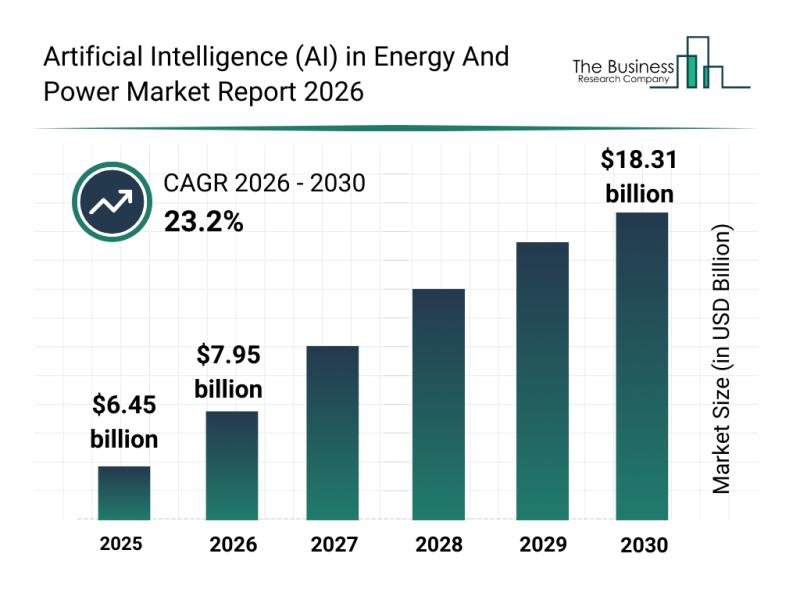
The market for artificial intelligence in energy and power is anticipated to grow substantially, reaching a valuation of $18.31 billion by 2030. This expansion corresponds to an impressive compound annual growth rate (CAGR) of 23.2%. The surge in growth during the forecast period is driven by several factors, including the expansion of AI-powered grid automation, wider adoption of distributed energy resources, an increasing demand for real-time load balancing, the rise of AI-based energy analytics platforms, and advancements in machine learning for optimizing energy use. Key market trends expected to influence this growth include enhanced AI applications in demand forecasting, broader deployment of AI-enabled smart grid systems, increased utilization of AI for integrating renewable energy, more sophisticated AI-driven energy management solutions, and improved AI-driven power distribution and load balancing techniques.
Download a free sample of the artificial intelligence (ai) in energy and power market report:
https://www.thebusinessresearchcompany.com/sample.aspx?id=13578&type=smp
Key Players Leading the Artificial Intelligence in Energy and Power Sector
Several prominent companies dominate the artificial intelligence in energy and power industry, including Google LLC, Microsoft Corporation, Mitsubishi Electric Corporation, Bosch.IO, Siemens AG, General Electric Company, Intel Corporation, International Business Machines Corporation (IBM), Cisco Systems Inc., Schneider Electric SE, Honeywell International Inc., SAP SE, ABB Group, NVIDIA Corporation, Toshiba Corporation, Emerson Electric Co, Rockwell Automation Inc., SAS Institute Inc, DNV GL, Sierra Wireless Inc., C3.AI Inc., Vayyar Imaging Ltd., Uptake Technologies Inc., Verdigris Technologies Inc., Aurora Solar Technologies, and SenseHawk.
In a significant development in January 2024, Electric Power Engineers, LLC, a US-based utility engineering and energy transition consulting firm, acquired ENER-i.AI. This acquisition aims to incorporate ENER-i.AI’s advanced software-as-a-service (SaaS) energy intelligence platform into Electric Power Engineers’ portfolio. ENER-i.AI specializes in innovative tools such as the ENER-i Energy Intelligence Platform and ENER-i InSights, designed to enhance modern power-grid planning and operational efficiency.
View the full artificial intelligence (ai) in energy and power market report:
https://www.thebusinessresearchcompany.com/report/artificial-intelligence-ai-in-energy-and-power-global-market-report
Emerging Trends Driving AI Innovation in the Energy and Power Industry
Leading companies in the AI-driven energy sector are constantly innovating to address complex energy demands, particularly for commercial customers. One notable advancement is Gridmatic’s launch of Gridmatic Retail in January 2023. This AI-powered energy marketer focuses on optimizing clean energy purchasing, offering predictability and automation tailored for commercial and industrial clients with sophisticated energy needs. Gridmatic Retail provides advanced retail energy products like time-matched renewable energy, 24/7 carbon-free power, and contracts that accommodate load variability.
This approach not only facilitates the transition to net-zero emissions but also helps stabilize renewable-powered grids. By leveraging AI, Gridmatic delivers highly customizable renewable contracts suited to customers facing variable and complex energy requirements, underscoring the growing role of AI in transforming energy markets.
Detailed Market Segmentation for AI in Energy and Power
The artificial intelligence in energy and power market can be segmented into key categories to better understand its scope:
1) Technology Types:
– Machine Learning
– Natural Language Processing
– Computer Vision
2) Application Areas:
– Demand Forecasting
– Energy Production and Distribution Optimization
– Energy Management
– Smart Grids
– Smart Meters
– Other Applications
3) End-User Categories:
– Commercial and Industrial
– Residential
Sub-segments within these technologies include:
For Machine Learning: predictive maintenance, demand forecasting, and energy management systems.
For Natural Language Processing (NLP): chatbots for customer service, voice assistants for energy management, and document analysis and reporting.
For Computer Vision: asset monitoring and inspection, safety and surveillance systems, and fault detection in equipment.
This segmentation highlights how AI technologies are being applied across diverse functions and user groups, illustrating the broad potential for AI to enhance efficiency, reliability, and sustainability in the energy and power sector.
Reach out to us:
The Business Research Company: https://www.thebusinessresearchcompany.com/,
Americas +1 310-496-7795,
Europe +44 7882 955267,
Asia & Others +44 7882 955267 & +91 8897263534,
Email us at info@tbrc.info.
Follow Us On:
LinkedIn: https://in.linkedin.com/company/the-business-research-company,
Twitter: https://twitter.com/tbrc_info,
YouTube: https://www.youtube.com/channel/UC24_fI0rV8cR5DxlCpgmyFQ
Learn More About The Business Research Company
With over 17500+ reports from 27 industries covering 60+ geographies, The Business Research Company has built a reputation for offering comprehensive, data-rich research and insights. Armed with 1,500,000 datasets, the optimistic contribution of in-depth secondary research, and unique insights from industry leaders, you can get the information you need to stay ahead.Our flagship product, the Global Market Model (GMM), is a premier market intelligence platform delivering comprehensive and updated forecasts to support informed decision-making.
This release was published on openPR.