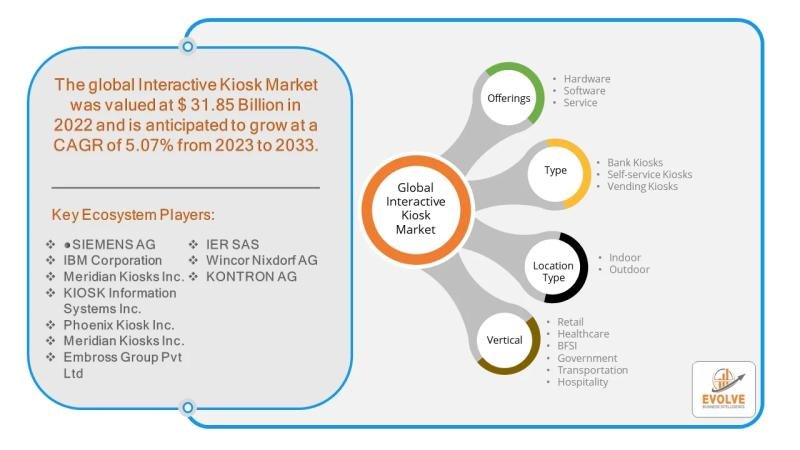
The global interactive kiosk market is on a robust growth trajectory, and a significant portion of this growth is being driven by the banking and financial services industry (BFSI). As consumer preferences shift towards seamless, on-demand, and contactless services, interactive kiosks are emerging as a powerful tool for banks to enhance customer experience, streamline operations, and reduce wait times. This presents a high-opportunity segment within the broader market, fueled by technological advancements and the escalating demand for self-service solutions.
Download the full report now to discover market trends, opportunities, and strategies for success.
https://evolvebi.com/report/interactive-kiosk-market-analysis/
Problems Faced and Proposed Solutions
Despite the immense opportunity, the interactive kiosk market, including the banking segment, faces notable challenges. One of the primary problems faced is the high initial installation and ongoing maintenance costs. This can be a significant barrier for small and medium-sized financial institutions looking to modernize their services. The cost is compounded by the need for custom hardware and software integration for different banking functions. Furthermore, there are security risks and the need to comply with stringent government regulations.
A viable solution lies in a multi-pronged approach that leverages technology and strategic sourcing. The industry is moving towards software-led innovation, where cloud-based platforms and robust remote device management can significantly reduce operational costs and simplify software updates. By decoupling hardware from software, banks can implement more flexible and scalable solutions. To combat high initial costs, businesses are exploring leasing options and adopting System-on-Chip (SoC) solutions, which integrate all necessary components into a single display, simplifying the hardware footprint.
US Tariff Implications on the Global Interactive Kiosk Market
The global nature of the interactive kiosk market makes it susceptible to geopolitical and economic factors, particularly US tariffs. The imposition of tariffs on electronic components and display screens, many of which are sourced from Asia, has put significant cost pressure on US-based kiosk providers. These tariffs increase manufacturing and deployment costs, leading to margin pressure and, in some cases, higher prices for end-users.
In response, the industry is undergoing a strategic realignment. Companies are actively diversifying their supply chains, shifting component sourcing from China to countries like Vietnam, South Korea, and Mexico to mitigate tariff impacts. Additionally, policies like the CHIPS Act are encouraging domestic production, building a more resilient and localized tech manufacturing base within the US. While these tariffs initially acted as a headwind, they have ultimately pushed the market toward greater resilience, innovation, and strategic agility.
Download the full report now to discover market trends, opportunities, and strategies for success.
https://evolvebi.com/report/interactive-kiosk-market-analysis/
To understand further and explore opportunities in the Global Interactive Kiosk Market or any related industry, please share your queries/concerns at info@evolvebi.com.
Evolve Business Intelligence
C-218, 2nd floor, M-Cube
Gujarat 396191
India
Email: sales@evolvebi.com
Website: https://evolvebi.com/
Evolve Business Intelligence is a market research, business intelligence, and advisory firm providing
innovative solutions to challenging pain points of a business. Our market research reports include data
useful to micro, small, medium, and large-scale enterprises. We provide solutions ranging from mere
data collection to business advisory.
Evolve Business Intelligence is built on account of technology advancement providing highly accurate
data through our in-house AI-modelled data analysis and forecast tool – EvolveBI. This tool tracks real-
time data including, quarter performance, annual performance, and recent developments from
fortune’s global 2000 companies.
This release was published on openPR.