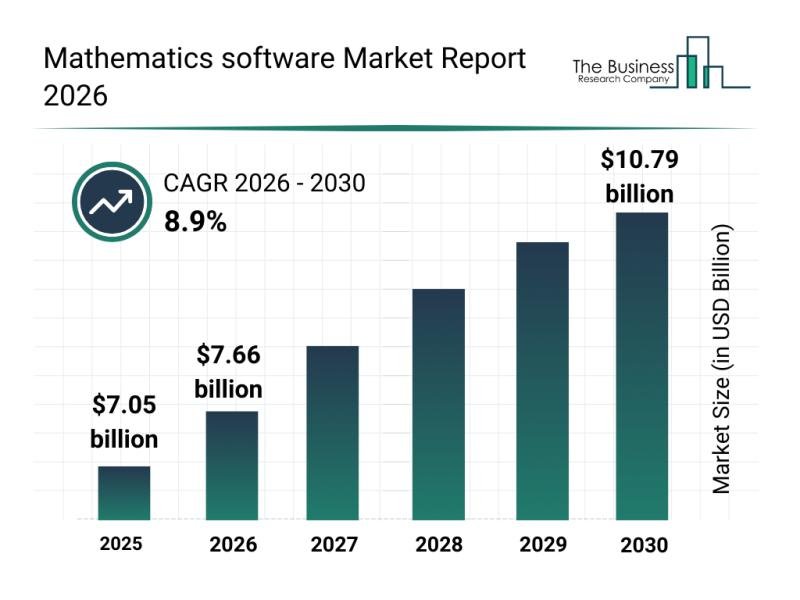
Mathematics software Market
The mathematics software market is poised for significant expansion as technology continues to reshape how learning and research are conducted. Advancements in artificial intelligence and cloud computing, alongside evolving educational practices, are driving demand for innovative software solutions that cater to diverse user needs. Below is an in-depth look at the market’s size, key players, emerging trends, and segmentation.
Projected Growth and Market Size of Mathematics Software
The mathematics software market is expected to experience robust growth, reaching a valuation of $10.79 billion by 2030. This expansion corresponds to a compound annual growth rate (CAGR) of 8.9%. Several factors contribute to this upward trajectory, including the increased adoption of AI-powered learning tools, deeper integration with cloud-based learning management systems (LMS), and the growing necessity for real-time educational analytics. Additionally, the rise of hybrid and remote learning environments, as well as the expanded use of mathematics software in professional research and development settings, supports this market growth. During the forecast period, notable trends include a surge in cloud-based mathematics software, greater use of interactive and visualization tools, a higher demand for curriculum-aligned lesson plans, the development of adaptive assessments and tutoring platforms, and enhanced analytics and reporting capabilities.
Download a free sample of the mathematics software market report:
https://www.thebusinessresearchcompany.com/sample.aspx?id=35356&type=smp&utm_source=OpenPR&utm_medium=Paid&utm_campaign=Mar_PR
Key Drivers Accelerating Growth in the Mathematics Software Market
Growing adoption of AI technologies within educational software is transforming the mathematics learning experience by providing more personalized and efficient solutions. AI-powered assistants help users solve complex problems quickly, making learning more accessible and effective. Furthermore, the rising integration of mathematics software with cloud-based LMS platforms allows for seamless content delivery and resource management, which is crucial for supporting hybrid and remote learning models prevalent today.
Increased use of mathematics software beyond education, especially in professional research and development, is another critical factor propelling this market. Industries are leveraging these tools for precise calculations, simulations, and data analysis, which enhances productivity and innovation. The demand for real-time analytics also reflects an educational shift toward data-driven decision-making, enabling educators to tailor instruction to the needs of individual learners.
View the full mathematics software market report:
https://www.thebusinessresearchcompany.com/report/mathematics-software-market-report?utm_source=OpenPR&utm_medium=Paid&utm_campaign=Mar_PR
Leading Companies Influencing the Mathematics Software Industry
Several prominent organizations dominate the mathematics software landscape, including Microsoft Corporation, Siemens AG, International Business Machines Corporation, Intel Corporation, Oracle Corporation, SAP SE, Dassault Systèmes SE, Hexagon AB, Autodesk Incorporated, Cadence Design Systems Incorporated, SAS Institute Incorporated, PTC Inc., CASIO, National Instruments Corporation, MathWorks Incorporated, Wolfram Research Incorporated, and COMSOL Inc. These companies continue to innovate and expand their offerings to meet the evolving demands of both educational institutions and professional users.
A recent example of strategic growth is Discovery Education Inc.’s acquisition of DreamBox Learning Inc. in August 2023. Based in the US, Discovery Education provides digital learning platforms and adaptive educational software. This acquisition broadens Discovery Education’s portfolio by incorporating DreamBox’s adaptive mathematics and reading software, which delivers personalized learning experiences to millions of students and educators worldwide. This move highlights the increasing importance of adaptive technologies that cater to individualized learning paths.
Emerging Trends and Innovations Shaping the Mathematics Software Market
Mathematics software developers are increasingly focusing on integrating advanced AI-powered assistants to enhance user experience. These assistants automate the generation of formulas, equations, and step-by-step solutions, reducing the time needed for problem-solving and improving accuracy. Such innovations are pivotal in helping users, from students to researchers, tackle complex mathematical tasks efficiently.
An illustrative example of this trend occurred in March 2024, when Maplesoft, a Canada-based software company, released Maple 2024. This new version features an AI Formula Assistant that supplies formulas, equations, explanations, and Maple commands, significantly reducing the time users spend on workflows. It also includes advanced algorithms for multivariate polynomial systems and integral equations, boosting problem-solving capabilities. Additionally, Maple 2024 offers an expanded “Check My Work” feature that evaluates each step of a student’s solution to detect mistakes, alongside improved units support and automatic command completion, enhancing usability for both educational and research purposes.
Detailed Segmentation of the Global Mathematics Software Market
This market is comprehensively segmented to address various components and user requirements:
By Component Type:
– Software
– Services
– Support and Maintenance
By Features Offered:
– Interactive Visualizations
– Problem-Solving Algorithms
– Collaboration Tools
– Customizable User Interfaces
– Integration Capabilities with Other Software
By Deployment Type:
– On-Premise
– Cloud-Based
– Hybrid Deployment
By Application:
– Engineering Construction
– Schools, Academic and Research Institutes
– Other Applications
By End Use Industry:
– Education
– Healthcare
– Research and Development
– Financial Services
– Engineering and Manufacturing
Further subcategories under software include computer algebra systems, statistical analysis software, geometry and visualization tools, learning management systems, and tutoring and assessment software. Services cover implementation, consulting, training and education, and customization. Support and maintenance encompass technical support, software updates, troubleshooting, and user assistance through helpdesk services.
This detailed segmentation reflects the diverse needs and applications of mathematics software across educational, industrial, and research domains, underlining the market’s wide reach and potential.
Reach out to us:
The Business Research Company: https://www.thebusinessresearchcompany.com/,
Americas +1 310-496-7795,
Europe +44 7882 955267,
Asia & Others +44 7882 955267 & +91 8897263534,
Email us at info@tbrc.info.
Follow Us On:
LinkedIn: https://in.linkedin.com/company/the-business-research-company,
Twitter: https://twitter.com/tbrc_info,
YouTube: https://www.youtube.com/channel/UC24_fI0rV8cR5DxlCpgmyFQ
Learn More About The Business Research Company
With over 17500+ reports from 27 industries covering 60+ geographies, The Business Research Company has built a reputation for offering comprehensive, data-rich research and insights. Armed with 1,500,000 datasets, the optimistic contribution of in-depth secondary research, and unique insights from industry leaders, you can get the information you need to stay ahead.Our flagship product, the Global Market Model (GMM), is a premier market intelligence platform delivering comprehensive and updated forecasts to support informed decision-making.
This release was published on openPR.