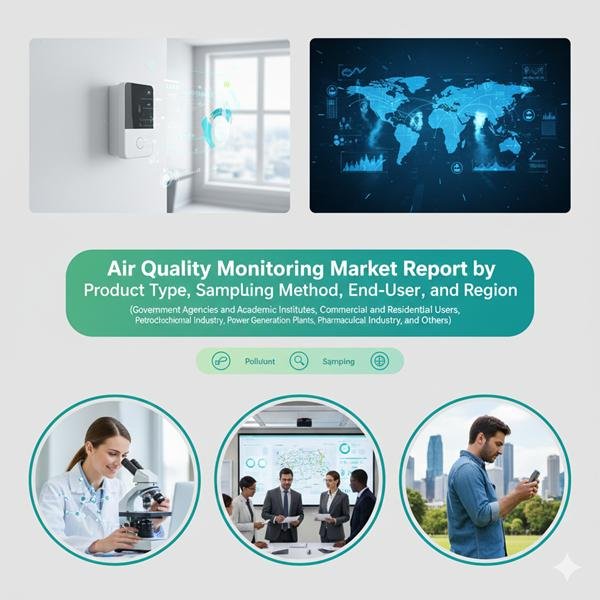
The market is experiencing moderate growth because of rising concerns about the effects of air pollution on health.
Market Overview
Study Assumption Years
• Base Year: 2025
• Historical Year/Period: 2020-2025
• Forecast Year/Period: 2026-2034
The global air quality monitoring market size was USD 5.5 Billion in 2025 and is forecasted to reach USD 9.5 Billion by 2034, growing at a CAGR of 6.20% during 2026-2034. Growth is driven by urbanization, industrialization, rising pollution awareness, and integration of IoT and AI technologies in monitoring systems. These advancements enhance real-time data collection and analysis, boosting market demand.
Rising Regulatory Pressure and Public Health Awareness
The global air quality monitoring market is growing steadily due to increased concern towards environment protection and public health by governments, industries, and communities worldwide. Growth in occurrence of diseases such as asthma, cardiovascular diseases, and respiratory infections due to air pollution have induced the government to impose stringent emission standards and monitor air quality in real-time. The emergence of stringent regulations that mandate cities and industrial zones to install air quality monitoring stations and add more sensors and data analysis tools are driving the market. Adoption of mobile applications and digital dashboards that provide air quality index details to the public are making consumers aware and making municipalities invest in transparent air quality monitoring solutions. Air quality monitoring solutions are used at industrial sites to show compliance with environmental regulations to avoid penalties and help ensure employee health. The increasing prevalence of smart cities has also affected the market, creating demand for connected air quality monitoring integrated into traffic management, weather forecasting, and public health systems. As air pollution continues to rise as a social and political issue, demand remains for accurate, reliable and scalable air quality monitoring tools.
Technological Advancements and Expansion of Low-Cost Sensors
By 2025, the air quality monitoring market features increased accuracy, affordability, and flexibility with the integration of the Internet of things (IoT), cloud computing, and artificial intelligence (AI). These developments ease real-time data gathering, predictive analytics, and automated reporting within various environments. Small, affordable sensors allow groups like schools, housing societies, commercial properties, and individual consumers to do air quality monitoring. They also measure air quality locally in a way that may not happen otherwise, since smaller sensors can network together. Applications on mobile phones or smart home devices can notify users to take action during pollution events. Industrial and commercial users can benefit from analytics solutions to identify emission hotspots and optimize mitigation strategies. In the broader industry outlook, technological advancements and the resulting reduction of entry barriers and growth in data accessibility are also broadening the market from advanced economies to emerging and developing economies.
Air Quality Monitoring Market Trends
Several trends driving the evolution of air quality monitoring technologies are converging environmental sciences with digital and big data technologies, including the transition from stand-alone centralized air quality monitoring stations to decentralized networks of sensors to monitor spatially- and temporally-resolved pollution levels. In 2025, cloud and AI are allowing for pollution predictions and responses. Environmentally conscious people often use portable and wearable air pollution monitors to track individual pollutant exposure. Smart city initiatives are bringing air quality data to transport networks, urban planning and public health alerts. There is also an increasing focus on integrating satellite and ground observations for regional and global monitoring of air pollution. As demand for data transparency increases, air quality data sets are increasingly shared and made available open-source by governments and organizations. Future air quality monitoring ecosystems tend toward more predictive, user centric, and technologically-enabled environments.
Market Drivers
The air quality monitoring market is driven by environmental, regulatory and technological factors coupled with the increase in level of air pollution due to urbanization and industrialization. Demanding continuous monitoring and assessing air quality drives the global market. In 2025, the trend of stringent environmental regulations and strict emission control will drive industries, power plants, and construction sites toward the adoption of reliable monitoring systems. People grow concerned that poor air quality impacts human health so they will likely expand monitoring efforts in the public and private sectors. Innovative technologies, like Internet of Things (IoT) sensor networks, and advanced analytic techniques, like machine learning and artificial intelligence, introduce and drive the increased adoption of monitoring systems because these systems increase efficiency and are cost effective. There is a growth in the infrastructure put in place by developing countries to monitor the environment, further driving the air quality monitoring market.
Request for a Free Sample Report: https://www.imarcgroup.com/air-quality-monitoring-market/requestsample
Market Segmentation
Product Type:
• Indoor Monitors: Devices used indoors to track air pollutants, enhancing indoor air quality management in residential and commercial spaces.
• Outdoor Monitors: Dominant segment, essential for evaluating and controlling pollution in urban and industrial environments through advanced sensor technologies.
• Wearable Monitors: Portable devices allowing personal air quality tracking, supporting demand for individual and indoor monitoring.
Pollutant:
• Chemical Pollutant: Largest market share; includes nitrogen oxides, sulfur dioxide, carbon monoxide, ozone, and VOCs monitored for health and regulatory compliance.
• Physical Pollutant: Includes particulate matter and dust affecting air quality.
• Biological Pollutant: Microorganisms and biological agents impacting health, monitored for environmental safety.
Sampling Method:
• Active/Continuous Monitoring: Leading segment; automated, ongoing collection and analysis of air quality, critical for real-time pollutant tracking.
• Passive Monitoring: Non-continuous, relies on diffusion methods for pollutant measurement.
• Intermittent Monitoring: Periodic sampling providing snapshots of air quality.
• Stack Monitoring: Focuses on emissions from stacks or industrial sources.
End-User:
• Government Agencies and Academic Institutes: Conduct research, policy development, and regulatory enforcement using extensive monitoring systems.
• Commercial and Residential Users: Growing segment due to health concerns; employs devices for safe indoor environments.
• Petrochemical Industry: Uses sophisticated monitoring to control emissions and ensure workplace safety.
• Power Generation Plants: Monitors pollutants released during energy production to comply with environmental standards.
• Pharmaceutical Industry: Ensures air quality for sensitive manufacturing conditions.
• Others: Various sectors employing air quality monitoring for operational and safety purposes.
Regional Insights
One of the main reasons North America is at the forefront of the air quality monitoring market is the presence of strict environmental regulations, the willingness to adopt advanced technologies, and an increased awareness of the health impacts due to pollution. The region’s proactive environmental policies and investments are the key factors that facilitate the wide-ranging implementation of monitoring systems in urban and industrial areas. Public agencies and private companies working together, as well as smart city initiatives, are among the factors that contribute to market expansion, thus, strengthening North America’s position as the leading market.
Recent Developments & News
In May 2024, Thermo Fisher Scientific initiated the production of air quality monitoring system analyzers in Nasik, India, to facilitate local industries in managing air pollution with increased data accuracy. Moreover, in May 2024, Wayne County collaborated with JustAir Solutions to set up 100 air quality monitors across 43 communities, which will offer real-time pollution data and alerts to residents. They also plan to distribute 500 mobile monitors later in the year for increased public health awareness.
Key Players
• Thermo Fisher Scientific
• Siemens Aktiengesellschaft
• Teledyne Technologies
• Emerson Electric
• General Electric Company
• 3M Company
• Horiba
• Merck KGaA
• Aeroqual
• TSI Incorporated
• Testo India Pvt. Ltd.
• Honeywell International Inc.
• Agilent Technologies
• TE Connectivity
• Tisch Environmental
• Spectris plc
Customization Note
If you require any specific information that is not covered currently within the scope of the report, we will provide the same as a part of the customization.
Ask Our Expert & Browse Full Report with TOC & List of Figures: https://www.imarcgroup.com/request?type=report&id=1302&flag=E
Contact Us
IMARC Group,
134 N 4th St. Brooklyn, NY 11249, USA,
Email: sales@imarcgroup.com,
Tel No: (D) +91 120 433 0800,
United States: +1-201971-6302
About Us
IMARC Group is a global management consulting firm that helps the world’s most ambitious changemakers to create a lasting impact. The company provide a comprehensive suite of market entry and expansion services.
IMARC offerings include thorough market assessment, feasibility studies, company incorporation assistance, factory setup support, regulatory approvals and licensing navigation, branding, marketing and sales strategies, competitive landscape and benchmarking analyses, pricing and cost research, and procurement research.
This release was published on openPR.