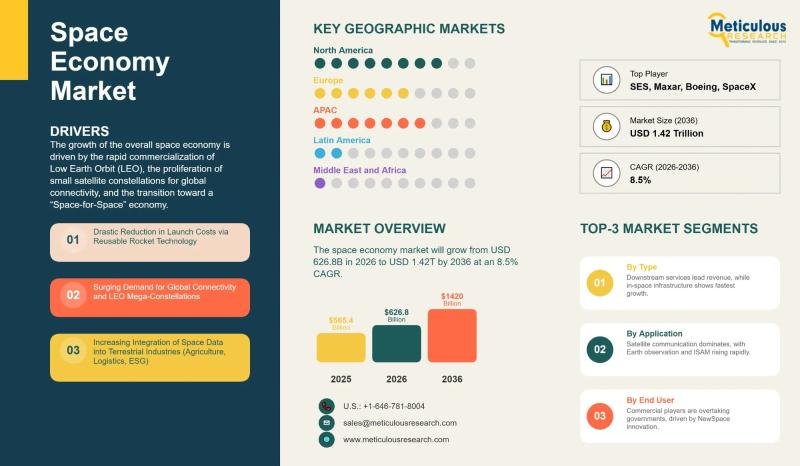
Space economy grows from USD 626.8B in 2026 to USD 1.42T by 2036, driven by LEO commercialization at 8.5%.
The global space economy was valued at USD 565.4 billion in 2025 and is projected to grow from USD 626.8 billion in 2026 to approximately USD 1.42 trillion by 2036, expanding at an annual rate of 8.5% over the forecast period from 2026 to 2036. This expansion is being fueled by the rapid commercialization of Low Earth Orbit, the proliferation of satellite mega-constellations, declining launch costs thanks to reusable rocket systems, and the emergence of what is being called a “Space-for-Space” industrial ecosystem.
Space has transitioned from a domain dominated by government agencies pursuing strategic objectives into a commercially dynamic frontier where private enterprises increasingly drive innovation, reduce costs, and generate revenue across both terrestrial applications and orbital activities.
Download Sample Report Here : https://www.meticulousresearch.com/download-sample-report/cp_id=6391
Market Overview
The space economy encompasses the entire value chain of activities related to exploring, researching, managing, and utilizing space. It includes upstream operations like building launch vehicles and manufacturing satellites, downstream applications such as satellite-enabled services and analytics, and emerging in-space infrastructure activities that are only now becoming economically viable.
The industry is currently in what analysts call the “Space 4.0” era, defined by collaborative public-private partnerships, cost-efficient launch systems, commercial satellite services, and orbital industrialization. Beyond traditional satellite broadcasting and navigation services, space-derived data now supports agriculture planning, logistics optimization, climate monitoring, financial systems synchronization, and the development of autonomous mobility systems. A particularly transformative development is the rise of the “Space-for-Space” economy, which includes satellite servicing to extend the operational life of existing assets, orbital debris removal to clean up space and prevent collisions, in-space assembly of large structures that would be impossible to launch in one piece, microgravity manufacturing of materials with unique properties, and lunar infrastructure development. This creates a sustainable economic loop that operates beyond Earth’s atmosphere rather than simply serving Earth-based customers.
Market Highlights
The numbers tell a story of sustained expansion across multiple dimensions. The market is expected to reach USD 1.42 trillion by 2036, growing at 8.5% annually from 2026 through 2036. North America dominates in 2026, while Asia-Pacific is projected as the fastest-growing region. The downstream segment, which includes services and applications built on top of space infrastructure, holds the largest share at 70 to 75% of total revenue. Satellite communication remains the largest application by revenue. In-space manufacturing and space tourism are expected to witness the highest growth rates. Notably, the commercial end-user segment is expected to surpass government spending, which represents a fundamental shift in who is driving the industry.
Key Market Trends
Proliferation of LEO Mega-Constellations
The rapid deployment of small satellite constellations in Low Earth Orbit is transforming global connectivity. LEO satellites provide low-latency broadband access that enables global IoT expansion and helps bridge the digital divide by bringing connectivity to remote areas that terrestrial infrastructure cannot economically reach. Companies like SpaceX are deploying constellations consisting of thousands of satellites, reshaping telecommunications and fostering AI-driven analytics markets that leverage satellite imagery for agriculture forecasting, carbon monitoring, and supply chain intelligence that was not previously possible at this scale or resolution.
Browse in Depth : https://www.meticulousresearch.com/product/space-economy-market-6391
Transition Toward In-Space Infrastructure and ISAM
The market is shifting toward In-Space Servicing, Assembly, and Manufacturing, commonly abbreviated as ISAM. Satellite life-extension missions that can repair or refuel satellites instead of replacing them, orbital refueling capabilities, debris mitigation to prevent the cascade of collisions that could make certain orbits unusable, and modular space station development are all expanding rapidly. like Blue Origin and Sierra Space are advancing commercial space station concepts designed to operate after the International Space Station is retired, while orbital manufacturing startups are exploring microgravity production of high-performance materials and biotechnological products that cannot be made on Earth.
This orbital industrialization is expected to become a major revenue contributor during the second half of the forecast period as the technology matures and the business models prove themselves.
Market Dynamics
Driver: Drastic Reduction in Launch Costs
Reusable launch vehicle technology has significantly reduced the cost of accessing space. The success of companies like SpaceX in landing and reusing rocket boosters has democratized orbital access, enabling more frequent launches and lowering entry barriers for startups and emerging nations that previously could not afford space programs. Heavy-lift systems currently under development are expected to support lunar base construction, orbital manufacturing facilities, and eventually interplanetary logistics as humanity expands beyond Earth orbit.
Opportunity: Emergence of the Lunar Economy
The renewed focus on lunar exploration under programs such as NASA’s Artemis initiative is catalyzing what is being called the “Lunar Economy.” This includes the development of lunar habitats where crews can live and work, landers that can transport cargo and personnel to the surface, power systems to generate electricity in the harsh lunar environment, and In-Situ Resource Utilization technologies that can extract water, oxygen, and potentially fuel from lunar materials rather than bringing everything from Earth.
Companies like Lockheed Martin Corporation and Northrop Grumman Corporation are securing contracts for deep-space systems and lunar infrastructure development, positioning the Moon not as a final destination but as a strategic economic gateway to Mars missions and deeper space exploration.
Segment Insights
Why the Downstream Segment Dominates
The downstream segment, comprising satellite-enabled services, analytics, and ground equipment, accounts for approximately 70 to 75% of total market revenue in 2026. This dominance stems from the recurring revenue generated by satellite communication, GPS navigation that underpins everything from ride-sharing apps to precision agriculture, financial timing services that synchronize global markets, and Earth observation analytics that inform decisions across industries.
Integration with 5G, artificial intelligence, and cloud computing is further expanding downstream applications, supporting smart cities, autonomous vehicles, and precision agriculture ecosystems that depend on accurate positioning and timely data. While upstream manufacturing and launch activities remain critical enablers of everything else, the emerging Space-for-Space segment is expected to witness the fastest growth rate as orbital industrialization becomes practical.
Application Insights
Satellite Communication Leads Revenue
Satellite communication accounts for 40 to 45% of the total market in 2026. The shift from Geostationary satellites positioned far above the equator to LEO constellations much closer to Earth enables high-speed, low-latency internet that can genuinely compete with terrestrial fiber networks in performance, not just in reaching places where fiber does not go. Earth observation is also expanding significantly, driven by environmental, social, and governance reporting requirements, climate monitoring commitments, disaster response needs, and commodity market analytics that use satellite imagery to estimate crop yields or track oil inventories. Companies such as Planet Labs and Maxar Technologies provide high-resolution imagery and geospatial intelligence services that fuel downstream analytics markets worth billions on their own.
Regional Insights
North America Maintains Market Leadership
North America holds the largest share of the global space economy in 2026. The region benefits from strong NASA and Department of Defense funding that continues to support both research and procurement, a vibrant venture capital ecosystem willing to fund ambitious space startups, advanced aerospace supply chains built up over decades, and favorable regulatory frameworks that allow commercial activity while maintaining safety. The region’s leadership is reinforced by companies such as The Boeing Company, Lockheed Martin Corporation, and SpaceX, which together represent much of the global industry’s capability.
Asia-Pacific: Fastest Growing Region
Asia-Pacific is projected to register the fastest growth through 2036, driven by ambitious national programs in China and India, expanding satellite communication networks to serve large populations, and increasing sovereign space investments as more countries recognize space capabilities as strategic assets. India’s cost-efficient launch ecosystem and China’s constellation development initiatives are strengthening regional competitiveness and providing alternatives to traditional Western suppliers.
Buy the Complete Report with an Impressive Discount: https://www.meticulousresearch.com/view-pricing/1708
Competitive Landscape
The global space economy is highly dynamic and innovation-driven. Key companies include SpaceX, Lockheed Martin Corporation, Northrop Grumman Corporation, The Boeing Company, Rocket Lab, SES, and Blue Origin. Competition centers on launch efficiency measured in cost per kilogram to orbit, satellite innovation that packs more capability into smaller packages, orbital infrastructure capabilities that enable new business models, and data monetization models that extract value from the enormous amount of information space systems collect.
Conclusion
The global space economy is on a trajectory to surpass USD 1.42 trillion by 2036, driven by Low Earth Orbit commercialization, mega-constellation deployment, reusable launch systems, and the rise of orbital industrialization. As the commercial sector overtakes government spending in driving growth and innovation, the industry is entering a new era characterized by scalable infrastructure, lunar economic development, and integrated space-terrestrial value chains that treat space not as a distant frontier but as an accessible domain for economic activity. The space economy of 2036 will look fundamentally different from today, with activities in orbit and beyond contributing directly to economic output rather than simply enabling it from above.
Related Reports:
Quantum Communication Market: https://www.meticulousresearch.com/product/quantum-communication-market-6385
About Us:
We are a trusted research partner for leading businesses worldwide, empowering Fortune 500 organizations and emerging enterprises with actionable market intelligence tailored to drive revenue transformation and strategic growth. Our insights reveal forward-looking revenue opportunities, providing our clients with a competitive edge through a diverse suite of research solutions-syndicated reports, custom research, and direct analyst engagement.
Each year, we conduct over 300 syndicated studies and manage 60+ consulting engagements across eight key industry sectors and 20+ geographic markets. With a focus on solving the complex challenges facing global business leaders, our research enables informed decision-making that propels sustainable growth and operational excellence. We are dedicated to delivering high-impact solutions that transform business performance and fuel innovation in the competitive global marketplace.
Contact Us:
Meticulous Market Research Pvt. Ltd.
1267 Willis St, Ste 200 Redding,
California, 96001, U.S.
Email- sales@meticulousresearch.com
USA: +1-646-781-8004
Europe: +44-203-868-8738
APAC: +91 744-7780008
Visit Our Website: https://www.meticulousresearch.com/
For Latest Update Follow Us:
LinkedIn- https://www.linkedin.com/company/meticulous-research
This release was published on openPR.