Passive Optical Network (PON) Equipment Market
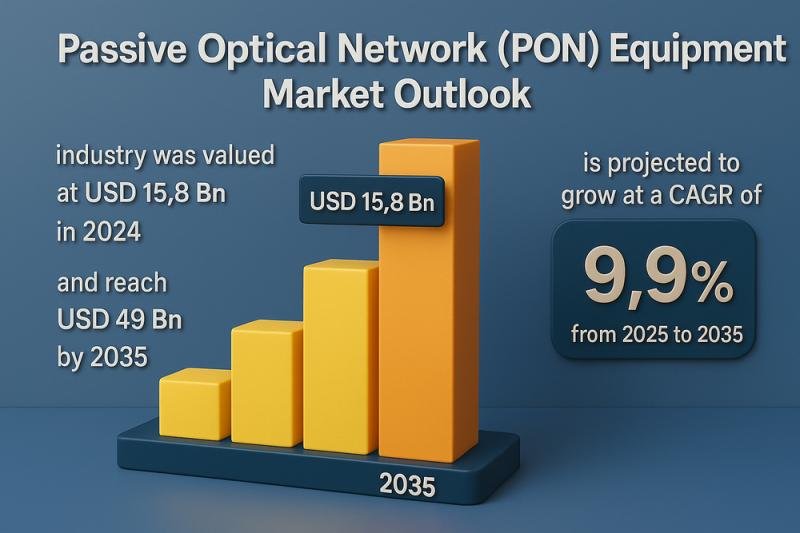
The global Passive Optical Network (PON) Equipment Market is set to witness robust growth over the next decade, fueled by the surging demand for high-speed broadband connectivity, rapid digitalization, and government-backed infrastructure initiatives. According to the latest market analysis, the global PON equipment industry, valued at US$ 15.8 billion in 2024, is projected to expand at a CAGR of 9.9% from 2025 to 2035, reaching approximately US$ 49 billion by 2035.
A Passive Optical Network (PON) is a fiber-optic telecommunications technology that employs a point-to-multipoint architecture to deliver data from a single transmission point to multiple user endpoints. Comprising components such as Optical Line Terminals (OLTs), Optical Network Units (ONUs), Optical Distribution Networks (ODNs), and splitters, PON technology is designed for efficient, scalable, and cost-effective broadband deployment.
With the global surge in internet consumption, cloud computing, video streaming, and IoT applications, PON equipment has become an integral part of modern communication infrastructure – enabling faster, more reliable, and energy-efficient data transmission.
Access key findings and insights from our Report in this sample – https://www.transparencymarketresearch.com/sample/sample.php?flag=S&rep_id=2024
Market Overview
The PON equipment market has emerged as a cornerstone of next-generation broadband infrastructure. It enables service providers to deliver ultra-high-speed internet, voice, and video services to residential, commercial, and industrial users efficiently.
The technology’s advantages – including high bandwidth capacity, reduced network maintenance costs, and simplified management – have made it the preferred choice for Fiber-to-the-Home (FTTH) and Fiber-to-the-Building (FTTB) deployments worldwide. The global shift toward digital inclusion and the expansion of smart city projects have further amplified the adoption of PON systems across developed and emerging economies.
Key Drivers of Market Growth
1. Rising Demand for High-Speed Broadband
The increasing number of internet users and the exponential growth of data-intensive applications – from 4K video streaming to cloud-based enterprise systems – have created an unprecedented demand for high-speed broadband. PON technology, particularly Gigabit PON (GPON) and 10G PON, provides the bandwidth and scalability required to meet these evolving demands.
2. Government Policies and Digital Inclusion Initiatives
Governments globally are investing heavily to bridge the digital divide. Initiatives like India’s BharatNet Project, China’s Broadband China Strategy, and California’s Senate Bill 156 are fostering large-scale fiber deployments. Such initiatives, accompanied by subsidies and financial incentives, are catalyzing the adoption of PON technology across rural and underserved regions.
3. Urbanization and Smart Infrastructure Development
Rapid urbanization and smart city projects are driving investments in advanced communication networks. PON systems offer the efficiency and scalability essential for connected urban ecosystems, from smart grids to IoT-based public services.
Key Players and Industry Leaders
The PON equipment market features several globally recognized players actively pursuing product innovation, partnerships, and geographic expansion.
Prominent companies include:
• Adtran Inc.
• Calix, Inc.
• Cisco Systems, Inc.
• Huawei Technologies Co., Ltd
• InCoax Networks AB
• Mitsubishi Electric Corporation
• Molex
• Motorola Solutions Inc.
• Nokia Corporation
• Verizon Communications, Inc.
• ZTE Corporation
These industry leaders are prioritizing R&D, interoperability solutions, and cloud-based management systems to enhance PON infrastructure reliability and flexibility.
Recent Developments
The market has witnessed notable advancements and strategic collaborations in 2025:
• Calix (August 2025): Announced expanded network design options in the ASM5001 for Intelligent Access-creating an aggregation system that unifies subscriber management and OLT control, reducing complexity and enabling faster scalability.
• Vecima Networks (May 2025): Introduced the Entra vPON Manager, a cloud-native platform that streamlines XGS-PON subscriber management and enhances interoperability.
• Vecima-Sercomm Partnership (2025): Conducted comprehensive interoperability testing between Vecima’s Entra EXS1610 All-PONTM Shelf and Sercomm’s ONU, offering flexible, multi-vendor broadband solutions.
These developments underscore the industry’s focus on network automation, interoperability, and cloud integration – paving the way for next-generation broadband ecosystems.
Market Opportunities and Challenges
Opportunities
• Emergence of 10G, 25G, and 50G PON Standards: As demand for ultra-high bandwidth rises, next-generation PON technologies are gaining traction in industrial and enterprise networks.
• 5G Backhaul and IoT Integration: PON’s ability to support dense connectivity and low-latency performance makes it an ideal solution for 5G and IoT infrastructure.
• Growing Investments in Rural Broadband: Ongoing efforts to expand connectivity in developing regions present significant opportunities for equipment providers and service integrators.
Challenges
• Technical Complexity and Cost of Deployment: The implementation of PON networks requires specialized expertise in optical transmission and multiplexing, posing challenges for smaller operators.
• Interoperability Issues: Despite progress, achieving full compatibility across vendors remains a key challenge for large-scale PON deployments.
• High Initial Capital Investment: Although cost-effective in the long run, the upfront costs for infrastructure and skilled labor can deter smaller ISPs and local governments.
Latest Market Trends
The Passive Optical Network (PON) equipment market is undergoing a paradigm shift driven by technology convergence and smart connectivity:
• Shift to XGS-PON and NG-PON2: Network operators are upgrading legacy GPON systems to next-generation standards offering symmetrical 10 Gbps speeds.
• Cloud-Managed PON Solutions: Adoption of virtualized management systems enables centralized control and faster troubleshooting.
• Sustainability and Energy Efficiency: Green networking and low-power optical components are gaining importance as organizations aim to reduce their carbon footprint.
• Open-Access Networks: Governments and private players are promoting open-access models to foster competition and improve affordability for end-users.
Market Segmentation
The PON equipment market is segmented by component, structure, application, end-user, and region:
• By Component: Optical Line Terminals (OLTs), Optical Network Terminals (ONTs), Optical Splitters, Optical Cables, Wavelength Division
Multiplexers/Demultiplexers, and Optical Transceivers.
• By Structure: Gigabit PON (GPON), Ethernet PON (EPON), 10G-EPON, XG(S)-PON, NG-PON2, and 50G-PON.
• By Application: FTTH (Fiber-to-the-Home), FTTC (Fiber-to-the-Curb), FTTB (Fiber-to-the-Building), FTTP (Fiber-to-the-Premises), FTTO (Fiber-to-the-Office), and others.
• By End-User: Residential, Commercial, Industrial, and Government/Education sectors.
• By Region: North America, Europe, Asia Pacific, Latin America, and the Middle East & Africa.
Buy this Premium Research Report for a deep dive into essential data – https://www.transparencymarketresearch.com/checkout.php?rep_id=2024<ype=S
Future Outlook
Looking ahead, the global PON equipment market is expected to evolve into a cornerstone of next-generation connectivity infrastructure. Continuous advancements in XGS-PON, NG-PON2, and 50G-PON technologies will deliver unparalleled data speeds and reliability.
The convergence of 5G, IoT, and fiber broadband will redefine how industries, governments, and consumers interact in a hyper-connected world. Vendors that focus on cost-efficient deployment models, interoperability, and AI-driven network management will emerge as leaders in this dynamic landscape.
By 2035, the proliferation of fiber-to-everywhere (FTTx) networks will make PON technology indispensable for digital transformation across both developed and developing economies.
Why Buy This Report?
This comprehensive market analysis offers:
• Accurate quantitative forecasts (2024-2035) with key growth metrics.
• Detailed segment and regional analysis highlighting emerging opportunities.
• Insightful profiles of top global players, including strategies, product portfolios, and recent innovations.
• Qualitative insights into market dynamics, competitive landscapes, and future technologies.
• Actionable intelligence for investors, telecom operators, and policymakers aiming to capitalize on the evolving broadband ecosystem.
Explore Latest Research Reports by Transparency Market Research:
Quantum Computing Market:
https://www.transparencymarketresearch.com/quantum-computing-market.html
DCB and AMB Substrate Market: https://www.transparencymarketresearch.com/dcb-and-amb-substrate-market.html
AI in Aviation Market: https://www.transparencymarketresearch.com/ai-in-aviation-market.html
Battery Monitoring IC Market: https://www.transparencymarketresearch.com/battery-monitoring-ic-market.html
About Transparency Market Research
Transparency Market Research, a global market research company registered at Wilmington, Delaware, United States, provides custom research and consulting services. Our exclusive blend of quantitative forecasting and trends analysis provides forward-looking insights for thousands of decision makers. Our experienced team of Analysts, Researchers, and Consultants use proprietary data sources and various tools & techniques to gather and analyses information.
Our data repository is continuously updated and revised by a team of research experts, so that it always reflects the latest trends and information. With a broad research and analysis capability, Transparency Market Research employs rigorous primary and secondary research techniques in developing distinctive data sets and research material for business reports.
Contact Us:
Transparency Market Research Inc.
CORPORATE HEADQUARTER DOWNTOWN,
1000 N. West Street,
Suite 1200, Wilmington, Delaware 19801 USA
Tel: +1-518-618-1030
USA – Canada Toll Free: 866-552-3453
This release was published on openPR.