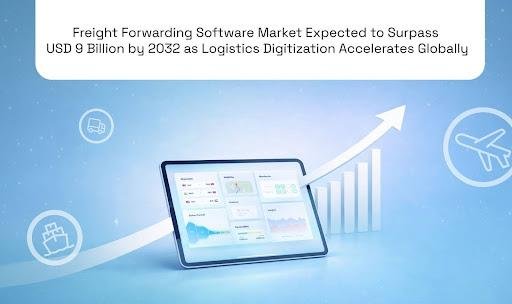
The global freight forwarding software https://cargoez.com/freight-forwarding-software freight forwarding software market is on a significant growth trajectory, with industry analysts projecting the sector to exceed USD 9 billion by 2032, expanding at a compound annual growth rate (CAGR) of approximately 8.2% from 2026. The expansion reflects a structural shift in how logistics operators manage cross-border trade, customs compliance, and multi-modal shipment coordination.
Unlike previous growth cycles driven primarily by trade volume, the current wave is being shaped by technology adoption. Freight forwarders, NVOCCs, customs brokers, and importers are migrating away from legacy systems and manual workflows toward cloud-based platforms that integrate shipment management, documentation automation, and real-time tracking into a single operational layer.
What Is Driving Market Growth in 2026
Several converging factors are accelerating software adoption across the freight forwarding industry this year.
Cross-border eCommerce continues to expand at double-digit rates globally, increasing the volume and complexity of shipments that forwarding companies must manage simultaneously. At the same time, regulatory environments across North America, Europe, and Asia-Pacific are tightening, with mandatory digital filing requirements, evolving customs automation standards, and new carbon reporting obligations adding compliance layers that manual processes simply cannot keep pace with.
Customer expectations are also shifting. Shippers now expect real-time shipment visibility comparable to consumer parcel tracking. Freight forwarders who cannot offer live status updates, proactive delay notifications, and digital customer portals are finding themselves at a competitive disadvantage relative to operators who can.
Finally, staffing pressures across the logistics sector are making automation a financial necessity rather than a preference. Companies managing high shipment volumes with lean teams are increasingly dependent on platforms that can automate documentation generation, compliance filing, and billing workflows without adding headcount.
The Technology Stack Freight Forwarders Are Adopting
Modern freight forwarding software typically consolidates several previously siloed functions: rate and tariff management, booking and shipment tracking, customs compliance filing (including AMS and ISF for US-bound cargo), document generation, customer relationship management, warehouse coordination, and accounts and invoicing.
The shift from point tools to unified platforms is significant. When these functions operate in separate systems, data must be re-entered at each handoff, increasing error risk and slowing turnaround times. Integrated platforms eliminate these handoffs, reducing documentation errors and shortening the time between booking and cargo movement.
AI capabilities are increasingly embedded into these platforms. Predictive ETAs, exception flagging, intelligent rate optimization, and automated compliance checks are becoming standard expectations as the market matures.
Small and Mid-Sized Operators Lead Adoption Growth
While large logistics enterprises have invested in proprietary systems for years, the fastest adoption growth is currently occurring among small and mid-sized freight forwarders. Cloud-based deployment models have dramatically reduced the upfront cost and implementation complexity that previously made enterprise-grade software inaccessible to smaller operators.
Platforms that offer scalable subscription pricing, rapid onboarding, and modular feature sets are gaining particular traction in this segment. Operators in this tier are often managing the transition from spreadsheets and email-based workflows for the first time, and the operational impact of switching to integrated software is correspondingly large.
Industry data suggests that freight forwarders who have made the transition to modern platforms report measurable improvements across documentation accuracy, shipment visibility, and customer satisfaction, with many citing a reduction in manual processing time as the most immediate operational benefit.
Regional Outlook
North America remains the largest market for freight forwarding software, driven by the complexity of US customs filing requirements and the high volume of trans-Pacific and trans-Atlantic trade lanes. The Asia-Pacific region is the fastest-growing, with logistics operators in India, Southeast Asia, and the Middle East accelerating digital investment to support rising export volumes and integration into global supply chains.
Europe’s adoption is being further shaped by the EU’s push toward digital customs systems and interoperability standards, which are creating compliance requirements that effectively mandate software investment for operators active in European trade corridors.
Notable Platforms in the Space
The market includes a mix of legacy enterprise systems and a growing number of cloud-based platforms designed to simplify freight forwarding operations.
In recent years, newer solutions have emerged with a stronger focus on usability, faster onboarding, and cost efficiency, particularly for small and mid-sized freight forwarders. These platforms are helping operators transition away from fragmented workflows toward unified systems that combine shipment management, compliance automation, CRM Software https://cargoez.com/logistics-crm-software and customer-facing portals.
One such platform, CargoEZ, is positioned within this new generation of solutions, offering an integrated approach tailored to freight forwarders, NVOCCs, and customs brokers managing air and ocean shipments.
Outlook Through 2030
The freight forwarding software market is expected to continue consolidating around platforms that deliver genuine AI capabilities, not just workflow automation, but predictive analytics, exception management, and intelligent rate optimization. Platforms that can demonstrate measurable ROI on implementation are increasingly winning enterprise deals, while ease of onboarding remains the key differentiator in the SMB segment.
With global trade volumes projected to grow steadily through the remainder of the decade, demand for scalable, compliant, and integrated freight forwarding software is expected to remain robust across all major regions.
United State
At Link Panda, we help brands grow authority and visibility through high-quality guest posts on real websites and high-quality press release sites. Every placement comes with strong DA, DR, real organic traffic, and natural link profiles-all delivered at fair and competitive pricing.
This release was published on openPR.