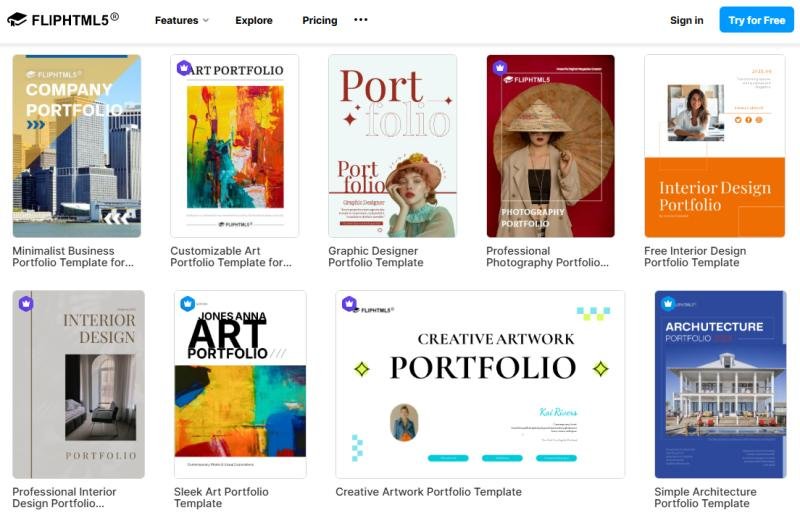
FlipHTML5’s portfolio templates enable users to efficiently build and customize digital portfolios to showcase their work online.
FlipHTML5 broadens the possibilities for digital portfolio creation by allowing users not only to convert existing PDF files into interactive portfolios but also to start from scratch with a range of portfolio templates (https://fliphtml5.com/templates/portfolio/). This approach eliminates the need for advanced design skills or starting with a blank page, making it possible for designers, educators, marketers, and other professionals to present their achievements in a visually structured format. These portfolio templates offer a foundation upon which users can assemble content, arrange sections, and highlight key projects, thus reducing the technical barriers commonly associated with portfolio development.
Portfolio templates available on FlipHTML5 are both diverse and easy to navigate. Users can access the template library directly from the dashboard, where templates can be filtered by theme, layout style, or intended use case. Whether the goal is to create a teaching portfolio, a marketing summary, or a design showcase, the filtering system helps users quickly identify a template that aligns with their objectives.
These well-designed portfolio templates serve a wide range of applications for various target audiences. Educators can utilize them to compile teaching materials, lesson highlights, and student feedback, while marketers may assemble campaign case studies and analytics. Creative professionals, such as photographers and graphic designers, can use the templates to present project collections or client work in a format optimized for digital engagement. The templates are designed to be adaptive, supporting both single-page and multi-section portfolios, and can be reorganized to suit evolving content needs.
Enhancing the appearance of a portfolio is straightforward within FlipHTML5. Users can alter themes, adjust backgrounds, and select from multiple pre-designed scenes to create a distinctive presentation. The online editor supports the addition of multimedia elements such as high-resolution images, videos, audio clips, animations, and clickable links, enriching the narrative and fostering audience engagement. This multimedia support ensures that digital portfolios (https://fliphtml5.com/blog/create/digital-portfolio/) are not only informative but also interactive and visually appealing.
After finalizing the portfolio, sharing is facilitated through several options: users can generate a unique URL or QR code for online distribution, embed the portfolio directly into a website using an embed code, or export the document for offline sharing. The platform also supports real-time updates-any changes made to the portfolio are instantly reflected in the shared link, ensuring that viewers always access the latest version.
Winston Zhang, CEO of FlipHTML5, commented, “Portfolio templates are designed to lower the entry barrier for digital publishing. They empower users from diverse backgrounds to present their work professionally and interactively, regardless of prior design experience. For those seeking greater personalization, our AI portfolio generator (https://fliphtml5.com/ai/ai-portfolio-generator) analyzes uploaded content and offers structure and layout suggestions, further accelerating the creation process.”
To learn more about portfolio templates and their applications, please visit https://fliphtml5.com/.
FlipHTML5
Flat/Rm D3, 11/F, Luk Hop Industrial Building,
No.8 Luk Hop Street, San Po Kong, Kowloon,
Hong Kong
Website: https://fliphtml5.com/
Email: pr@fliphtml5.com
About FlipHTML5
FlipHTML5 is an advanced digital publishing platform that enables individuals and organizations to create, customize, and share interactive documents online. With an emphasis on accessibility and multimedia integration, FlipHTML5 provides tools for building a variety of digital publications, including portfolios, magazines, and marketing collateral, adaptable for diverse professional and creative needs.
This release was published on openPR.