Enterprise Quantum Computing Market
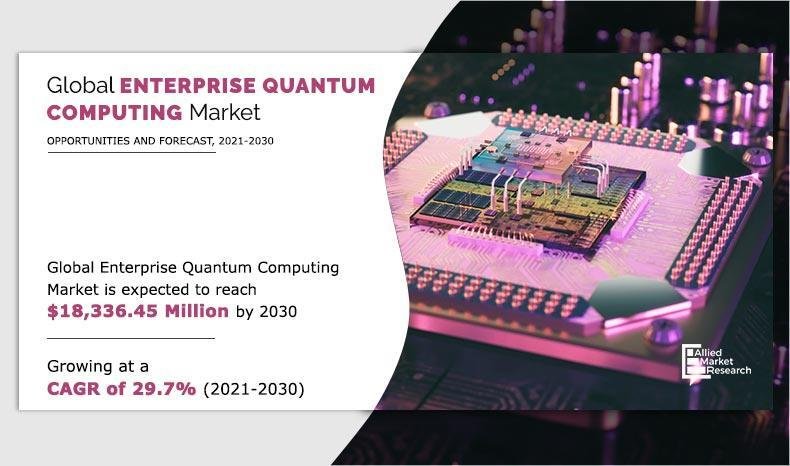
According to the report published by Allied Market Research, the global enterprise quantum computing market generated $1.37 billion in 2020 and is estimated to reach $18.33 billion by 2030, witnessing a CAGR of 29.7% from 2021 to 2030. The report offers a detailed analysis of changing market trends, top segments, key investment pockets, value chain, regional landscape, and competitive scenario.
An increase in investments in quantum computing technology, demand for high-performance computing, and demand from medical research and financial markets drive the growth of the global enterprise quantum computing market. However, operational challenges and stability & error correction issues hinder the market growth. On the other hand, the advent of on-premises quantum computers for businesses and technological advancements create new opportunities in the coming years.
Download Sample Report (Get Full Insights in PDF – 350 Pages) at: https://www.alliedmarketresearch.com/request-sample/5143
Enterprise quantum computing refers to the application of quantum computing technology within large organizations to solve complex problems that are difficult or impossible for classical computers to handle efficiently. Quantum computing harnesses the principles of quantum mechanics to process information in fundamentally different ways than traditional computing, which relies on binary bits (0s and 1s). Quantum computers, on the other hand, use quantum bits or “qubits,” which can exist in multiple states simultaneously (a concept known as superposition) and can be entangled, allowing them to perform computations at much higher speeds for certain types of problems.
In the enterprise context, quantum computing can be applied in fields like cryptography, optimization, drug discovery, materials science, financial modeling, and artificial intelligence. For example, it could enable companies to rapidly optimize supply chains, forecast financial markets, develop new materials, or enhance cybersecurity. However, enterprise adoption of quantum computing is still in its early stages, as the technology requires specialized hardware, is highly complex, and currently exists mostly in experimental or hybrid classical-quantum forms.
Leading players of the global enterprise quantum computing market analyzed in the research include Alibaba Group, Google, D-Wave Systems Inc., International Business Management Corporation (IBM), Huawei Technologies Co., Ltd., Intel Corporation, ID Quantique, Rigetti & Co, Inc., Microsoft, and Toshiba Research Europe Ltd.
For Report Customization: https://www.alliedmarketresearch.com/request-for-customization/5143
By deployment mode, the cloud segment held the largest share in 2020 and is anticipated to maintain this trend throughout the forecast period. This is due to the numerous benefits of cloud deployment, including high data security and safety. Additionally, the cloud segment is projected to experience the highest growth in the coming years. Since cloud deployment eliminates the need for investment in IT infrastructure, with data stored on cloud servers, it is increasingly popular among small and medium-sized businesses, particularly for geospatial analytics software.
In terms of components, the hardware segment led the enterprise quantum computing market in 2020 and is expected to continue this trend. This dominance is attributed to the rising adoption of quantum computing solutions by organizations seeking a competitive edge and improved customer retention. These solutions save time and cost, make use of existing data assets, and enhance image analysis through a single software application. Additionally, providers are enhancing their software to support a wider range of enterprise applications, creating significant growth opportunities in the market.
However, the service segment is expected to experience the highest growth in enterprise quantum computing as it ensures efficient collaboration between software providers and users through services like implementation, training, consulting, and managed services. Adopting these services enhances customer satisfaction across industries like BFSI, IT & telecommunications, and healthcare, optimizing customer needs while reducing operational costs, thereby increasing the demand for these services.
For deployment mode, the on-premises segment captured the largest share in 2020 and is expected to retain its leading position over the forecast period, largely due to the high level of data security it offers. However, the cloud segment is anticipated to grow the fastest, as it does not require significant IT infrastructure investment, with all data securely stored on cloud servers. This trend is driving demand for enterprise quantum computing software, particularly among small and medium-sized businesses.
Buy Now & Get Up to 50% off on This Report: https://www.alliedmarketresearch.com/enterprise-quantum-computing-market/purchase-options
Based on components, the hardware segment contributed to the highest share in 2020, accounting for around half of the total share, and is expected to maintain its leadership status during the forecast period. However, the services segment is estimated to manifest the largest CAGR of 33.0% from 2021 to 2030.
Based on application, the optimization segment held the largest share in 2020, contributing to around one-third of the total share of the global enterprise quantum computing industry, and is projected to maintain its lead position during the forecast period. However, the cyber security segment is estimated to witness the highest CAGR of 34.0% from 2021 to 2030.
Enterprise quantum computing market trends in Asia-Pacific is expected to exhibit highest growth during the forecast period, owing to strong economic growth along with the ongoing development in quantum computing, which drives organizations to invest heavily in enterprise quantum computing market to sustain growth and improve productivity.
In addition, factors such as major shift toward digital transformation, cloud deployment & technological advancement among small & medium businesses, and continuously ongoing modernization in quantum computational strategy in emerging economies notably contribute toward the market growth. Furthermore, key players in Asia-Pacific are focusing on enhancing their operations and increasing their overall efficiency to stay competitive in the market, which is expected to provide lucrative opportunities for the growth of the market during the forecast period.
Access the full summary at: https://www.alliedmarketresearch.com/enterprise-quantum-computing-market
Covid-19 Scenario:
1. Various organizations across the world adopted advanced computing techniques to enhance their business processes amid shift to “work from home” culture and improve operational efficiency.
2. Countries installed enterprise quantum computing applications and implemented various solutions to maintain operations in the healthcare and life sciences sectors.
Contact:
David Correa
1209 Orange Street,
Corporation Trust Center,
Wilmington, New Castle,
Delaware 19801 USA.
Int’l: +1-503-894-6022
Toll Free: + 1-800-792-5285
UK: +44-845-528-1300
India (Pune): +91-20-66346060
Fax: +1-800-792-5285
help@alliedmarketresearch.com
About Us:
Allied Market Research (AMR) is a full-service market research and business-consulting wing of Allied Analytics LLP, based in Portland, Oregon. AMR provides global enterprises as well as medium and small businesses with unmatched quality of “Market Research Reports” and “Business Intelligence Solutions.” AMR has a targeted view to provide business insights and consulting to assist its clients in making strategic business decisions and achieving sustainable growth in their respective market domains.
AMR launched its user-based online library of reports and company profiles, Avenue. An e-access library is accessible from any device, anywhere, and at any time for entrepreneurs, stakeholders, researchers, and students at universities. With reports on more than 60,000 niche markets with data comprising 600,000 pages along with company profiles on more than 12,000 firms, Avenue offers access to the entire repository of information through subscriptions. A hassle-free solution to clients’ requirements is complemented with analyst support and customization requests.
This release was published on openPR.