Process Digital Twin Market
The process digital twin market is on the verge of remarkable growth, driven by advancements in technology and increasing industry adoption. As businesses seek more efficient and predictive solutions, digital twins offer valuable insights and optimization capabilities. The following sections delve into market valuation, key players, industry trends, and segment analysis to provide a comprehensive overview of this rapidly evolving sector.
Projected Market Size and Growth Trajectory for Process Digital Twin
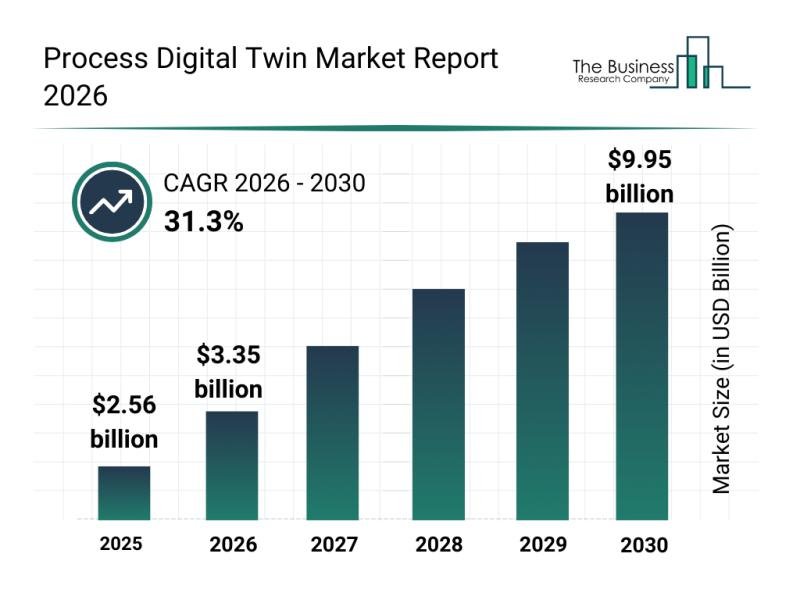
The process digital twin market is poised to expand significantly, with its valuation expected to reach $9.95 billion by 2030. This represents a compound annual growth rate (CAGR) of 31.3% during the forecast period. Several factors are contributing to this rapid growth, including the widespread deployment of AI-enabled simulation software, increased use of cloud and hybrid models, a growing emphasis on predictive analytics, expansion within the energy and utilities sectors, and rising demand for compliance and risk management tools. Key trends shaping this market include the surge in cloud-based process digital twins, the rising need for predictive maintenance solutions, integration of real-time monitoring and control systems, tailored simulation and modeling services, and a focus on optimizing business processes through data.
Download a free sample of the process digital twin market report:
https://www.thebusinessresearchcompany.com/sample.aspx?id=35422&type=smp&utm_source=OpenPR&utm_medium=Paid&utm_campaign=Mar_PR
Leading Players Driving the Process Digital Twin Market
Several prominent companies play a vital role in the process digital twin market. These include International Business Machines Corporation, General Electric Digital LLC, Oracle Corporation, Schneider Electric SE, Honeywell International Inc., SAP SE, Emerson Electric Co, Rockwell Automation Inc., Dassault Systèmes SE, Siemens Digital Industries Software, Hexagon AB, Yokogawa Electric Corporation, Ansys Inc., PTC Inc., MathWorks Inc., Bentley Systems Incorporated, Kongsberg Digital AS, Cognite AS, and DataProphet Technologies Inc.
A notable recent development occurred in October 2024 when Siemens AG, based in Germany, acquired Altair Engineering Inc. for $10.6 billion. This strategic acquisition aims to bolster Siemens’ capabilities in simulation, high-performance computing, and artificial intelligence, enhancing its digital twin offerings and accelerating data-driven process optimization. Altair Engineering, a US company, specializes in simulation and analytics tools essential for process digital twin development and enhancement.
Emerging Industry Trends Shaping the Future of Process Digital Twins
One of the major focuses in the process digital twin industry is the merging of digital twin technology with business optimization applications. This includes real-time operational intelligence platforms that combine live process data with advanced analytics and simulations to provide actionable insights. These platforms continuously gather and analyze operational data, empowering businesses to make informed decisions and optimize performance instantly.
For example, Siemens AG launched Digital Twin Composer in January 2026. This software integrates sensor data with high-fidelity simulations and advanced analytics, supporting comprehensive business optimization and decision-making. It offers real-time insights, simulation-driven scenario testing before implementing physical changes, and an integrated view of design, production, and performance data. This approach helps companies align operations with strategic goals, reduce cycle times, and increase throughput. Nonetheless, adopting such advanced integrations requires significant investments in data infrastructure and cross-functional expertise.
View the full process digital twin market report:
https://www.thebusinessresearchcompany.com/report/process-digital-twin-market-report?utm_source=OpenPR&utm_medium=Paid&utm_campaign=Mar_PR
Detailed Breakdown of Process Digital Twin Market Segments
This report categorizes the process digital twin market into several segments for a clearer understanding:
1) Component Type: Software, Services
2) Deployment Method: On-Premises, Cloud
3) Enterprise Size: Small and Medium Enterprises, Large Enterprises
4) Application Areas: Business Process Optimization, Predictive Maintenance, Performance Monitoring, Compliance and Risk Management, Other Applications
5) End-User Industries: Manufacturing, Healthcare, Energy and Utilities, Oil and Gas, Automotive, Aerospace and Defense, Other End-Users
Further subcategories include:
– Software Types: Process Modeling and Simulation Software, Data Integration and Management Software, Analytics and Visualization Software, AI and Machine Learning Enabled Software, Real-Time Monitoring and Control Software
– Services Offered: Consulting, Implementation and Integration, Training and Support, Maintenance and Upgradation, Managed Services
This segmentation helps stakeholders identify specific opportunities and tailor strategies within the growing process digital twin market.
Reach out to us:
The Business Research Company: https://www.thebusinessresearchcompany.com/,
Americas +1 310-496-7795,
Europe +44 7882 955267,
Asia & Others +44 7882 955267 & +91 8897263534,
Email us at info@tbrc.info.
Follow Us On:
LinkedIn: https://in.linkedin.com/company/the-business-research-company,
Twitter: https://twitter.com/tbrc_info,
YouTube: https://www.youtube.com/channel/UC24_fI0rV8cR5DxlCpgmyFQ
Learn More About The Business Research Company
With over 17500+ reports from 27 industries covering 60+ geographies, The Business Research Company has built a reputation for offering comprehensive, data-rich research and insights. Armed with 1,500,000 datasets, the optimistic contribution of in-depth secondary research, and unique insights from industry leaders, you can get the information you need to stay ahead.Our flagship product, the Global Market Model (GMM), is a premier market intelligence platform delivering comprehensive and updated forecasts to support informed decision-making.
This release was published on openPR.