Dynamic Random-Access Memory (DRAM) Market
The Dynamic Random-Access Memory market plays a crucial role in the global semiconductor ecosystem, powering everything from smartphones and data centers to artificial intelligence (AI) platforms and high-performance computing systems. DRAM technology remains the backbone of modern digital infrastructure due to its ability to store data temporarily for quick processing, enabling faster computing speeds and improved device performance.
Rapid technological transformation across industries has intensified competition within the Dynamic random-access memory market, prompting leading companies to invest heavily in advanced memory architectures, process node innovation, and supply chain optimization. The increasing demand for cloud computing, AI accelerators, gaming hardware, and automotive electronics has further pushed DRAM manufacturers to expand their product portfolios and strengthen partnerships with device manufacturers.
➤ Request Free Sample PDF Report @ https://www.researchnester.com/sample-request-3460
Top Companies & Their Strategies
Samsung Electronics
Samsung Electronics remains one of the most influential companies in the Dynamic random-access memory market , leveraging its advanced semiconductor manufacturing capabilities and large-scale production infrastructure. The company focuses on cutting-edge process technologies such as EUV lithography to produce high-density DRAM chips that support high-performance computing and AI workloads.
Samsung’s strategy emphasizes product diversification, including high-bandwidth memory (HBM), server DRAM, and low-power DRAM solutions for mobile devices. Its strong global supply chain and vertically integrated manufacturing model provide a cost advantage and help maintain leadership in memory innovation. Strategic collaborations with cloud providers and GPU manufacturers further strengthen its market presence.
SK Hynix
SK Hynix is a key player driving innovation in the Dynamic random-access memory market , particularly in high-performance memory solutions. The company has positioned itself as a leader in HBM technology, which is widely used in AI accelerators and advanced computing platforms.
Through aggressive R&D investments and strategic acquisitions, SK Hynix has expanded its capabilities in advanced semiconductor packaging and memory architecture. Its partnership-driven approach with data center operators and chip designers allows it to tailor DRAM solutions for specialized workloads, improving performance efficiency for AI and machine learning applications.
Micron Technology
Micron Technology has established itself as a major competitor in the DRAM market, focusing on innovation, advanced memory designs, and strategic supply chain management. The company produces DRAM products for multiple sectors, including consumer electronics, automotive systems, and enterprise servers.
Micron’s strength lies in its ability to deliver high-performance memory solutions with optimized power efficiency. The company actively invests in advanced manufacturing nodes and memory packaging technologies to enhance performance while reducing production costs. Its strong presence in North America also provides strategic alignment with major technology companies developing AI infrastructure.
Nanya Technology
Nanya Technology has emerged as an important participant in the Dynamic random-access memory market , particularly within the Asia-Pacific semiconductor ecosystem. The company focuses on specialized DRAM products used in industrial devices, consumer electronics, and networking equipment.
Nanya’s strategy centers on targeted innovation and efficient manufacturing processes that allow it to compete with larger memory producers. By concentrating on specific DRAM segments rather than mass-market production, the company has built a reputation for reliability and cost-effective memory solutions.
➤ Explore detailed profiles of top players and new entrants in this space – access your free sample report → https://www.researchnester.com/sample-request-3460
Winbond Electronics
Winbond Electronics plays a significant role in the DRAM market, particularly in niche memory solutions designed for embedded systems and IoT applications. The company’s product portfolio includes specialty DRAM chips optimized for industrial automation, consumer electronics, and automotive electronics.
Winbond’s competitive advantage lies in its focus on reliability and long product life cycles, which are essential for industrial devices and automotive components. Its strong manufacturing base in Asia and its partnerships with semiconductor distributors support its expansion into emerging markets.
Powerchip Semiconductor Manufacturing Corporation (PSMC)
Powerchip Semiconductor Manufacturing Corporation is another emerging force in the Dynamic random-access memory market, particularly in foundry-based DRAM production. The company collaborates with global semiconductor firms to manufacture specialized memory chips.
PSMC’s strategy focuses on providing manufacturing capacity and technology partnerships to companies seeking alternative DRAM production sources. By leveraging advanced fabrication facilities and flexible production models, the company contributes to supply chain diversification in the global semiconductor industry.
ChangXin Memory Technologies (CXMT)
ChangXin Memory Technologies represents China’s growing presence in the DRAM market. The company has rapidly developed domestic DRAM manufacturing capabilities and aims to strengthen China’s semiconductor independence.
CXMT focuses on increasing production efficiency and expanding its DRAM product portfolio for consumer electronics and computing devices. Government-backed investments and partnerships with domestic technology companies have accelerated its development and positioned it as a key emerging competitor in the global memory industry.
Kioxia (Emerging Memory Ecosystem Participant)
While primarily known for NAND flash memory, Kioxia participates in the broader memory ecosystem and contributes to technological innovation that influences the Dynamic random-access memory market . The company collaborates with semiconductor manufacturers to develop integrated memory solutions for enterprise storage and data centers.
Kioxia’s research in advanced memory architectures and high-speed storage technologies helps shape the future landscape of high-performance computing and memory integration.
➤ Gain access to expanded insights on competitive strategies, market size, and regional analysis. View our Dynamic random-access memory market Report Overview here: https://www.researchnester.com/reports/dynamic-random-access-memory-dram-market/3460
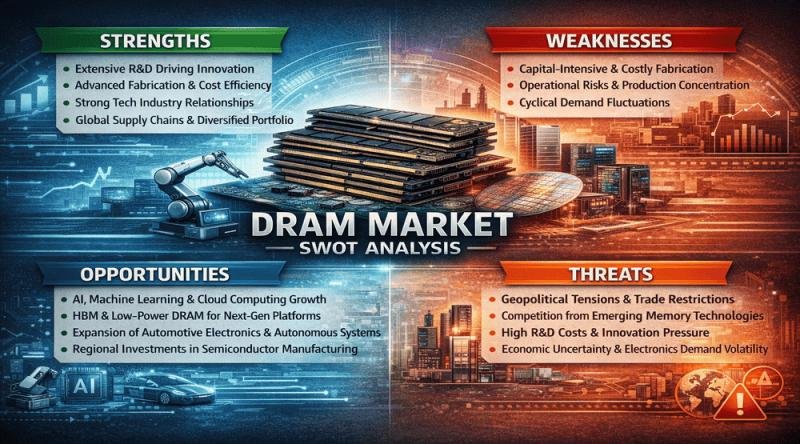
SWOT Analysis
Strengths
The leading companies in the Dynamic random-access memory market benefit from extensive research and development capabilities that drive continuous innovation in memory architecture and semiconductor manufacturing. Their advanced fabrication facilities and economies of scale enable large-volume production while maintaining competitive cost structures. Strong relationships with major technology companies, including cloud providers, smartphone manufacturers, and GPU developers, create consistent demand for DRAM products. In addition, global supply chains and diversified product portfolios help these companies address multiple application segments such as AI computing, gaming, mobile devices, and automotive electronics.
Weakness
Despite their technological leadership, DRAM manufacturers face significant operational challenges due to the capital-intensive nature of semiconductor fabrication. Establishing and maintaining advanced memory fabrication plants requires continuous investments in equipment, process upgrades, and research initiatives. Additionally, the concentration of DRAM production among a limited number of companies increases exposure to supply disruptions and operational risks. Dependence on cyclical demand from consumer electronics and computing sectors can also lead to fluctuations in production planning and revenue stability.
Opportunities
The growing adoption of artificial intelligence, machine learning, and cloud computing infrastructure presents substantial opportunities for companies operating in the DRAM market. Advanced memory technologies such as high-bandwidth memory (HBM) and low-power DRAM are becoming critical for next-generation computing platforms. The rapid expansion of automotive electronics, autonomous driving systems, and connected devices is also creating new demand for reliable and high-performance memory solutions. Furthermore, regional investments in semiconductor manufacturing and supply chain diversification are encouraging companies to expand production capacity and enter new geographic markets.
Threats
The Dynamic random-access memory market faces multiple external threats, including geopolitical tensions and trade restrictions that may affect semiconductor supply chains. Increasing competition from emerging memory technologies, such as advanced non-volatile memory solutions, could disrupt traditional DRAM demand in certain applications. Rapid technological advancements require continuous innovation, placing pressure on companies to sustain high research spending. Additionally, global economic uncertainty and fluctuations in electronics demand can create volatility in production cycles and inventory management.
➤ Interested in a customized SWOT for your target competitor? Request your tailored assessment → https://www.researchnester.com/sample-request-3460
Investment Opportunities & Emerging Trends
The Dynamic random-access memory market continues to attract significant investment due to the increasing importance of memory technology in AI computing, cloud infrastructure, and high-performance electronics. One of the most prominent investment themes is the expansion of high-bandwidth memory (HBM) production to support AI accelerators and advanced graphics processors used in data centers and machine learning systems.
Another important trend is the integration of DRAM with advanced packaging technologies, such as 3D stacking and chiplet architectures. These technologies enable faster data transfer and improved energy efficiency, making them essential for next-generation computing systems.
Semiconductor companies are investing in these innovations to strengthen their competitive positioning and support emerging computing workloads.
Regional expansion is also a key investment focus in the DRAM market. Governments in several countries are supporting semiconductor manufacturing through incentive programs aimed at strengthening domestic chip production. As a result, DRAM manufacturers are exploring new fabrication facilities and strategic partnerships in regions such as North America, East Asia, and parts of Europe.
Venture capital funding is also supporting startups working on advanced memory controllers, AI memory optimization software, and semiconductor design tools. These startups play an important role in enhancing the efficiency and performance of DRAM systems used in data centers and AI computing environments.
Another emerging trend is the growing importance of automotive DRAM solutions. Modern vehicles increasingly rely on advanced driver assistance systems (ADAS), infotainment platforms, and onboard computing units, all of which require high-speed memory for real-time data processing. This trend has created opportunities for memory manufacturers to develop automotive-grade DRAM products designed for durability and reliability.
Recent Developments
Over the past year, several companies operating in the Dynamic random-access memory market have introduced new high-performance DRAM products designed for AI servers and high-performance computing systems. Semiconductor manufacturers have also expanded their research programs focused on EUV-based memory production to enhance chip density and energy efficiency.
Major DRAM producers have strengthened collaborations with GPU and AI processor manufacturers to develop optimized memory architectures capable of handling large-scale data processing workloads. In addition, several companies have announced investments in advanced semiconductor fabrication facilities aimed at improving supply chain resilience and supporting future demand for memory technologies.
Governments across multiple regions have introduced policy initiatives designed to boost domestic semiconductor manufacturing, encouraging DRAM producers to participate in national chip development programs. At the same time, strategic partnerships between memory manufacturers and cloud computing providers have accelerated the development of specialized DRAM modules tailored for AI and data center environments.
➤ Request Free Sample PDF Report @ https://www.researchnester.com/sample-request-3460
➤ Related News –
https://www.linkedin.com/pulse/cyber-threat-intelligence-market-navigating-next-phase-rida-patel-zx1yc/
https://www.linkedin.com/pulse/what-driving-global-application-programming-interface-rida-patel-quluf/
AJ Daniel
Corporate Sales, USA
Research Nester
77 Water Street 8th Floor, New York, 10005
Email: info@researchnester.com
USA Phone: +1 646 586 9123
Europe Phone: +44 203 608 5919
Research Nester is a one-stop service provider with a client base in more than 50 countries
leading in strategic market research and consulting with an unbiased and unparalleled approach
towards helping global industrial players, conglomerates and executives for their future investment
while avoiding forthcoming uncertainties. With an out-of-the-box mindset to produce statistical
and analytical market research reports, we provide strategic consulting so that our clients can
make wise business decisions with clarity while strategizing and planning for their forthcoming needs
and succeed in achieving their future endeavors. We believe every business can expand to its new horizon, provided a right guidance at a right time is available through strategic minds.
This release was published on openPR.