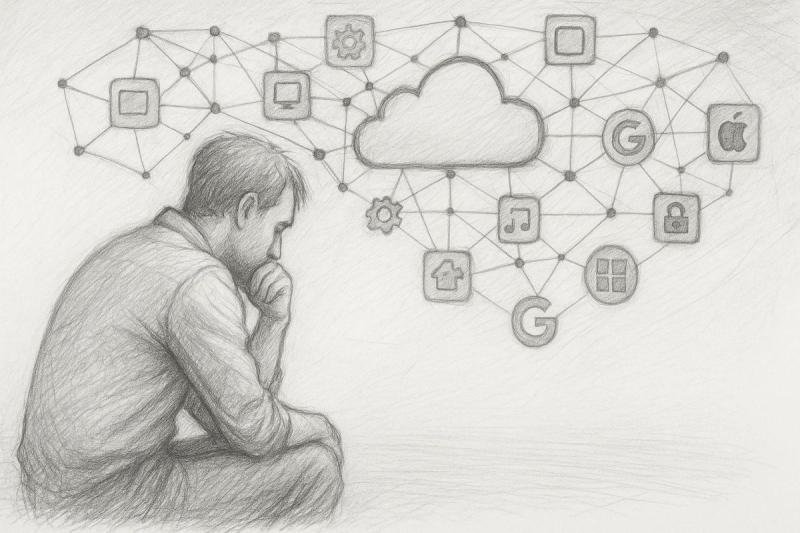
Technology that disempowers us: The silent step backwards in digitalization ( (C) M. Schall Verlag)
In his new article _”Digital dependency – How we have lost our self-determination to the cloud”_, author and software developer Markus Schall takes a critical look at the ever deeper interdependence between people, everyday life and digital infrastructure. What initially sounded convenient – cloud, AI, synchronization, available everywhere – increasingly turns out to be a tacit loss of control on closer inspection.
From a tool to a relationship of dependency
Just a few years ago, the cloud was a useful backup system for many, one tool among others. Today, however, entire areas of life and business models are dependent on the availability of external servers. Emails, contacts, documents, calendars, photos, AI systems – hardly any digital service still works without a constant internet connection to providers such as Google, Microsoft or Apple.
“The cloud has not liberated us. It has bound us – through convenience,”_ says Schall in his article.
A creeping process – barely noticed
In his article, Schall describes how this digital heteronomy has not crept into our lives overnight, but quietly and silently. Every new service, every convenient app, every automatic backup has restricted the scope of action a little more – until many users today hardly know where their data is actually physically stored.
This development has long since affected more than just private users. Self-employed people, companies and entire public authorities are also effectively no longer able to act independently if a major cloud provider goes down, raises prices or changes political guidelines.
The myth of progress
The press release refers to a central thesis of the article:
Digitalization is not automatically progress. If it leads to dependency, it is a step backwards – even if it looks convenient.
Schall calls for us to critically question the “myth of the digital always being good” and to remember an old adage: if you don’t control the infrastructure yourself, you have no real control over your data, your communication and ultimately your decisions.
A return to the essentials
“Digital self-determination begins with a conscious decision for or against dependencies”, Schall continues. In his article, he shows practical examples of how you can make yourself more independent with simple means – for example by storing data locally, avoiding constant synchronization or setting up your own infrastructure.
More than just a technology article: A social warning
The article is not just aimed at IT professionals or those with an affinity for technology. Rather, it is about an attitude:
How much control over our own lives do we tacitly relinquish – in exchange for a little convenience?
And: isn’t it time to re-evaluate this trade-off?
Data protection as a duty, not an optional extra
While companies and the self-employed strive for efficiency and convenience, data protection is all too often declared a minor matter. Especially in Germany, where the GDPR actually prescribes the highest standards, the picture is different in practice: Office 365 is used without hesitation, iCloud Drive is conveniently activated and sensitive documents are automatically synchronized to foreign servers – often without any transparency about where exactly the data actually ends up.
The question of server location is not only legally relevant, but also strategic. Anyone who processes personal data has a clear accountability obligation under the GDPR and must ensure that data processing complies with European standards. However, this is precisely what many US cloud providers do not actually do – despite all their promises.
Using such services may be technically convenient, but it harbors legal and ethical risks that become apparent at the latest during a data protection audit. It is therefore high time to take a more self-confident approach to data storage – with European solutions, transparent structures and a clear awareness of the responsibility that digital self-determination entails.
Read, think, decide anew
The full article “Digital dependency – How we have lost our self-determination to the cloud” is now available on Markus Schall’s author portal, the menu item ‘Blog’ on the publishers Website.
About the author
Markus Schall is a software developer, author and publisher. With over 20 years of experience in the digital environment, he regularly writes on topics relating to self-determination, technology, society and the future. In his articles, he combines technical expertise with social classification and calls for a self-determined, reflective approach to digital tools.
Frequently asked questions
1. why is the use of cloud services problematic in the first place?
Many cloud services conceal where the data is stored and how it is processed. Anyone who stores sensitive information (e.g. customer data, contract documents or accounting data) on external servers without control is not only handing over data – but often also control over business processes, dependencies and data protection.
2 But aren’t cloud services more secure than local systems?
Security is not synonymous with loss of control. Cloud services often have good basic security, but they enforce dependencies. For example, if you can no longer access the provider (account blocking, technical problems), you may lose everything – even in the event of minor misunderstandings or system errors.
3. what does the GDPR say about data storage in the cloud?
The GDPR obliges companies to clearly document where personal data is stored and what protective measures apply. Many cloud users cannot say for sure – for example, if they use Microsoft 365, iCloud Drive or Dropbox for business purposes without knowing whether the servers are located in the USA or the EU.
4 So is the use of services such as Office 365 or Google Workspace illegal?
Not necessarily – but often borderline if it is not clearly documented where the data is located, which order processing contracts exist and how access is granted. Smaller companies in particular are quick to overlook their legal obligations.
5. are there alternatives to the cloud?
Yes – and more than ever. Local data storage (e.g. via your own servers, NAS systems or self-hosting solutions) is easier to implement today than it used to be. European providers with clear data protection standards are also gaining in importance. The aim should not be to avoid the cloud, but to make a confident choice.
6 Why do many companies not even realize how dependent they have become?
Because usability obscures the dependencies. For example, anyone who simply drags and drops files “into the cloud” rarely thinks about the legal, technical or economic consequences. Many systems function so “smoothly” that the risks only become apparent in an emergency – for example, in the event of a lockdown, cyberattack or server failure.
7 Which sectors are particularly at risk?
Above all, creative professionals, service providers, publishers, agencies, consultants and freelancers who work with sensitive customer data. But also schools, public authorities or medium-sized companies that work with Microsoft or Apple products, for example, often without checking whether the data storage is GDPR-compliant.
8. what can be done specifically to regain more digital self-determination?
* Make conscious decisions: Which data may go where?
* Check local alternatives and favor them if necessary
* Regularly review contracts with cloud providers (AV contracts!)
* Keep backups outside the cloud
* Build up technical skills in the team to deal with infrastructure issues more confidently
To the article:
Digital dependency – How we have lost our self-determination to the cloud
M. Schall Verlag
Hackenweg 97
26127 Oldenburg
Germany
https://schall-verlag.de/en
Herr Markus Schall
info@schall-verlag.de
Development of customizable ERP software with CRM, billing and inventory management for macOS, Windows and iOS based on the Claris FileMaker platform. Design of local AI systems for connecting databases to local LLM language models. Development and distribution of database systems, ERP software and merchandise management systems based on the FileMaker platform. Experience with FileMaker databases since 1994, winner of an FMM Award 2011, awarded by FileMaker Magazine.
This release was published on openPR.