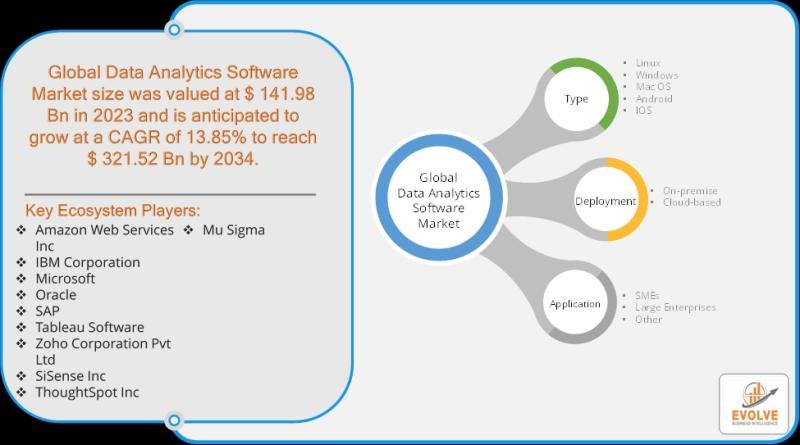
The Global Data Analytics Software Market is experiencing phenomenal growth, presenting significant opportunities across various platforms, with Android poised to capture a substantial share. Valued at an impressive USD 141.98 Billion in 2023, this market is projected to skyrocket to USD 321.52 Billion by 2034, demonstrating a robust Compound Annual Growth Rate (CAGR) of 13.85% from 2024 to 2034. This surge is primarily fueled by the escalating adoption of Big Data Technologies and an increasing global demand for data-driven decision-making.
Download the full report now to discover market trends, opportunities, and strategies for success.
https://evolvebi.com/report/global-data-analytics-software-market-analysis/
The inherent opportunities in this market are further amplified by the rapid advancements and growing adoption of Artificial Intelligence (AI) and Machine Learning (ML), alongside the widespread expansion of IoT and Edge Analytics. Android, with its dominant global mobile presence, open-source nature, and extensive developer ecosystem, is uniquely positioned to capitalize on these trends, especially as data generation at the edge and on mobile devices continues to explode.
Problems Faced: Data Privacy and Security Concerns
Despite the immense potential, the Global Data Analytics Software Market grapples with significant challenges, predominantly surrounding data privacy and security. The risk of cyberattacks, data breaches, and the imperative to comply with stringent regulations like GDPR pose substantial hurdles. These concerns can erode user trust, hinder data sharing, and necessitate robust, innovative solutions.
Proposed Solutions for Data Privacy and Security
Addressing these critical concerns is paramount for sustained growth. A multi-faceted approach leveraging advanced technologies and best practices is essential:
• Robust Security Protocols: Implementing multi-layered security measures, including strong encryption for data at rest and in transit (e.g., AES-256 and TLS), firewalls, and secure access controls (e.g., Role-Based Access Control and Multi-Factor Authentication).
• Data Minimization & Anonymization: Adopting a “collect only what matters” approach and employing techniques like anonymization and pseudonymization to protect personally identifiable information (PII) while retaining data utility for analysis.
• Privacy by Design: Integrating privacy-preserving techniques into the initial design and development of data analytics systems, rather than as an afterthought. This includes built-in encryption and user-centric privacy settings.
• Automated Compliance & Monitoring: Utilizing tools for policy management, real-time threat detection (potentially AI/ML-powered), and automated regulatory reporting to ensure continuous compliance with data protection laws.
• Incident Response Planning: Developing comprehensive incident response plans that outline clear steps for containment, communication, and post-incident analysis in the event of a breach. Regular simulation exercises are crucial for preparedness.
• Employee Training & Awareness: Educating all staff on data privacy best practices, the latest threat landscapes, and the importance of recognizing social engineering tactics to prevent human error-induced breaches.
• Third-Party Risk Management: Thoroughly evaluating the security practices of third-party vendors and partners involved in data processing.
• Advanced Technologies: Exploring and adopting cutting-edge technologies like Homomorphic Encryption (allowing computation on encrypted data) and Federated Learning (enabling model training on decentralized data without sharing raw data) for enhanced privacy.
Download the full report now to discover market trends, opportunities, and strategies for success.
https://evolvebi.com/report/global-data-analytics-software-market-analysis/
US Tariff Implications on the Global Data Analytics Software Market
US tariffs, while primarily targeting physical goods, have ripple effects that impact the global data analytics software market. The increased cost of imported technology components, such as servers, storage systems, networking hardware, and AI accelerators (e.g., GPUs) from countries like China, directly affects the operational expenses for data analytics software providers, especially those offering cloud-based solutions.
Key implications include:
• Increased Infrastructure Costs: A 25% levy on Chinese-made servers and GPUs, for instance, has forced cloud providers to absorb or pass on cost increases. This can lead to higher fees for clients and squeezed margins for subscription-based analytics services.
• Supply Chain Disruptions: Tariffs can disrupt the supply of critical components, leading to extended lead times for hardware procurement. This can delay the deployment of new analytics platforms and hinder market expansion.
• Higher R&D Costs: The development of cutting-edge analytics solutions, particularly those involving AI and ML, relies on advanced computing resources. Tariffs on these components can inflate research and development costs, disproportionately affecting startups and smaller firms.
• Regulatory Uncertainty: Fluctuating exemptions and policy changes create unpredictability, making it challenging for analytics providers to forecast costs and maintain compliance, especially for industry-specific solutions that rely on tariff-affected IoT sensors and edge computing devices.
• Shift in Sourcing and Business Models: Companies are responding by exploring multi-cloud diversification, leveraging open-source and edge solutions to reduce reliance on centralized, tariff-vulnerable infrastructure, and focusing more on SaaS and subscription models to shift capital expenditure to operational expenditure. There’s also a move towards nearshoring and reshoring production to mitigate tariff impacts.
Download the full report now to discover market trends, opportunities, and strategies for success.
https://evolvebi.com/report/global-data-analytics-software-market-analysis/
Despite these challenges, the long-term outlook for the Global Data Analytics Software Market remains positive. The increasing demand for data-driven insights across all sectors is a powerful driver that will continue to propel growth, even as businesses adapt to evolving trade policies.
To understand further and explore opportunities in the Global Data Analytics Software Market or any related industry, please share your queries/concern at info@evolvebi.com.
Evolve Business Intelligence
C-218, 2nd floor, M-Cube
Gujarat 396191
India
Email: sales@evolvebi.com
Website: https://evolvebi.com/
Evolve Business Intelligence is a market research, business intelligence, and advisory firm providing
innovative solutions to challenging pain points of a business. Our market research reports include data
useful to micro, small, medium, and large-scale enterprises. We provide solutions ranging from mere
data collection to business advisory.
Evolve Business Intelligence is built on account of technology advancement providing highly accurate
data through our in-house AI-modelled data analysis and forecast tool – EvolveBI. This tool tracks real-
time data including, quarter performance, annual performance, and recent developments from
fortune’s global 2000 companies.
This release was published on openPR.