The cyber threat intelligence (CTI) market has become a strategic cornerstone in modern cybersecurity operations. As digital ecosystems expand and cyberattacks grow in sophistication, organizations are shifting from reactive defense models to intelligence-driven security frameworks. Cyber threat intelligence empowers enterprises to proactively identify, analyze, and mitigate threats before they escalate into critical breaches. The market’s competitive landscape features established cybersecurity giants and innovative startups leveraging AI, big data analytics, and automation to deliver real-time threat visibility and actionable insights.
➤ Request Free Sample PDF Report @ https://www.researchnester.com/sample-request-8131
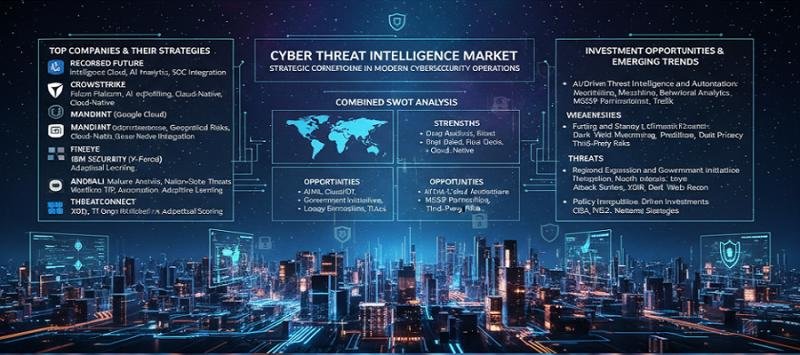
Top Companies & Their Strategies
1. Recorded Future
Recorded Future stands at the forefront of the cyber threat intelligence market with its Intelligence Cloud platform, which aggregates data from open web, dark web, and technical sources. Its strength lies in AI-driven analytics and natural language processing that automate the correlation of threat indicators. The company’s focus on integrating CTI with security operations centers (SOCs) and incident response workflows has solidified its enterprise appeal. Its strong customer base in government and financial services demonstrates its credibility in managing high-risk, data-sensitive environments.
2. CrowdStrike
CrowdStrike leverages its Falcon platform to integrate endpoint protection with advanced threat intelligence and behavioral analytics. The company’s intelligence services provide adversary profiling, real-time threat detection, and malware analysis at scale. CrowdStrike’s key competitive edge is its cloud-native architecture and global telemetry network, which capture and analyze billions of events daily. This visibility enables it to offer predictive insights and attribution data, positioning it as a market leader in both threat hunting and managed detection services.
3. Mandiant (a Google Cloud company)
Mandiant, now part of Google Cloud, has a long-standing reputation for incident response and intelligence-led cybersecurity consulting. Its intelligence division provides deep insight into global threat actors, campaign behaviors, and geopolitical cyber risks. The integration with Google Cloud has strengthened its cloud-native intelligence capabilities, allowing seamless data correlation across hybrid environments. Mandiant’s expertise in forensics and real-time intelligence feeds makes it indispensable for organizations seeking to align strategy with emerging threat landscapes.
4. IBM Security (IBM X-Force)
IBM’s X-Force Threat Intelligence team combines decades of cybersecurity research with real-time analytics to support enterprise and government defense. IBM’s advantage lies in its integration of CTI within the QRadar SIEM and Cloud Pak for Security platforms, providing clients with actionable intelligence and threat detection in one ecosystem. Its global research network and cross-industry intelligence sharing capabilities enhance its position as a comprehensive CTI provider. IBM’s balanced mix of human expertise and AI automation supports large-scale organizations managing multi-vector threats.
➤ Explore detailed profiles of top players and new entrants in this space – access your free sample report → https://www.researchnester.com/sample-request-8131
5. FireEye
FireEye, known for its extensive malware analysis and advanced threat protection technologies, remains a significant player in the CTI ecosystem despite its structural evolution post-Mandiant divestiture. The company continues to deliver real-time threat feeds and contextual intelligence, focusing on helping enterprises identify vulnerabilities in operational systems. Its specialization in nation-state threat analysis and integration of machine learning into detection workflows give FireEye a distinct edge in intelligence-driven defense solutions.
6. Anomali
Anomali offers an enterprise-grade threat intelligence platform (TIP) that aggregates, normalizes, and enriches threat data from multiple feeds. Its ThreatStream solution enables organizations to operationalize CTI across SOCs, SIEMs, and endpoint detection tools. Anomali’s competitive strength lies in its scalable platform architecture and automation capabilities, reducing analyst fatigue while improving incident prioritization. Its partnerships with defense agencies and security vendors further enhance its threat data relevance.
7. Trellix
Trellix, formed from the merger of McAfee Enterprise and FireEye, represents a new generation of extended detection and response (XDR) combined with intelligence automation. Its living security architecture fuses machine learning, analytics, and CTI for adaptive threat defense. Trellix’s expansive partner ecosystem and global reach across enterprise and government sectors make it a formidable player in integrated threat management. The company’s focus on adaptive intelligence ensures resilience in a fast-evolving cyber landscape.
8. ThreatConnect
ThreatConnect distinguishes itself with its Threat Intelligence Operations (TI Ops) platform, which blends threat data aggregation with workflow automation. Its modular design allows analysts to customize intelligence processes, integrating directly with SIEMs, SOARs, and third-party tools. The company’s strength lies in enabling collaborative threat sharing and providing contextual threat scoring, empowering organizations to make intelligence-informed security decisions efficiently.
➤ Gain access to expanded insights on competitive strategies, market size, and regional analysis. View our Cyber Threat Intelligence Market Report Overview here: https://www.researchnester.com/reports/cyber-threat-intelligence-market/8131
Combined SWOT Analysis for Leading Companies
Strengths
The leading companies in the cyber threat intelligence market demonstrate deep analytical capability, AI integration, and global data visibility. Their platforms combine structured and unstructured data sources to create actionable insights. Many benefit from strong cross-industry partnerships, enhancing their data quality and real-time threat attribution. Cloud-native architectures, automation-driven workflows, and government-grade analytics provide scalability and resilience-enabling these firms to protect complex, hybrid IT environments across industries.
Weaknesses
Despite technological advancement, several CTI platforms face challenges related to data overload and false positives, which can overwhelm analysts and slow incident response times. High implementation costs and skill shortages also limit adoption among mid-sized enterprises. Integration with legacy systems remains complex, and vendor interoperability is often limited by proprietary frameworks. Some players also face regional compliance hurdles, particularly with cross-border threat data sharing, which can restrict intelligence distribution.
Opportunities
The cyber threat intelligence market is rich with opportunities as AI, machine learning, and automation reshape cyber defense models. The proliferation of cloud infrastructure, IoT devices, and remote operations demands scalable intelligence systems. Expanding government initiatives on cyber resilience and regulatory mandates for critical infrastructure protection are driving adoption across defense, finance, and healthcare sectors. Additionally, partnerships between CTI providers and managed security service providers (MSSPs) are opening new commercial pathways, while the rise of threat intelligence-as-a-service (TIaaS) models offers recurring revenue potential.
Threats
The market faces threats from rapidly evolving attack vectors and the increasing use of AI-driven cyberattacks, which can outpace traditional intelligence cycles. The competitive field is intensifying as new entrants and open-source intelligence platforms disrupt pricing structures. Data privacy regulations like GDPR and region-specific cyber laws can limit intelligence sharing. Additionally, the growing reliance on third-party intelligence feeds introduces data quality risks and potential inaccuracies in real-time threat detection.
➤ Access a complete SWOT breakdown with company-specific scorecards: Claim your sample report → https://www.researchnester.com/sample-request-8131
Investment Opportunities & Emerging Trends
AI-Driven Threat Intelligence and Automation
One of the most significant investment themes in the cyber threat intelligence market is the adoption of AI and automation to accelerate threat detection and contextualization. Companies like CrowdStrike and Recorded Future are integrating machine learning-based pattern recognition to identify zero-day threats faster. Investors are increasingly drawn to startups developing AI-native threat analytics platforms, capable of real-time correlation across massive data sets. The fusion of automated intelligence gathering and behavioral analytics is expected to redefine threat detection and response efficiency.
Mergers, Acquisitions, and Strategic Alliances
The past year has seen an uptick in M&A and strategic collaborations aimed at consolidating cyber intelligence capabilities. Google Cloud’s acquisition of Mandiant exemplifies the trend toward integrated CTI and cloud security ecosystems. Trellix’s formation through the McAfee-FireEye merger highlights industry realignment around extended detection and response (XDR) solutions. Similarly, partnerships between CTI vendors and public agencies-such as IBM’s collaborations on national cybersecurity frameworks-underscore the growing alignment between private intelligence and public defense initiatives.
Funding and Startup Growth
Venture capital activity remains strong, with investors focusing on emerging CTI startups specializing in dark web monitoring, predictive analytics, and automated threat correlation. Companies like Cybersixgill, Intel 471, and Darktrace are attracting attention for their AI-powered threat modeling and real-time dark web surveillance. Funding is also flowing toward platforms that simplify intelligence sharing and collaboration among organizations, addressing the sector’s long-standing silo problem.
Regional Expansion and Government Initiatives
North America leads global investment in cyber threat intelligence due to robust enterprise adoption and strong federal cybersecurity mandates. Europe follows closely, with heightened investment spurred by GDPR compliance and regional cyber defense initiatives. Asia-Pacific is emerging as a high-growth investment hub, driven by government-backed digital security programs in India, Singapore, and Japan. Regional CTI sharing frameworks and national cybersecurity agencies are fueling public-private collaboration, creating lucrative opportunities for technology vendors and service providers alike.
➤ Request Free Sample PDF Report @ https://www.researchnester.com/sample-request-8131
➤ Related News –
https://www.linkedin.com/pulse/how-cyber-threat-intelligence-reshaping-cybersecurity-56wxf/
http://linkedin.com/pulse/what-future-mobile-user-authentication-market-lyyzf/
Contact Data
AJ Daniel
Corporate Sales, USA
Research Nester
77 Water Street 8th Floor, New York, 10005
Email: info@researchnester.com
USA Phone: +1 646 586 9123
Europe Phone: +44 203 608 5919
About Research Nester
Research Nester is a one-stop service provider with a client base in more than 50 countries, leading in strategic market research and consulting with an unbiased and unparalleled approach towards helping global industrial players, conglomerates and executives for their future investment while avoiding forthcoming uncertainties. With an out-of-the-box mindset to produce statistical and analytical market research reports, we provide strategic consulting so that our clients can make wise business decisions with clarity while strategizing and planning for their forthcoming needs and succeed in achieving their future endeavors. We believe every business can expand to its new horizon, provided a right guidance at a right time is available through strategic minds.
This release was published on openPR.