Converged Infrastructure Market
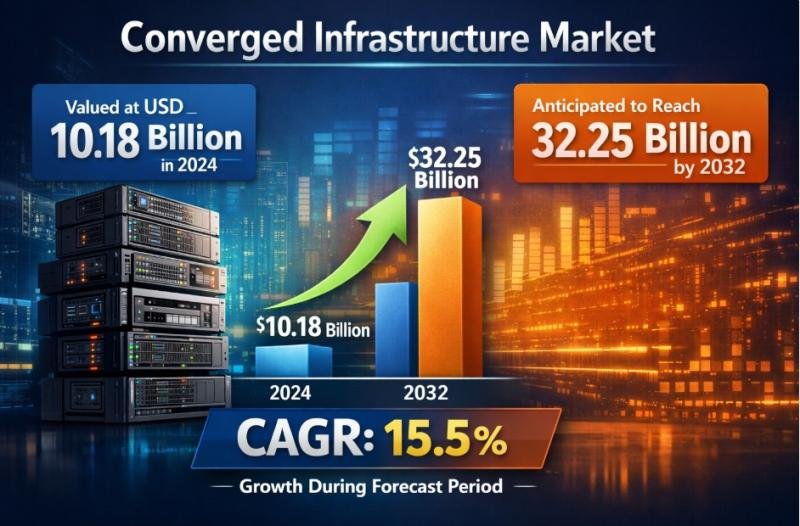
The Converged Infrastructure Market was valued at USD 10.18 billion in 2024 and is projected to reach USD 32.25 billion by 2032, expanding at a robust CAGR of 15.5% during the forecast period. The rapid digital transformation of enterprises, increasing demand for scalable IT infrastructure, and the need for simplified data center management are key drivers fueling market growth globally.
Converged infrastructure (CI) integrates compute, storage, networking, and virtualization into a single optimized system, enabling organizations to streamline IT operations, reduce capital expenditure, and improve performance efficiency. As enterprises increasingly adopt hybrid cloud, virtualization, AI-driven workloads, and edge computing, converged infrastructure has become a strategic investment for modern IT environments.
Browse the full Report at https://www.credenceresearch.com/report/converged-infrastructure-market
Market Overview
The shift from traditional siloed IT infrastructure to integrated systems is redefining enterprise data center strategies. Organizations are prioritizing agility, scalability, and automation. Converged infrastructure offers pre-validated, modular systems that reduce deployment complexity and minimize operational overhead.
The market growth is strongly supported by:
Expansion of cloud computing and hybrid IT models
Growing adoption of virtualization technologies
Rising demand for remote office/branch office (ROBO) solutions
Increasing cybersecurity and disaster recovery requirements
Edge computing expansion across industries
Large enterprises initially drove adoption; however, small and medium-sized enterprises (SMEs) are increasingly embracing converged solutions due to improved cost-efficiency and simplified management frameworks.
Get Free PDf Sample Request: https://www.credenceresearch.com/report/converged-infrastructure-market#request_sample
Market Segmentation Analysis
By Type
Reference Architecture Integrated Systems (RAIS)
RAIS solutions provide standardized blueprints for infrastructure deployment. These systems offer validated combinations of hardware and software, reducing integration risks. They are widely used by enterprises seeking predictable performance and quick deployment timelines.
Fabric Architecture Integrated System (FAIS)
FAIS integrates networking fabric into the core architecture, delivering enhanced scalability and high-speed data transmission. These systems are ideal for large-scale data centers and high-performance computing environments.
Converged Infrastructure Component Integrated System (ICIS)
ICIS solutions integrate storage, compute, and networking components into modular units. They offer flexible expansion and are particularly suited for enterprises requiring workload customization.
Converged Infrastructure Workload Integrated System (WIS)
WIS platforms are optimized for specific workloads such as databases, ERP systems, AI applications, and analytics. These systems are gaining traction among organizations deploying mission-critical applications.
By Verticals
IT and Telecommunications
The IT and telecom sector holds a dominant market share due to increasing data traffic, 5G rollouts, and cloud-native infrastructure deployment. Converged systems help telecom operators manage network virtualization efficiently.
Manufacturing
Smart manufacturing and Industry 4.0 initiatives are driving demand for integrated infrastructure systems to manage IoT devices, real-time analytics, and production automation.
Transportation and Logistics
Logistics companies are leveraging converged infrastructure for real-time tracking systems, warehouse automation, and predictive maintenance analytics.
Defense and Government
Government agencies and defense organizations require secure, high-performance infrastructure to support sensitive operations. Converged solutions offer centralized management and enhanced cybersecurity capabilities.
BFSI
The BFSI sector relies heavily on secure data processing, fraud detection, and compliance management. Converged infrastructure ensures high availability and low latency for financial transactions.
Retail
Retailers are increasingly deploying CI systems for omnichannel operations, inventory management, and personalized customer analytics.
Energy and Utilities
Smart grid deployment, predictive asset monitoring, and renewable energy integration require scalable infrastructure systems.
Healthcare
Healthcare institutions utilize converged infrastructure for electronic health records (EHR), telemedicine platforms, and medical imaging systems.
Get Free PDf Sample Request: https://www.credenceresearch.com/report/converged-infrastructure-market#request_sample
By Application
Virtualizing Critical Applications
Enterprises are virtualizing databases, ERP systems, and customer management platforms to improve resource utilization and performance efficiency.
Data Centre Consolidation
Organizations are consolidating multiple data centers into unified platforms to reduce operational costs and enhance infrastructure agility.
Remote Office/Branch Office (ROBO)
ROBO deployment has surged due to global workforce distribution. Converged systems provide centralized management and data security for remote locations.
Backup and Disaster Recovery
Increasing cyber threats and regulatory requirements are accelerating investments in robust backup and disaster recovery systems.
Virtual Desktop Infrastructure (VDI)
VDI solutions are expanding due to hybrid work models, allowing secure and scalable remote desktop environments.
Browse the full Report at https://www.credenceresearch.com/report/converged-infrastructure-market
Regional Insights
North America
North America dominates the global market due to advanced IT infrastructure, early adoption of cloud technologies, and strong enterprise digitization initiatives.
U.S.
The U.S. leads the region, driven by hyperscale data centers, AI integration, and digital transformation across industries.
Canada
Canada is witnessing growth in government digitization projects and cloud infrastructure expansion.
Mexico
Mexico’s manufacturing and telecom sectors are fueling adoption of integrated infrastructure systems.
Europe
Europe is experiencing steady growth, supported by data sovereignty regulations and enterprise modernization initiatives.
Germany
Germany leads the European market, driven by Industry 4.0 investments.
France
France is witnessing increasing adoption in BFSI and telecom sectors.
U.K.
The U.K. market is supported by financial services digitalization and cloud-native transformation.
Italy & Spain
Southern European countries are increasingly adopting integrated infrastructure for public sector modernization.
Asia Pacific
Asia Pacific is expected to register the fastest growth rate during the forecast period.
China
China’s large-scale data center expansion and 5G infrastructure are key growth drivers.
Japan
Japan focuses on automation, robotics, and high-performance IT systems.
India
India’s booming IT services sector and startup ecosystem are boosting infrastructure modernization.
South Korea & South-east Asia
Rapid digitalization, fintech growth, and smart city initiatives are accelerating market adoption.
Latin America
Brazil
Brazil is investing in telecom and banking infrastructure modernization.
Argentina
Argentina shows growing adoption in the public and BFSI sectors.
Middle East & Africa
GCC Countries
GCC nations are investing heavily in smart cities and digital government platforms.
South Africa
South Africa leads sub-Saharan adoption with data center investments.
Get Free PDf Sample Request: https://www.credenceresearch.com/report/converged-infrastructure-market#request_sample
Market Drivers
Hybrid Cloud Adoption – Enterprises are combining on-premise and cloud solutions, requiring unified infrastructure platforms.
Digital Transformation Initiatives – Automation and AI integration demand scalable computing systems.
Cost Efficiency – Reduced hardware footprint and simplified management lower total cost of ownership.
Edge Computing Growth – Expansion of IoT and real-time analytics requires localized processing capabilities.
Cybersecurity Needs – Integrated systems enhance security management and data protection.
Market Challenges
High initial capital investment
Integration complexity with legacy systems
Vendor lock-in concerns
Skills gap in advanced IT infrastructure management
Despite these challenges, technological advancements and managed service offerings are mitigating adoption barriers.
Competitive Landscape and Key Player Analysis
The converged infrastructure market is moderately consolidated, with major global IT vendors competing through innovation, partnerships, and strategic acquisitions.
Scale Computing
Scale Computing specializes in hyperconverged infrastructure (HCI) solutions tailored for edge and mid-market enterprises. Its solutions emphasize simplicity and cost efficiency.
Huawei Technologies Co., Ltd.
Huawei provides comprehensive converged and cloud infrastructure solutions, particularly strong in Asia Pacific markets.
Quantum Corporation
Quantum focuses on data storage and management systems optimized for high-performance workloads.
Cisco Systems, Inc.
Cisco integrates networking with compute and storage systems, offering unified data center platforms and cloud-ready infrastructure.
NetApp
NetApp provides hybrid cloud infrastructure and data management solutions with strong integration capabilities.
Microsoft
Microsoft’s Azure Stack and hybrid cloud infrastructure solutions play a significant role in enterprise digital transformation.
Broadcom
Broadcom supports the ecosystem with virtualization software and semiconductor technologies powering converged platforms.
Nutanix
Nutanix is a leading hyperconverged infrastructure provider offering cloud software platforms for enterprise IT.
Hewlett Packard Enterprise Development LP
HPE delivers integrated infrastructure systems with strong global service capabilities.
Dell Inc.
Dell provides end-to-end converged and hyperconverged solutions integrated with VMware ecosystems.
Browse the full Report at https://www.credenceresearch.com/report/converged-infrastructure-market
Future Outlook
The future of the converged infrastructure market is strongly aligned with AI-driven automation, hybrid cloud expansion, and edge computing. As organizations increasingly rely on digital ecosystems, infrastructure modernization will remain a strategic priority.
Key future trends include:
Integration of AI and machine learning into infrastructure management
Increased adoption of hyperconverged infrastructure (HCI)
Growth in edge-ready converged systems
Software-defined data centers (SDDC) expansion
Sustainability-driven data center innovations
By 2032, converged infrastructure is expected to become the backbone of enterprise IT environments, enabling faster innovation cycles, improved operational resilience, and scalable digital transformation.
Conclusion
The global converged infrastructure market is poised for substantial expansion, growing from USD 10.18 billion in 2024 to USD 32.25 billion by 2032, at a CAGR of 15.5%. Rising demand for simplified IT environments, cloud integration, and high-performance computing solutions is reshaping enterprise infrastructure strategies worldwide.
With strong participation from leading technology providers and rapid digitalization across industries, the market is expected to witness transformative growth throughout the forecast period.
Browse the full Report at https://www.credenceresearch.com/report/converged-infrastructure-market
Contact US:
Credence Research Inc, Tower C-1105 , S 25, Akash Tower,
Vishal Nahar, Pimple Nilakh, Haveli,
Pune – 411027, India
India – +91 6232 49 3207
sales@credenceresearch.com
http://www.credenceresearch.com
About US:
Credence Research is a leading international provider of market intelligence and a key component in the due diligence process. We deliver high-quality, extensive, deep-dive reports that empower leaders and investors to make informed decisions and mitigate risks. Our strategic insights, based on extensive research frameworks and advanced data modeling, provide authoritative primary sources for evaluating market performance and potential across a wide range of industries.
This release was published on openPR.