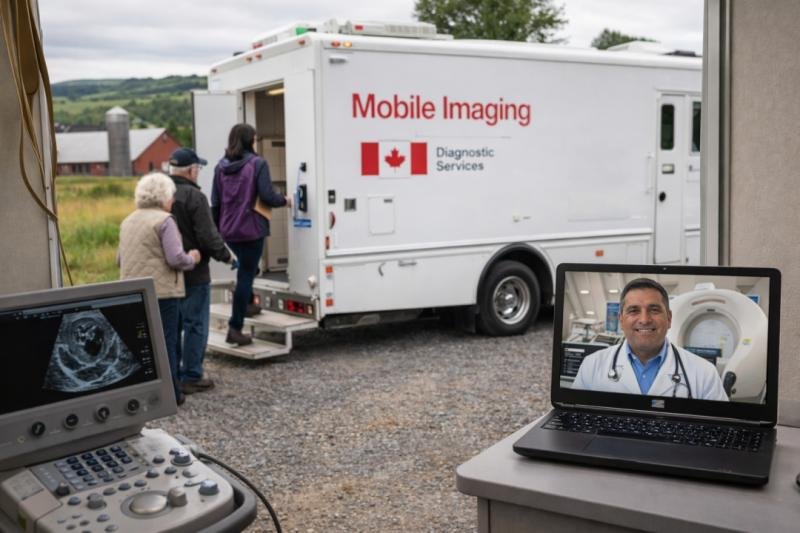
Access to life-saving diagnostics should never depend on a patient’s postal code. Technology now gives us the ability to bring advanced imaging expertise to every community–no matter how remote.
Editorial by Samantha Di Khali, Khali Comunica – Former Ontario Ministry of Health Chief Architect Hugo Raposo examines the growing diagnostic imaging access gap affecting rural healthcare communities across Canada.
Access to diagnostic imaging is one of the most critical components of modern healthcare. Technologies such as CT scans, MRI, ultrasound, and advanced retinal imaging allow clinicians to detect diseases earlier, guide treatment decisions, and monitor patient outcomes with precision. Yet despite the sophistication of these tools, access to imaging services remains uneven across Canada-particularly in rural and remote communities.
For patients living outside major urban centres, obtaining timely imaging can involve long travel distances, extended wait times, and delayed diagnoses. These challenges not only affect patient outcomes but also place additional pressure on healthcare systems already managing increasing demand.
Hugo Raposo, who previously served as Chief Architect for the Ontario Ministry of Health and played a central role in shaping digital health modernization initiatives across the province, believes addressing this imaging access gap requires both technological innovation and system-level thinking. Many of the digital capabilities now being introduced across Canada’s healthcare infrastructure are emerging from these broader modernization efforts designed to improve coordination and accessibility of care.
“Diagnostic imaging is one of the most powerful tools clinicians have for identifying disease early,” Raposo explained. “But when access to those tools is uneven, the quality and timeliness of care can vary dramatically depending on where a patient lives.”
A Persistent Rural Healthcare Challenge
Canada’s geography presents a unique challenge for healthcare delivery. Large portions of the population live in rural or remote regions where access to specialized medical infrastructure can be limited. While urban hospitals often operate advanced imaging centres with multiple scanners and dedicated radiology teams, smaller rural hospitals may have limited equipment and fewer specialists available to interpret results.
This disparity can lead to delays in diagnostic evaluation. Patients requiring advanced imaging may be referred to larger urban facilities, sometimes traveling hundreds of kilometres to access services that are readily available in metropolitan areas.
These delays are particularly concerning when imaging is required to diagnose serious conditions such as cancer, cardiovascular disease, or neurological disorders. Early detection is often critical for effective treatment, and any delay in diagnosis can have significant implications for patient outcomes.
“Timely imaging is not just a convenience-it is often the first step toward identifying life-threatening conditions,” Raposo said. “When patients face barriers to accessing those services, the consequences can be profound.”
The Role of Digital Health Infrastructure
Raposo’s work in healthcare architecture has focused on designing digital infrastructure capable of improving how healthcare systems manage information and coordinate care across institutions.
During his tenure contributing to major digital health initiatives in Ontario, modernization programs introduced new interoperability capabilities between hospitals, diagnostic laboratories, and clinical information systems. These initiatives were designed to ensure that imaging results and patient data could be securely shared across healthcare providers, reducing delays caused by fragmented information systems.
Interoperable digital platforms allow clinicians in different locations to access imaging results quickly and collaborate more effectively on patient care decisions. As these capabilities continue to expand across healthcare networks, they are beginning to reduce the need for patients to travel long distances simply to obtain diagnostic consultations.
“Digital health infrastructure can help bridge geographic barriers,” Raposo noted. “When imaging data can be shared securely across institutions, specialists can review results remotely and support clinicians working in rural communities.”
Tele-Radiology and Remote Diagnostics
One of the most promising developments in improving rural imaging access is the expansion of tele-radiology systems. These platforms allow medical imaging scans performed in one location to be transmitted securely to radiologists in another location for interpretation.
Through tele-radiology, hospitals without full-time radiology specialists can still obtain expert analysis of imaging results. This approach enables smaller healthcare facilities to provide diagnostic services that would otherwise require patient referrals to larger centres. Many of these capabilities are being accelerated as part of broader healthcare modernization initiatives aimed at connecting clinical systems across regions.
Raposo sees tele-radiology as an important step toward building more equitable healthcare systems.
“Remote diagnostic capabilities allow expertise to travel digitally rather than requiring patients to travel physically,” he explained. “This can dramatically improve access to care in regions where specialist availability is limited.”
However, implementing these systems requires robust digital infrastructure, secure data exchange protocols, and integrated clinical workflows that ensure imaging results are delivered quickly and accurately.
Artificial Intelligence and Imaging Accessibility
Artificial intelligence is also emerging as a valuable tool for expanding imaging capabilities in underserved regions. Machine learning algorithms can analyze medical images and assist clinicians in identifying potential abnormalities that may require further investigation.
These systems can serve as decision-support tools for healthcare professionals working in environments where radiology expertise may not always be immediately available. As digital health platforms continue to evolve, AI-driven imaging tools are beginning to integrate into the broader modernization of healthcare systems.
AI-powered imaging analysis can help prioritize urgent cases, highlight suspicious findings, and reduce the risk of delayed diagnoses. While AI is not a replacement for trained radiologists, it can help extend diagnostic capabilities to healthcare settings that might otherwise lack specialized resources.
“Artificial intelligence has the potential to support clinicians in environments where imaging expertise is limited,” Raposo said. “Used responsibly, these tools can help ensure that patients receive timely attention even in geographically remote areas.”
Strengthening Rural Healthcare Systems
Improving access to diagnostic imaging in rural Canada will require coordinated investments across multiple dimensions of the healthcare system.
Infrastructure development remains essential. Rural hospitals must have access to modern imaging equipment capable of supporting high-quality diagnostic evaluations. At the same time, digital health systems must ensure that imaging data can be transmitted, stored, and analyzed securely across healthcare networks.
Training and workforce development also play an important role. Expanding telemedicine capabilities and integrating advanced decision-support tools can help healthcare professionals working in rural settings manage complex cases more effectively.
For Raposo, the solution lies in viewing healthcare systems as interconnected ecosystems rather than isolated institutions-an approach that has guided many of the modernization initiatives now being introduced across Canada’s healthcare infrastructure.
“Technology allows us to rethink how healthcare services are delivered across large geographic areas,” he explained. “By combining digital infrastructure, telemedicine, and advanced analytics, we can bring diagnostic capabilities closer to patients-regardless of where they live.”
A More Equitable Future for Healthcare Access
Canada’s healthcare system was founded on the principle that access to care should not depend on a person’s financial resources. Yet geographic disparities remain one of the most significant barriers to achieving truly equitable healthcare delivery.
Closing the imaging access gap will require continued collaboration between policymakers, healthcare providers, and technology leaders. Investments in digital health infrastructure, remote diagnostics, and intelligent imaging systems are already beginning to reshape how diagnostic services can be delivered across large geographic regions.
According to Raposo, the technology needed to achieve this goal already exists. The challenge now lies in continuing to scale and implement these systems in ways that strengthen healthcare access across the entire country.
“Healthcare innovation should ultimately be measured by how effectively it improves patient outcomes,” he concluded. “When technology helps bring critical diagnostic capabilities to underserved communities, it has the potential to transform healthcare delivery for millions of people.”
About Hugo Raposo
Hugo Raposo is a technology strategist, enterprise architect, and digital health innovator with more than 27 years of international experience leading large-scale technology transformation initiatives. He previously served as Chief Architect for the Ontario Ministry of Health, where he helped shape the architecture behind major digital health modernization programs, including interoperable electronic health record systems and advanced analytics platforms designed to improve clinical coordination and healthcare system efficiency across Canada.
(This editorial was prepared by Samantha Di Khali of Khali Comunica and presents insights from Hugo Raposo, former Chief Architect at the Ontario Ministry of Health, on closing Canada’s rural imaging access gap.)
Media Contact
Company Name: Khali Comunica
Contact Person: Samantha di Khali
Email:Send Email [https://www.abnewswire.com/email_contact_us.php?pr=closing-the-imaging-access-gap-in-canadas-rural-healthcare-system-perspective-from-hugo-raposo-former-chief-architect-at-the-ontario-ministry-of-health]
Phone: +5511978277567
City: Sao Paulo
State: SP
Country: Brazil
Website: https://samanthadikhalicomunica.com.br/
Legal Disclaimer: Information contained on this page is provided by an independent third-party content provider. ABNewswire makes no warranties or responsibility or liability for the accuracy, content, images, videos, licenses, completeness, legality, or reliability of the information contained in this article. If you are affiliated with this article or have any complaints or copyright issues related to this article and would like it to be removed, please contact retract@swscontact.com
This release was published on openPR.