Circular Battery Economy Market
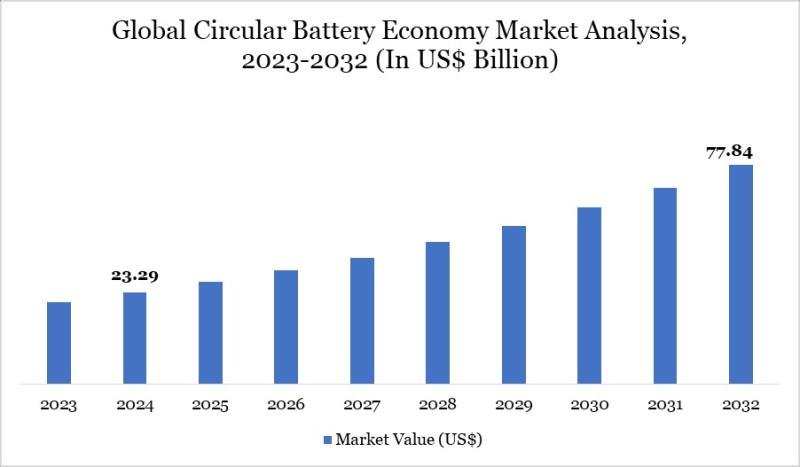
The Circular Battery Economy Market reached US$ 23.29 billion in 2024 and is projected to reach US$ 77.84 billion by 2032, growing at a CAGR of 16.28% during the forecast period 2025 to 2032.
Market growth is driven by the rapid expansion of electric vehicles, renewable energy integration, and increasing demand for lithium ion batteries across mobility, consumer electronics, and energy storage applications. Global battery demand is projected to reach 4.7 TWh and exceed US$ 400 billion in value by 2030, expanding at an annual rate of over 30% from 2022. However, conventional linear battery lifecycles based on extraction, usage, and disposal are creating significant environmental and economic challenges. The circular battery economy addresses these concerns by emphasizing reuse, recycling, second life applications, and sustainable material recovery, reducing landfill waste and improving resource efficiency.
Companies and governments are actively advancing circular initiatives to strengthen supply chain resilience and sustainability. Industry leaders such as Tesla and Northvolt are investing in battery recycling and closed loop production systems. Supportive policy frameworks in countries like Netherlands and Australia are further accelerating adoption. These strategic investments, regulatory support, and technological advancements are collectively transforming the global battery ecosystem toward long term sustainability and industrial innovation.
Get a Free Sample PDF Of This Report (Get Higher Priority for Corporate Email ID):- https://www.datamintelligence.com/download-sample/circular-battery-economy-market?sai-v
The Circular Battery Economy Market focuses on extending battery life cycles through reuse, repurposing, and recycling to maximize resource efficiency, reduce waste, and create a sustainable closed loop energy ecosystem.
Key Developments
✅ February 2026: In Belgium, Umicore expanded its Hoboken battery recycling facility capacity to 150000 tons per year and signed new closed loop supply agreements with European EV manufacturers to supply recovered lithium, cobalt, and nickel back into cathode production.
✅ January 2026: In the United States, Li-Cycle progressed development of its Rochester, New York Hub, targeting processing capacity of 35000 tons of black mass annually, and secured long term feedstock agreements with North American automotive OEMs to strengthen the domestic circular battery supply chain.
✅ December 2025: In China, CATL expanded its battery recycling subsidiary Brunp Recycling, increasing annual recycling capacity beyond 300000 tons, and enhanced its integrated cathode material recovery system to support its closed loop battery manufacturing ecosystem.
✅ November 2025: In Sweden and Germany, Northvolt scaled its Revolt Ett recycling plant toward a 125000 tons per year processing target and integrated recycled nickel, manganese, and cobalt into new cell production at its gigafactories.
✅ October 2025: In Nevada, United States, Redwood Materials expanded its recycling and refining campus with plans to produce 100 GWh equivalent of anode and cathode materials annually using recovered lithium, nickel, and cobalt from end of life batteries.
✅ September 2025: In South Korea, SungEel HiTech increased its global recycling capacity to approximately 200000 tons per year and advanced new facilities in Malaysia and Hungary to strengthen circular battery material recovery across Asia Pacific and Europe.
Key Players
Li-Cycle Holdings Corp. | Redwood Materials Inc. | Umicore SA | Glencore plc | Ascend Elements | Retriev Technologies Inc. | American Battery Technology Company | TES | Battery Resourcers | Ecobat Technologies Ltd. | Others
Buy Now & Unlock 360° Market Intelligence: https://www.datamintelligence.com/buy-now-page?report=circular-battery-economy-market?sai-v
(Single User Report: USD 4350 & One Year Database Subscription: USD 12K)
Market Drivers
Rising adoption of electric vehicles and renewable energy systems increasing demand for lithium-ion battery recycling, reuse, and second-life applications.
Growing concerns over critical raw material supply security including lithium, cobalt, nickel, and graphite driving investments in battery recovery and circular supply chains.
Stringent environmental regulations and extended producer responsibility policies encouraging manufacturers to establish closed-loop battery management systems.
Increasing battery waste volumes from EVs, consumer electronics, and energy storage systems accelerating the need for efficient collection and recycling infrastructure.
Advancements in hydrometallurgical and direct recycling technologies improving material recovery rates and economic feasibility.
Corporate sustainability commitments and carbon reduction targets promoting circular battery ecosystem development.
Government incentives and funding programs supporting battery recycling plants, gigafactories, and domestic raw material independence.
Industry Developments
Expansion of large-scale lithium-ion battery recycling facilities to recover high-purity lithium, cobalt, and nickel for reuse in new battery production.
Strategic partnerships between EV manufacturers, battery producers, and recycling companies to build closed-loop supply chains.
Development of second-life battery applications for stationary energy storage, grid balancing, and backup power systems.
Integration of digital battery passports and traceability platforms to enhance lifecycle tracking and compliance.
Investments in advanced automation and AI-driven sorting technologies to improve recycling efficiency and reduce processing costs.
Collaborations between governments and private players to establish regional battery collection and reverse logistics networks.
Regional Insights
North America – 32% share: “Driven by rapid EV adoption, strong government incentives for domestic battery manufacturing, and expansion of recycling infrastructure.”
Europe – 30% share: “Supported by strict environmental regulations, EU battery directives, and strong focus on circular economy initiatives.”
Asia Pacific – 29% share: “Fueled by large-scale battery production in China, Japan, and South Korea, growing EV penetration, and significant investments in recycling capacity.”
Latin America – 5% share: “Boosted by emerging EV markets, increasing awareness of sustainable mining practices, and gradual development of recycling ecosystems.”
Middle East & Africa – 4% share: “Driven by renewable energy expansion, infrastructure development, and early-stage investments in battery waste management systems.”
Speak to Our Analyst and Get Customization in the report as per your requirements: https://www.datamintelligence.com/customize/circular-battery-economy-market?sai-v
Key Segments
By Battery Type
Lithium ion batteries dominate the market due to their high energy density, longer lifecycle, and strong compatibility with electric vehicles and renewable energy storage systems. Lead acid batteries continue to hold a share in cost sensitive applications, particularly in industrial equipment and backup power systems. Solid state batteries are emerging as a next generation technology, offering enhanced safety, higher energy efficiency, and improved recyclability potential within circular economy frameworks.
By Source
Automotive batteries represent a major source segment, driven by the rapid growth of electric vehicles and hybrid mobility solutions. Industrial batteries contribute significantly, especially from forklifts, grid storage, and telecom infrastructure. Consumer electronics batteries form a growing secondary source due to increasing device turnover rates and expanding e waste recycling initiatives.
By Technology
Mechanical recycling is widely adopted due to its established processes and scalability in recovering valuable metals such as lithium, cobalt, and nickel. Hydrometallurgical technology is gaining preference for its higher recovery efficiency and lower environmental impact compared to traditional smelting methods. Pyrometallurgical processes remain relevant for bulk material recovery, particularly in large scale recycling operations. Direct recycling technologies are emerging as an advanced solution aimed at preserving cathode material structure for improved sustainability and cost effectiveness.
Unlock 360° Market Intelligence with DataM Subscription Services: https://www.datamintelligence.com/reports-subscription
Power your decisions with real-time competitor tracking, strategic forecasts, and global investment insights all in one place.
✅ Competitive Landscape
✅ Sustainability Impact Analysis
✅ KOL / Stakeholder Insights
✅ Unmet Needs & Positioning, Pricing & Market Access Snapshots
✅ Market Volatility & Emerging Risks Analysis
✅ Quarterly Industry Report Updated
✅ Live Market & Pricing Trends
✅ Import-Export Data Monitoring
Have a look at our Subscription Dashboard: https://www.youtube.com/watch?v=x5oEiqEqTWg
Contact Us –
Company Name: DataM Intelligence
Contact Person: Sai Kiran
Email: Sai.k@datamintelligence.com
Phone: +1 877 441 4866
Website: https://www.datamintelligence.com
About Us –
DataM Intelligence is a Market Research and Consulting firm that provides end-to-end business solutions to organizations from Research to Consulting. We, at DataM Intelligence, leverage our top trademark trends, insights and developments to emancipate swift and astute solutions to clients like you. We encompass a multitude of syndicate reports and customized reports with a robust methodology.
Our research database features countless statistics and in-depth analyses across a wide range of 6300+ reports in 40+ domains creating business solutions for more than 200+ companies across 50+ countries; catering to the key business research needs that influence the growth trajectory of our vast clientele.
This release was published on openPR.