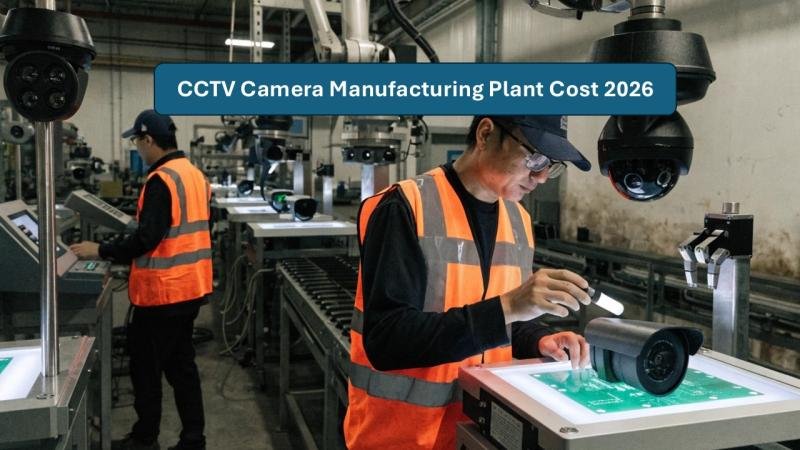
Setting up a CCTV Camera Manufacturing Plant positions investors in one of the most stable and essential segments of the electronics and surveillance value chain, backed by sustained global growth driven by rising security concerns, rapid adoption of smart home technologies, increasing government mandates for public surveillance infrastructure, and the dual-benefit advantages of addressing both residential safety needs and large-scale industrial monitoring requirements. As urbanization accelerates and security demands intensify across residential, commercial, and industrial sectors, the global CCTV camera market escalates toward a projected value of USD 132.30 Billion by 2034, and regulatory frameworks increasingly mandate surveillance system installations in public spaces and transportation infrastructure – the global CCTV camera industry continues to present compelling opportunities for manufacturers and entrepreneurs seeking long-term profitability in a high-demand, technology-driven sector.
Market Overview and Growth Potential
The global CCTV camera market was valued at USD 49.27 Billion in 2025 and is on a powerful upward trajectory. According to IMARC Group estimates, the market is expected to reach USD 132.30 Billion by 2034, exhibiting a CAGR of 11.6% from 2026 to 2034 – one of the strongest growth rates across the electronics and security technology landscape.
Several key forces are driving this expansion. Escalating global security and surveillance demands continue to push adoption across sectors. The integration of artificial intelligence (AI) and motion detection features is transforming CCTV cameras into intelligent monitoring systems. The shift toward cloud-based storage solutions and the growing importance of real-time monitoring are reshaping the market’s technology landscape. Smart home integration is further amplifying consumer-level demand, with the India Brand Equity Foundation reporting that the smart home devices market in India alone is expected to reach INR 1,40,000 crore (USD 16.03 Billion) by 2028, with security devices accounting for approximately 14% of the total market size.
Government regulations are also playing a decisive role – authorities worldwide are increasingly mandating the installation of surveillance equipment at public locations and transportation infrastructures, creating a reliable, policy-backed demand pipeline for manufacturers.
Request for a Sample Report: https://www.imarcgroup.com/cctv-camera-manufacturing-plant-project-report/requestsample
Plant Capacity and Production Scale
The proposed CCTV camera manufacturing facility is designed with an annual production capacity ranging between 500,000 to 2 million units, enabling significant economies of scale while maintaining operational flexibility to serve diverse market segments.
This production range allows manufacturers to serve multiple end-use sectors simultaneously, including residential security, commercial and retail establishments, public safety and law enforcement, industrial monitoring operations, and government and institutional clients. The scalable capacity model ensures that the plant can adapt output levels in response to evolving market demand, providing both production efficiency and commercial resilience across market cycles.
Financial Viability and Profitability Analysis
The CCTV camera manufacturing project demonstrates healthy profitability potential under normal operating conditions. Key financial metrics from the project analysis include:
• Gross Profit Margins: 30-40% – supported by stable demand across multiple end-use sectors and value-added product applications including AI integration, HD resolution, and smart connectivity features.
• Net Profit Margins: 12-20% – reflecting strong operational efficiency potential after accounting for all direct and indirect costs.
The financial projections for the proposed project have been developed based on realistic assumptions related to capital investment, operating costs, production capacity utilization, pricing trends, and demand outlook. These projections provide a comprehensive view of the project’s financial viability, ROI, profitability, and long-term sustainability. By the fifth year of operations, total operational costs are expected to increase due to inflation, market fluctuations, and potential rises in the cost of key materials, though revenue growth from increased capacity utilization is projected to outpace cost escalation under favorable market conditions.
Cost of Setting Up a CCTV Camera Manufacturing Plant:
Understanding the operating expenditure (OpEx) is crucial for effective financial planning and cost management. The cost structure for a CCTV camera manufacturing plant is primarily driven by:
Operating Cost Structure
The operating cost structure of a CCTV camera manufacturing plant is primarily driven by raw material consumption, particularly image sensors, which account for approximately 70-80% of total operating expenses (OpEx). The full OpEx breakdown includes:
• Raw Materials: 70-80% of OpEx – Core inputs include image sensors (CMOS/CCD), lens units, printed circuit boards (PCBs), microcontrollers, connectors, infrared (IR) LEDs, metal/plastic casings, and wiring components. Long-term supplier contracts are essential to mitigate price volatility and ensure supply continuity.
• Utility Cost: 5-10% of OpEx – Covering electricity, water, and other utility requirements essential to the manufacturing and assembly processes.
• Transportation Cost – For inbound raw material logistics and outbound finished product distribution to end markets.
• Packaging Cost – For finished CCTV camera packaging tailored to product type and target market requirements.
• Salaries and Wages – Human resource costs spanning plant operations, assembly, quality control, maintenance, and management functions.
• Depreciation – Accounting for the wear of manufacturing machinery and infrastructure over the plant’s operational lifespan.
• Taxes and Other Expenses – Including regulatory compliance costs, repairs, and maintenance activities.
In the first year of operations, operating costs are projected to be significant. By the fifth year, total operational costs are expected to increase substantially due to inflation, market fluctuations, and supply chain dynamics.
Ask Analyst for Customization: https://www.imarcgroup.com/request?type=report&id=11896&flag=C
Capital Investment Requirements
Establishing a CCTV camera manufacturing plant involves the following key capital expenditure components:
• Land and Site Development Costs – Including land acquisition, boundary development, land registration charges, and site preparation. This forms a substantial part of the overall investment and ensures a solid foundation for safe and efficient plant operations.
• Civil Works Costs – Construction of manufacturing floors, assembly areas, storage facilities, quality control labs, and administrative buildings.
• Machinery and Equipment Costs – The largest single component of capital expenditure. Essential equipment for a CCTV camera manufacturing plant includes:
o SMT (Surface Mount Technology) machines
o PCB assembly lines
o Lens fitting units
o Injection molding machines (for casing manufacturing)
o Soldering equipment
o Testing and calibration equipment
o Packaging and quality control systems
The scale of production and level of automation will determine the total machinery investment. All equipment must comply with industry standards for safety, efficiency, and reliability.
• Other Capital Costs – Covering additional infrastructure including utility systems, energy connections, waste management, and environmental compliance infrastructure.
The timeline to establish and operationalize a CCTV camera manufacturing plant typically ranges from 12 to 18 months, depending on plant scale, equipment procurement timelines, supply chain setup, and regulatory approvals.
Major Applications and Market Segments
CCTV cameras serve a broad and growing range of applications across multiple high-value sectors:
• Residential Security – Homeowners use CCTV cameras to monitor entry points, driveways, and key areas of the home remotely, driven by rising personal safety concerns and smart home integration.
• Commercial and Retail Security – Businesses deploy CCTV systems to monitor premises, detect security breaches, manage customer flow, prevent losses, and ensure employee safety.
• Public Safety and Law Enforcement – Cities and municipalities implement large-scale CCTV networks in public areas to improve safety, monitor traffic, and reduce crime, supported by government mandates.
• Industrial Monitoring – Manufacturing facilities and warehouses use CCTV cameras to monitor production lines, warehouse activities, and employee safety compliance.
• Traffic Monitoring – Deployed across transportation infrastructure to manage traffic flow and support law enforcement.
• Smart Home Integration – Connected CCTV systems operable via smartphones and tablets are driving consumer-level demand as smart home adoption accelerates.
Why Invest in CCTV Camera Manufacturing?
The investment case for CCTV camera manufacturing in 2026 is supported by a convergence of powerful structural trends and commercial advantages.
Increasing Demand for Security: As global concerns over crime and personal safety intensify, the demand for surveillance systems including CCTV cameras continues to grow across residential, commercial, public, and industrial sectors – creating a broad and resilient customer base for manufacturers.
Technological Advancements: The development of high-definition (HD) and IP-based CCTV cameras offering superior resolution and flexible connectivity, combined with the integration of AI and motion detection capabilities, is significantly expanding the product’s value proposition and market reach.
Smart Home Tailwinds: The rapid rise of connected smart home ecosystems is generating strong consumer-level demand for remotely controlled CCTV systems, opening a high-growth retail and e-commerce distribution channel.
Government Mandates: Governments worldwide are increasingly legislating the installation of CCTV cameras in public spaces, transportation infrastructure, and institutional environments – creating a guaranteed, policy-driven demand pipeline independent of private sector cycles.
Cost-Effectiveness and Wider Adoption: Advances in manufacturing and camera design have made CCTV systems more affordable and easier to install, accelerating adoption across a wider range of economic segments and geographies.
Recent Industry Momentum: In June 2025, Honeywell introduced a locally designed and manufactured CCTV camera portfolio in India in partnership with VVDN Technologies, targeting growing demand across government, healthcare, education, transport, and commercial sectors – underscoring the scale of market opportunity for locally manufactured CCTV products.
Break-Even Outlook: Break-even in the CCTV camera manufacturing business typically ranges from 2 to 5 years, depending on production scale, component sourcing costs, technology investment, and market demand. Strong distribution networks and consistent sales volume can help shorten this period significantly.
Buy Now: https://www.imarcgroup.com/checkout?id=11896&method=2175
Industry Leadership
The global CCTV camera industry is served by several major multinational manufacturers operating extensive production capacities across diverse end-use segments. Key players identified in the market include:
• Bosch Security Systems Inc.
• Honeywell Security Group
• Axis Communications AB
• Mobotix AG
• Panasonic System Networks Co., Ltd.
• Geovision Inc.
• Sony Electronics Ltd.
These companies serve end-use sectors spanning residential security, commercial and retail, public safety, industrial monitoring, and government and institutional applications – establishing the commercial benchmarks and competitive landscape that new entrants must navigate strategically
About Us:
IMARC Group is a global management consulting firm that helps the world’s most ambitious changemakers to create a lasting impact. The company provide a comprehensive suite of market entry and expansion services. IMARC offerings include thorough market assessment, feasibility studies, company incorporation assistance, factory setup support, regulatory approvals and licensing navigation, branding, marketing and sales strategies, competitive landscape and benchmarking analyses, pricing and cost research, and procurement research.
Services:
• Plant Setup
• Factoring Auditing
• Regulatory Approvals, and Licensing
• Company Incorporation
• Incubation Services
• Recruitment Services
• Marketing and Sales
Contact Us:
IMARC Group
134 N 4th St. Brooklyn, NY 11249, USA
Email: sales@imarcgroup.com
Tel No:(D) +91 120 433 0800
United States: +1-201971-6302
This release was published on openPR.










