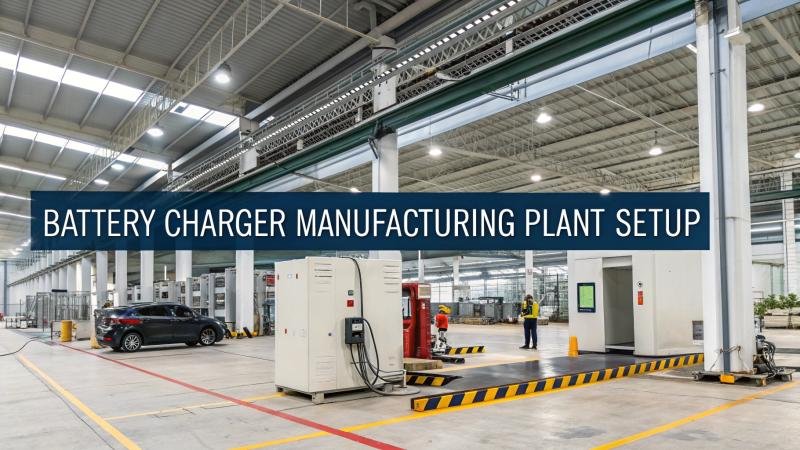
The global battery charger industry stands at the forefront of the electrification revolution, representing a critical enabler positioned at the convergence of consumer electronics proliferation, electric vehicle adoption acceleration, and renewable energy storage expansion.
As rechargeable batteries become increasingly ubiquitous across personal devices, industrial equipment, transportation systems, and energy infrastructure, the demand for efficient, reliable, and intelligent battery charging solutions continues to surge. For entrepreneurs and investors seeking profitable ventures in the electronics manufacturing sector, establishing a battery charger production facility represents a strategically sound decision backed by robust market fundamentals, sustained technological innovation, and expanding application diversity across residential, commercial, and industrial segments.
A battery charger is an electrical device that operates by providing a controlled current and voltage to replenish the energy of rechargeable batteries. Chargers are built to work with different types of batteries such as lithium-ion, lead-acid, nickel-metal hydride (NiMH), and nickel-cadmium (NiCd), hence their compatibility among different applications. Depending on the requirement, chargers vary from basic linear models to sophisticated smart chargers with microcontrollers, overcharge protection, temperature monitoring, and fast-charging features. These devices have found their way into a wide range of applications like consumer electronics, electric vehicles, industrial equipment, renewable energy storage systems, medical devices, and backup power solutions.
IMARC Group’s report, “Battery Charger Manufacturing Plant Project Report 2026: Industry Trends, Plant Setup, Machinery, Raw Materials, Investment Opportunities, Cost and Revenue,” offers a comprehensive guide for establishing a manufacturing plant. The battery charger manufacturing plant setup cost report offers insights into the manufacturing process, financials, capital investment, expenses, ROI, and more for informed business decisions.
The battery charger market is largely driven by rising use of consumer electronics, EVs, renewable energy storage, power tools, and UPS systems, along with favorable government incentives for EV adoption and growing awareness of energy-efficient charging solutions. Efficient and reliable battery chargers are no longer just a convenience but have become a necessity in both everyday and specialized industrial applications as the use of rechargeable batteries continues to grow.
Market Overview and Growth Potential
The global battery charger market demonstrates exceptional growth dynamics and substantial financial scale. The market size was valued at USD 28.04 Billion in 2025, reflecting the significant economic importance and widespread adoption of battery charging solutions across multiple sectors. According to comprehensive market analysis conducted by IMARC Group, the battery charger market is expected to reach USD 40.71 Billion by 2034, representing remarkable expansion opportunities for manufacturers and investors. This growth trajectory is supported by a robust CAGR of 4.2% from 2026 to 2034, indicating sustained market momentum and consistent demand expansion over the forecast period.
Request Sample: https://www.imarcgroup.com/battery-charger-manufacturing-plant-project-report/requestsample
The battery charger industry is undergoing a significant transformation, fueled by emerging trends in electrification, digitalization, and sustainability. The increasing adoption of electric vehicles, renewable energy storage systems, and smart consumer electronics is accelerating demand for efficient, intelligent, and reliable charging solutions. As per the IEA, over 20% of new cars sold worldwide in 2024 were electric, with global sales exceeding 17 million, a 25% rise from 2023.
To satisfy the evolving market expectations, manufacturers are prioritizing compact designs, fast charging, better safety features, and energy efficiency standards compliance. Constant technological innovations such as smart chargers with microcontrollers, temperature monitoring, and adaptive charging protocols are improving performance and user-friendliness. Developing nations are also playing a significant role in growth through their electronic consumption, industrial and residential infrastructure development, and government policies favoring clean energy and EV adoption.
Plant Capacity and Production Scale
The proposed battery charger manufacturing facility is designed with an annual production capacity ranging between 5 – 10 million units, enabling economies of scale while maintaining operational flexibility. This capacity range has been strategically selected to balance capital efficiency with market demand, allowing manufacturers to serve diverse market segments effectively while optimizing production costs and inventory management. The facility’s design enables efficient production across multiple product categories and charger types, addressing varied functional requirements and application needs.
The production facility can manufacture diverse charger types including basic linear chargers offering simple, cost-effective designs for basic applications; smart chargers with microcontrollers featuring sophisticated charging management with overcharge protection, temperature monitoring, and adaptive charging protocols; fast-charging units enabling rapid battery replenishment; multi-chemistry chargers with versatile designs compatible with different battery types including lithium-ion, lead-acid, NiMH, and NiCd; wireless charging solutions providing inductive charging systems for consumer electronics; and industrial charging systems comprising heavy-duty chargers for commercial and industrial battery applications.
Financial Viability and Profitability Analysis
The battery charger manufacturing project demonstrates healthy profitability potential under normal operating conditions, supported by stable demand and value-added applications across multiple end-use sectors. Financial analysis reveals attractive margin structures that make this venture financially compelling for investors seeking sustainable returns in the electronics manufacturing sector.
Gross profit margins typically range between 30-40%, reflecting the value addition achieved through the manufacturing process, product differentiation, and technological capabilities. This solid gross margin provides adequate buffer against component price fluctuations and operational cost variations, while supporting investment in research and development, quality improvement initiatives, and market development activities.
Net profit margins are projected to range between 12-18%, demonstrating strong bottom-line performance after accounting for all operational expenses, depreciation, taxes, and other costs. These net margins compare favorably with other electronics manufacturing segments and indicate robust cash generation potential and financial sustainability. The financial projections for the proposed project have been developed based on realistic assumptions related to capital investment, operating costs, production capacity utilization, pricing trends, and demand outlook, providing a comprehensive view of the project’s financial viability, ROI, profitability, and long-term sustainability.
Speak to an Analyst: https://www.imarcgroup.com/request?type=report&id=9176&flag=C
Operating Cost Structure
The operating cost structure of a battery charger manufacturing plant is primarily driven by raw material and component consumption, which constitutes the overwhelming majority of total operating expenses. Understanding this cost structure is essential for effective financial planning, margin optimization, and competitive positioning.
Raw materials constitute approximately 70-80% of OpEx, representing the dominant cost component in battery charger production. The primary raw materials required for battery charger production include electronic components such as resistors, capacitors, transformers, diodes, integrated circuits (ICs), printed circuit boards (PCBs), plastic or metal casing, wires, and connectors.
Packaging materials and labeling items are also essential, along with quality control components like fuses and thermal protection devices. PCBs, transformers, capacitors, casings, and cables drive the majority of this cost category. Long-term contracts with reliable suppliers help mitigate price volatility and ensure a consistent supply of materials, which is critical for maintaining production continuity and cost predictability in the electronics manufacturing environment.
Utilities account for approximately 5-10% of OpEx, covering electricity, water, and other utility requirements for the manufacturing process. While utilities represent a smaller proportion compared to raw materials, effective energy management and process optimization can yield meaningful cost savings and improve overall operational efficiency.
Capital Investment Requirements
Establishing a battery charger manufacturing plant requires significant capital investment across multiple categories, each playing a critical role in creating a functional, efficient, and compliant production facility.
Land and site development forms a substantial part of the overall investment, including charges for land registration, boundary development, site preparation, and infrastructure establishment. The location must offer easy access to key raw materials such as PCBs, transformers, capacitors, casings, and cables, while maintaining proximity to target markets to minimize distribution costs. The site must have robust infrastructure, including reliable transportation networks, stable utilities, and effective waste management systems, while ensuring compliance with local zoning laws and environmental regulations.
Machinery and equipment account for the largest portion of the total capital expenditure (CapEx). Key machinery required for battery charger manufacturing includes SMT (Surface Mount Technology) lines for automated component placement, wave soldering machines for through-hole component assembly, reflow ovens for solder joint formation, testing benches for quality verification, programming stations for firmware installation, and automated packaging systems for final product preparation. All machinery must comply with industry standards for safety, efficiency, and reliability, while offering appropriate levels of automation to balance productivity with capital efficiency.
Civil works encompass building construction, facility layout optimization, and installation of production infrastructure. The layout should be optimized to enhance workflow efficiency, safety, and minimize material handling while accommodating both SMT and through-hole assembly processes. Separate areas must be designated for raw material storage, production operations, quality control laboratories, and finished goods storage, with adequate space incorporated for future expansion to accommodate business growth and product line diversification.
Other capital costs include pre-operative expenses, utility connections, safety equipment installation, environmental compliance systems, quality assurance infrastructure, and initial working capital requirements to support operations during the ramp-up phase and establish market presence.
Major Applications and Market Segments
Battery charger manufacturing serves diverse applications across multiple end-use sectors, providing manufacturers with opportunities for revenue diversification, market penetration, and risk mitigation through application diversity.
Consumer electronics represents a major market segment, with chargers required for smartphones, laptops, tablets, and wearables, driven by continuous device proliferation and replacement cycles. Electric vehicles constitute a rapidly growing application area, requiring charging units for EV batteries and auxiliary systems, supported by accelerating global EV adoption and infrastructure development.
Renewable energy systems present significant opportunities, with battery charging solutions needed for solar and wind storage applications, aligned with global clean energy transition initiatives. Industrial equipment provides stable demand, as chargers are essential for power tools, forklifts, and machinery across manufacturing, logistics, and construction sectors.
Backup power systems represent a critical application segment, encompassing UPS and inverter battery chargers required for ensuring uninterrupted power supply in commercial facilities, data centers, telecommunications infrastructure, and critical installations. These diverse applications ensure demand stability across economic cycles and provide multiple channels for market entry, expansion, and revenue growth.
Buy Now: https://www.imarcgroup.com/checkout?id=9176&method=2175
Why Invest in Battery Charger Manufacturing?
Several compelling factors make battery charger manufacturing an attractive investment opportunity in the current market environment, supported by structural growth drivers and favorable industry dynamics.
Expanding adoption across industries continues to drive market expansion, as increasing implementation of rechargeable batteries in different sectors including the consumer, industrial, and commercial sectors enhances the need for charging solutions. Strong growth in electric vehicles and renewable energy storage represents a transformational opportunity, as the rise of EVs and renewable energy systems significantly boosts the need for efficient battery charging solutions across residential, commercial, and industrial applications.
Continuous innovation in fast and smart charging technologies creates opportunities for differentiation and premium positioning, as advances in fast-charging, intelligent, and protective charger technologies enhance performance, safety, and user convenience, supporting improved margins and competitive advantage. Scalable manufacturing with automation potential represents a key operational strength, as battery charger production can be scaled efficiently through automation, improving output, consistency, and cost-effectiveness while maintaining quality standards.
High demand for customized and application-specific chargers supports product diversification and market segmentation strategies, as industries increasingly require chargers tailored to specific battery types, capacities, and operational needs, creating opportunities for specialized solutions and value-added offerings. The business model demonstrates resilience and growth potential, supported by fundamental trends in electrification, digitalization, and the global transition toward sustainable energy and transportation systems.
Industry Leadership
The global battery charger industry features several leading manufacturers with extensive production capacities and diverse application portfolios.
• Battery Tender
• Ctek
• Delta-Q Technologies Corp.
• Interstate Batteries
• IOTA Engineering
• Lester Electrical
• Minn Kota
• NOCO
• ProMariner
• Quick USA
All of which serve end-use sectors such as consumer electronics, electric vehicles, renewable energy, industrial equipment, telecommunications, automotive, and power backup systems. These industry leaders set benchmarks for quality, innovation, technological advancement, and operational excellence, while demonstrating the significant scale, market presence, and profitability potential available in this dynamic and growing market.
How IMARC Can Help?
IMARC Group is a global management consulting firm that helps the world’s most ambitious changemakers to create a lasting impact. The company provide a comprehensive suite of market entry and expansion services. IMARC offerings include thorough market assessment, feasibility studies, company incorporation assistance, factory setup support, regulatory approvals and licensing navigation, branding, marketing and sales strategies, competitive landscape and benchmarking analyses, pricing and cost research, and procurement research.
Contact Us:
IMARC Group
134 N 4th St. Brooklyn, NY 11249, USA
Email: sales@imarcgroup.com
Tel No:(D) +91 120 433 0800
United States: (+1-201971-6302
This release was published on openPR.