Automotive Biometric Sensors Market Outlook 2034
Automotive Biometric Sensors Market Outlook 2034
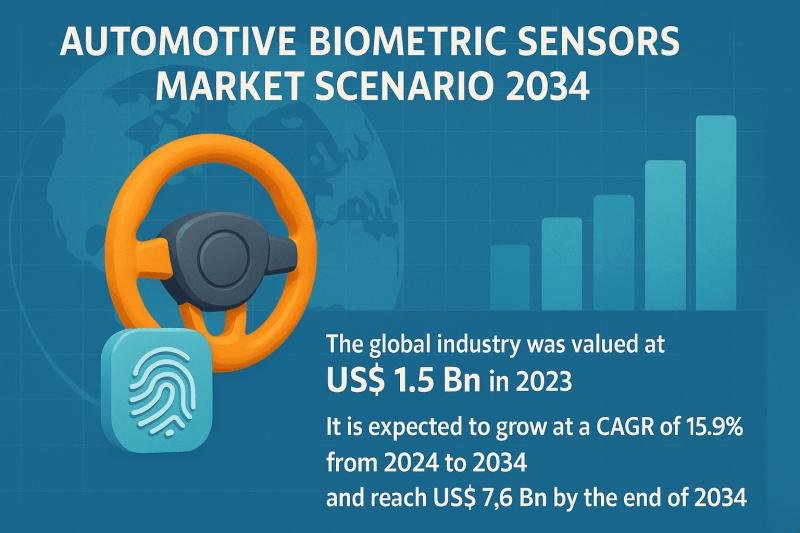
The global automotive biometric sensors market was valued at US$ 1.5 Billion in 2023 and is expected to reach US$ 7.6 Billion by 2034, growing at a strong CAGR of 15.9% from 2024 to 2034. Rising demand for advanced in-vehicle security and personalization features is propelling market growth. Biometric technologies such as fingerprint recognition, facial detection, and iris scanning are increasingly being integrated for secure access and driver monitoring. The surge in connected and autonomous vehicles is further accelerating the adoption of biometric sensor solutions.
🧠 Powering the future of intelligent, secure mobility
👉 Request your sample report copy now @ https://www.transparencymarketresearch.com/sample/sample.php?flag=S&rep_id=86026
Market Overview
Automotive biometric sensors are increasingly integrated into modern vehicles to enable functions such as driver identification, fatigue detection, emotion monitoring, and access control. These sensors use biological data including fingerprints, facial recognition, voice, retina, and heart rate to facilitate real-time insights and personalization.
With the shift toward autonomous and connected mobility, biometric sensors are becoming pivotal for Human-Machine Interface (HMI) in cars. OEMs and Tier 1 suppliers are embedding these sensors in steering wheels, seats, dashboards, and infotainment systems to enable adaptive responses based on driver behavior and physiological state.
Market Description
Biometric sensors in vehicles operate by capturing and analyzing physiological characteristics through technologies such as optical scanning, capacitive sensing, infrared imaging, and ECG-based monitoring. These sensors not only enhance in-car security by enabling biometric-based start systems, but also contribute to road safety by continuously assessing driver health and fatigue levels.
In luxury and high-performance segments, voice recognition and face ID are increasingly replacing traditional keys. In electric and autonomous vehicle platforms, biometric sensors help tailor cockpit settings and drive profiles, adding another layer of intelligence to next-gen mobility.
Analysis of Automotive Biometric Sensors Market Manufacturers
Key players in the automotive biometric sensors market are increasingly pursuing inorganic growth strategies, including partnerships and joint ventures, to establish a strong foothold in the evolving automotive biometric verification landscape. These initiatives aim to enhance in-vehicle security, personalize driver experiences, and support seamless digital transactions.
For example, in May 2022, Dermalog entered into a partnership with Rheinmetall to establish Rheinmetall Dermalog SensorTec GmbH. This new venture is dedicated to developing and supplying cutting-edge biometric technologies to automotive manufacturers. Similarly, in November 2021, Daimler’s Mobility Unit announced a collaboration with Visa to enable fingerprint-based authentication for in-vehicle digital payments, allowing drivers to make purchases securely without PINs or voice commands.
Prominent players covered in the automotive biometric sensors market report include:
• Cognitec Systems
• Continental AG
• Denso Corporation
• EGiS Technologies, Inc.
• EyeLock LLC
• Fingerprint Cards AB
• Flex Ltd.
• Gentex Corporation
• HID Global
• Honeywell International, Inc.
• Iritech, Inc.
• NXP Semiconductors N.V.
• SecuGen Corporation
• Synaptics Incorporated
• Valeo
• Visteon Corporation
• ZF Friedrichshafen AG
These companies are profiled in the report based on their product innovations, integration with ADAS and infotainment platforms, partnerships with OEMs, and revenue performance across regions.
Key Developments in the Automotive Biometric Sensors Market
• January 2022: LG Electronics unveiled a novel biometric authentication system that enables vehicle startup through facial recognition and finger gesture identification. The system employs multiple in-vehicle cameras-one to detect the user’s body parts, and another that dynamically adjusts its viewing angle to accurately capture biometric markers such as the iris, providing a seamless and secure user experience.
• March 2021: The U.S. Patent and Trademark Office (USPTO) published details of a patent filed by Samsung for a fingerprint-based vehicle ignition system. This innovation includes a fingerprint sensor embedded in the vehicle’s steering wheel, which can work in tandem with the driver’s smartphone as a secondary authentication factor, enhancing vehicle security and driver identification protocols.
📌 Get in-depth company analysis and roadmap insights in the sample report copy @ https://www.transparencymarketresearch.com/sample/sample.php?flag=S&rep_id=86026
Key Player Strategies
🔐 Biometric-Driven Vehicle Access
Leading OEMs are adopting facial and fingerprint recognition for seamless entry and engine ignition, replacing traditional key fobs.
🧬 Multimodal Sensor Integration
Suppliers are combining biometric modalities (e.g., face + heart rate) for more accurate and reliable driver profiling.
📈 Personalization Algorithms
AI-powered biometric systems are being used to customize in-car preferences-from seat position to music-based on driver profiles.
🌍 Emerging Market Expansion
Companies are targeting Asia-Pacific and Latin America, where biometric adoption is rising in mid-range vehicles.
🚗 ADAS and DMS Synergies
Biometric sensors are now linked with Advanced Driver Assistance Systems (ADAS) and Driver Monitoring Systems (DMS) to enhance overall safety and comfort.
Challenges
• Privacy & Data Security Concerns: Collecting sensitive biometric data raises concerns around misuse, requiring secure encryption and regulatory compliance.
• High Integration Costs: Embedding sensors into vehicles, especially in entry-level models, remains a financial challenge.
• Technical Limitations: Environmental conditions such as glare, darkness, or heavy facial accessories can impair sensor accuracy.
• OEM Customization Demands: Suppliers must cater to OEM-specific requirements across form factor, power efficiency, and software compatibility.
• Regulatory Hurdles: Differing global data protection laws complicate sensor deployment, especially in GDPR-sensitive regions like Europe.
Opportunities
🎯 Driver Monitoring in Autonomous Vehicles
As AVs become mainstream, in-cabin biometrics will be critical to monitor driver readiness for system handovers and in-transit wellness.
🏙️ Urban Car-Sharing & Fleet Security
Biometric authentication systems offer theft-proof, keyless access in car-sharing and ride-hailing vehicles.
🩺 Health Monitoring Integration
ECG and pulse-based sensors in seats and steering wheels open doors to in-transit wellness checks, making vehicles part of the personal health ecosystem.
📞 Voice Biometric Adoption
Integration of NLP and voice biometrics with infotainment and cockpit controls can reduce distraction and improve user experience.
📦 Aftermarket Installations
Retrofittable biometric modules for security and infotainment upgrades create revenue streams beyond OEM integration.
Market Segmentations
➤ By Sensor Type
• Fingerprint Recognition Sensors
• Facial Recognition Sensors
• Iris and Retina Scanners
• Heart Rate and ECG Sensors
• Voice Recognition Systems
➤ By Vehicle Type
• Passenger Vehicles
• Commercial Vehicles
• Electric & Autonomous Vehicles
➤ By Application
• Driver Identification & Authentication
• Health Monitoring & Fatigue Detection
• Emotion & Behavior Analysis
• In-Car Personalization
• Secure Access Control
➤ By Technology
• Capacitive Sensors
• Optical Sensors
• Thermal Imaging
• Infrared Sensors
• Ultrasonic Sensors
➤ By Region
• Asia-Pacific: Fastest growth due to tech-driven consumers, rising vehicle production, and EV adoption.
• Europe: Emphasis on driver safety regulations and biometric compliance standards.
• North America: Advanced R&D ecosystem and premium vehicle demand driving early adoption.
• Latin America & MEA: Growing use in fleet applications, retrofitting, and security-driven urban mobility solutions.
Why Buy This Report?
✅ Comprehensive Ecosystem Insights
Understand the role of biometric sensors across vehicle security, HMI, and in-cabin safety.
✅ Deep Technology Benchmarking
Compare different biometric modalities and their effectiveness across vehicle environments.
✅ Competitive Intelligence
Assess the leading players’ strategies, innovation capabilities, and regional penetration.
✅ Forward-Looking Analytics
Forecasts up to 2034 help in investment planning, sourcing strategies, and tech roadmaps.
✅ Segment-Specific Growth Pockets
Identify high-growth zones in health-focused biometrics, voice-based interaction, and DMS integration.
💼 Futureproof your automotive strategy with our in-depth market intelligence
👉 Purchase the full report now @ https://www.transparencymarketresearch.com/checkout.php?rep_id=86026<ype=S
Conclusion
The automotive biometric sensors market is at the heart of a revolution in vehicle intelligence and personalization. As mobility moves from mechanical to cognitive, biometric systems will redefine how vehicles interact with humans-seamlessly, securely, and sensitively.
From monitoring driver alertness to unlocking personalized entertainment systems, biometric sensors are enabling a safer, smarter, and more responsive driving experience. Companies that embrace AI-enhanced sensing, secure data frameworks, and modular design are poised to dominate this high-potential market in the years to come.
More Trending Research Reports-
• Automotive Sensors Market – https://www.transparencymarketresearch.com/automotive-sensors-market.html
• Automotive Seats Market – https://www.transparencymarketresearch.com/automotive-seats-market.html
• Southeast Asia Tuk-tuks Market – https://www.transparencymarketresearch.com/southeast-asia-tuk-tuks-market.html
• Automotive Lightweight Materials Market – https://www.transparencymarketresearch.com/automotive-lightweight-materials-market.html
• Automotive Heat Exchanger Market – https://www.transparencymarketresearch.com/automotive-heat-exchanger-market.html
About Us Transparency Market Research
Transparency Market Research, a global market research company registered at Wilmington, Delaware, United States, provides custom research and consulting services. The firm scrutinizes factors shaping the dynamics of demand in various markets. The insights and perspectives on the markets evaluate opportunities in various segments. The opportunities in the segments based on source, application, demographics, sales channel, and end-use are analysed, which will determine growth in the markets over the next decade.
Our exclusive blend of quantitative forecasting and trends analysis provides forward-looking insights for thousands of decision-makers, made possible by experienced teams of Analysts, Researchers, and Consultants. The proprietary data sources and various tools & techniques we use always reflect the latest trends and information. With a broad research and analysis capability, Transparency Market Research employs rigorous primary and secondary research techniques in all of its business reports.
Contact Us
Transparency Market Research Inc.
CORPORATE HEADQUARTER DOWNTOWN,
1000 N. West Street,
Suite 1200, Wilmington, Delaware 19801 USA
Tel: +1-518-618-1030
USA – Canada Toll Free: 866-552-3453
Website: https://www.transparencymarketresearch.com
Blog: https://tmrblog.com
Email: sales@transparencymarketresearch.com
This release was published on openPR.