Artificial Intelligence in Operating Room Market
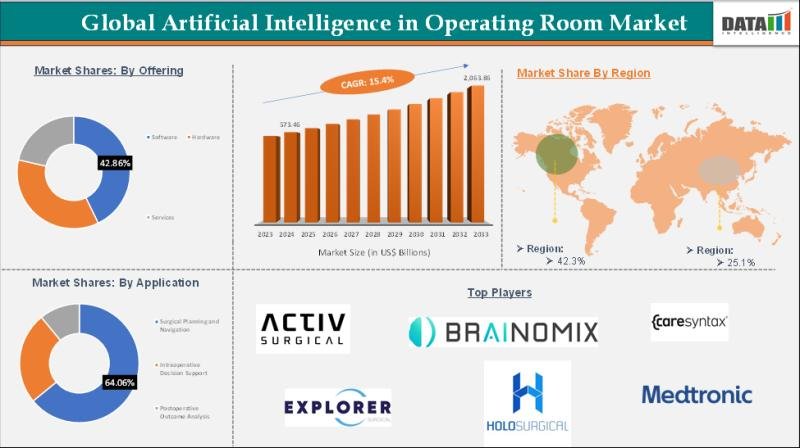
The integration of advanced digital technologies into surgical environments is transforming the way surgeries are performed, monitored, and analyzed. Artificial Intelligence (AI) is playing a critical role in enhancing surgical precision, improving patient outcomes, and optimizing operating room workflows. According to DataM Intelligence, the Artificial Intelligence in Operating Room Market reached US$573.46 million in 2024 and is expected to reach US$2,063.86 million by 2033, growing at a CAGR of 15.4% during the forecast period 2025-2033.
Artificial intelligence technologies are increasingly being integrated into operating rooms to support surgeons through advanced analytics, real-time imaging interpretation, predictive insights, and automated workflow management. These AI-powered solutions assist surgical teams in making faster and more accurate decisions during procedures while improving overall surgical efficiency and patient safety.
As healthcare systems worldwide focus on reducing surgical complications, enhancing clinical outcomes, and improving hospital productivity, the adoption of AI-powered operating room solutions is gaining significant momentum across hospitals, ambulatory surgical centers, and research institutions.
Request Executive Market Briefing: https://www.datamintelligence.com/download-sample/artificial-intelligence-in-operating-room-market?rk
👉 Recent Developments:
✅ October 2025: Medtronic introduced an advanced AI-powered surgical decision support platform designed to assist surgeons with real-time data analysis during complex procedures. The system integrates patient imaging, surgical navigation, and predictive analytics to enhance surgical precision and improve patient outcomes in modern operating rooms.
✅ August 2025: Intuitive Surgical expanded its AI-driven capabilities within robotic-assisted surgery platforms by introducing machine learning algorithms that provide intraoperative guidance and workflow optimization. The upgrade enables surgeons to receive automated insights and procedural recommendations during minimally invasive surgeries.
✅ June 2025: GE HealthCare launched a new artificial intelligence-based operating room analytics solution that monitors surgical workflows, equipment utilization, and patient vitals in real time. The platform helps hospitals improve operating room efficiency, reduce surgical delays, and enhance patient safety through predictive insights.
✅ April 2025: Siemens Healthineers introduced an AI-enabled imaging and surgical planning platform designed to integrate seamlessly with hybrid operating rooms. The solution leverages deep learning algorithms to analyze imaging data and assist surgeons with accurate preoperative planning and intraoperative visualization.
👉 Mergers & Acquisitions:
✅ November 2025: Stryker Corporation acquired a healthcare artificial intelligence startup specializing in surgical workflow optimization to strengthen its digital surgery ecosystem and enhance AI integration within smart operating rooms.
✅ September 2025: Philips Healthcare completed the acquisition of an AI-based surgical imaging analytics company to expand its portfolio of intelligent operating room solutions and improve real-time surgical decision-making capabilities.
✅ July 2025: Johnson & Johnson MedTech acquired a robotic surgery software developer focused on AI-powered surgical assistance systems, aiming to accelerate innovation in data-driven surgical technologies.
✅ May 2025: Zimmer Biomet acquired a digital health company specializing in AI-driven surgical data analytics, enabling enhanced surgical performance monitoring and predictive insights for orthopedic procedures.
👉 Transforming Surgical Procedures with Artificial Intelligence
Operating rooms are among the most complex and high-risk environments within healthcare facilities. Surgical teams must process large volumes of patient data, imaging results, and intraoperative information while performing delicate procedures that demand exceptional precision.
Artificial intelligence technologies help address these challenges by providing intelligent tools capable of analyzing large datasets in real time. AI systems can process surgical imaging, patient health records, and intraoperative data to support surgeons with accurate recommendations and insights during procedures.
For example, AI-powered platforms can analyze medical imaging scans to identify anatomical structures, detect abnormalities, and guide surgeons during minimally invasive procedures. These technologies enhance surgical accuracy and reduce the risk of human error, which ultimately improves patient outcomes.
In addition, AI-driven workflow management tools help streamline operating room operations by coordinating surgical schedules, tracking equipment usage, and optimizing staff allocation. Hospitals adopting AI-enabled operating room solutions can improve efficiency while reducing operational costs.
Request Custom Intelligence Report: https://www.datamintelligence.com/customize/artificial-intelligence-in-operating-room-market?rk
👉 Rising Demand for Intraoperative Decision Support Systems
One of the most significant applications within the Artificial Intelligence in Operating Room Market is intraoperative decision support. These AI-based systems analyze surgical data in real time and provide surgeons with critical insights during procedures.
Intraoperative decision support systems use machine learning algorithms and computer vision technologies to monitor surgical workflows, analyze instrument movement, and identify potential complications. These systems can alert surgeons to deviations from standard procedures or highlight potential risks before they escalate.
Such capabilities are particularly valuable in complex surgical specialties such as neurosurgery, orthopedics, and cardiovascular procedures, where precision and timely decision-making are crucial. By offering predictive insights and contextual recommendations, AI solutions enable surgeons to perform procedures more confidently and efficiently.
Hospitals are increasingly investing in these technologies as they strive to improve surgical outcomes while reducing the incidence of complications and postoperative readmissions.
👉 Advancements in Surgical Planning and Navigation
Artificial intelligence is also revolutionizing surgical planning and navigation, another important application segment within the market. AI algorithms can analyze patient-specific imaging data, including CT scans and MRI images, to create detailed surgical plans tailored to individual patient anatomy.
These systems help surgeons simulate surgical procedures before entering the operating room. By visualizing anatomical structures and potential challenges in advance, surgeons can plan optimal surgical approaches and minimize procedural risks.
AI-powered navigation systems also provide real-time guidance during surgery by overlaying digital imaging data onto live surgical views. This technology helps surgeons accurately locate tumors, blood vessels, and critical structures during minimally invasive procedures.
The adoption of AI-assisted surgical planning is particularly beneficial in complex procedures such as orthopedic joint replacement, neurosurgical tumor removal, and spinal surgeries, where precise navigation is essential.
👉 Postoperative Outcome Analysis Improving Patient Care
Beyond surgical procedures themselves, artificial intelligence is also improving postoperative outcome analysis. AI-powered analytics platforms can analyze surgical data, patient recovery metrics, and clinical outcomes to identify trends and optimize surgical practices.
Hospitals and research institutions use these tools to evaluate surgical performance, monitor complication rates, and develop evidence-based treatment strategies. By analyzing large datasets across multiple procedures, AI systems can identify best practices that improve patient recovery and reduce hospital stay durations.
These insights are also valuable for training surgeons and improving clinical protocols within healthcare institutions. As healthcare systems increasingly adopt data-driven approaches to patient care, AI-powered outcome analysis platforms are becoming essential tools for surgical quality improvement.
👉 Expanding Adoption Across Healthcare Facilities
The adoption of AI technologies in operating rooms is expanding rapidly across various healthcare facilities. Hospitals represent the largest end-user segment due to their high surgical volumes and increasing investments in advanced medical technologies.
Ambulatory Surgical Centers (ASCs) are also adopting AI-powered surgical tools to improve efficiency and handle growing patient demand for minimally invasive procedures. These facilities benefit from AI-driven workflow optimization and decision support systems that help streamline surgical processes.
Specialty clinics and academic research institutes are leveraging AI technologies for surgical innovation, clinical research, and medical training. AI-enabled platforms allow researchers to analyze surgical procedures in detail, identify patterns, and develop new treatment strategies that enhance surgical outcomes.
As global healthcare infrastructure continues to modernize, the integration of artificial intelligence into operating room environments is expected to accelerate significantly.
👉 Competitive Landscape and Industry Leaders
The Artificial Intelligence in Operating Room Market is characterized by strong technological innovation and increasing collaboration between healthcare providers and technology companies. Several key players are actively developing AI-powered surgical solutions designed to enhance precision, efficiency, and patient safety.
Major companies operating in the market include Activ Surgical, Inc., Brainomix Ltd., Caresyntax, Inc., Medtronic, DeepOR S.A.S, ExplORer Surgical Corp., Holo Surgical Inc., Tianjin JingMing New Tech. Devp. Co., Ltd, HANSON MEDITEC CO., LTD, and Huaian Meide Medical Instrument Co., Ltd.
These companies are focusing on developing advanced AI algorithms, surgical visualization platforms, and integrated operating room solutions that support real-time decision-making and data-driven surgical practices.
Many industry leaders are also forming strategic partnerships with hospitals and research institutions to accelerate the development of next-generation AI technologies for surgical applications. Continuous investments in research and development are expected to drive further innovation and expand the capabilities of AI-assisted surgery.
Purchase Corporate License | Market Intelligence: https://www.datamintelligence.com/buy-now-page?report=artificial-intelligence-in-operating-room-market?rk
👉 Market Segmentation Overview
The Artificial Intelligence in Operating Room Market is segmented based on offering, application, and end user.
Based on offering, the market includes software, hardware, and services. Software solutions dominate the segment due to their ability to integrate advanced analytics, imaging analysis, and decision-support tools within surgical workflows.
By application, the market is segmented into surgical planning and navigation, intraoperative decision support, and postoperative outcome analysis. Among these, intraoperative decision support is witnessing rapid growth due to increasing demand for real-time surgical insights and predictive analytics.
In terms of end users, the market includes hospitals, ambulatory surgical centers (ASCs), specialty clinics, and academic & research institutes. Hospitals currently hold the largest market share due to higher surgical volumes and the adoption of advanced operating room technologies.
👉 Strategic Outlook
The future of surgery is increasingly being shaped by artificial intelligence and digital innovation. AI-powered operating rooms have the potential to transform surgical care by improving accuracy, enhancing efficiency, and enabling data-driven clinical decision-making.
As healthcare providers continue to adopt advanced technologies to improve patient outcomes and reduce healthcare costs, the Artificial Intelligence in Operating Room Market is expected to witness strong growth over the coming decade.
Organizations investing in AI-enabled surgical platforms will gain significant advantages in clinical performance, operational efficiency, and patient satisfaction. With continuous advancements in machine learning, computer vision, and real-time analytics, artificial intelligence is poised to become a cornerstone of the next generation of surgical care.
Contact Us –
Company Name: DataM Intelligence
Contact Person: Sai Kiran
Email: Sai.k@datamintelligence.com
Phone: +1 877 441 4866
Website: https://www.datamintelligence.com
About Us –
DataM Intelligence is a Market Research and Consulting firm that provides end-to-end business solutions to organizations from Research to Consulting. We, at DataM Intelligence, leverage our top trademark trends, insights and developments to emancipate swift and astute solutions to clients like you. We encompass a multitude of syndicate reports and customized reports with a robust methodology.
Our research database features countless statistics and in-depth analyses across a wide range of 6300+ reports in 40+ domains creating business solutions for more than 200+ companies across 50+ countries; catering to the key business research needs that influence the growth trajectory of our vast clientele.
This release was published on openPR.