Artificial Intelligence Chipset
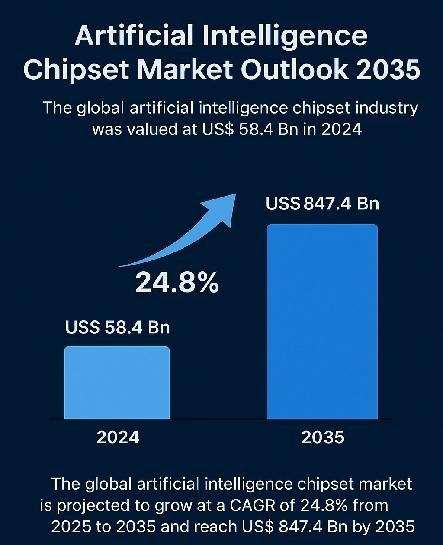
The global artificial intelligence (AI) chipset market is entering a transformative phase as AI technologies become the backbone of next-generation computing, automation, and intelligent decision-making systems. Valued at US$ 58.4 billion in 2024, the market is forecast to expand at an exceptional CAGR of 24.8% from 2025 to 2035, reaching a remarkable US$ 847.4 billion by the end of 2035. The exponential rise of AI adoption across industries such as automotive, healthcare, finance, retail, manufacturing, and telecommunications is driving unprecedented demand for high-performance AI chipsets. These chipsets are powering an era of intelligent machines capable of learning, reasoning, and executing tasks with human-like precision.
Dive Deeper into Data: Get Your In-Depth Sample Now! https://www.transparencymarketresearch.com/sample/sample.php?flag=S&rep_id=44757
AI Chipsets: Powering the Core of Intelligent Systems
Artificial intelligence chipsets serve as the computational engines behind AI algorithms, enabling the processing of massive volumes of data at high speeds with superior energy efficiency. These specialized semiconductors-comprising GPUs (Graphics Processing Units), TPUs (Tensor Processing Units), FPGAs (Field-Programmable Gate Arrays), and ASICs (Application-Specific Integrated Circuits)-are specifically designed to optimize machine learning (ML), deep learning (DL), and neural network operations. AI chipsets have become indispensable for training and inference tasks in data centers, autonomous vehicles, edge devices, and smart consumer electronics.
The demand for these chipsets is being accelerated by the global digital transformation wave, where AI capabilities are being integrated into everyday processes-from predictive maintenance in factories to real-time fraud detection in financial systems. The growing need for faster data processing and reduced latency in AI workloads has made AI chipsets the foundation of modern computing architectures.
Data Explosion and Edge Computing Fueling Growth
The explosive growth of data generated through IoT devices, sensors, and connected ecosystems is a critical factor driving the AI chipset market. It is estimated that global data creation will exceed 180 zettabytes by 2025, making it imperative for organizations to deploy AI-driven analytics at the edge-closer to where data is generated. This has spurred the demand for edge AI chipsets that enable on-device intelligence, reducing dependence on cloud infrastructure and improving real-time decision-making capabilities.
For instance, AI chipsets integrated into autonomous vehicles and drones allow for instant data processing, ensuring split-second responses for navigation and safety. Similarly, in healthcare, edge-based AI devices enable faster diagnostics and remote patient monitoring without relying entirely on cloud connectivity. The synergy between AI and edge computing is redefining operational efficiency across multiple industries and is expected to be a key growth engine for the market through 2035.
Technological Advancements Driving Competitive Innovation
Leading semiconductor manufacturers are engaged in an innovation race to design chipsets with higher processing power, lower energy consumption, and improved scalability. Companies such as NVIDIA, Intel, AMD, Qualcomm, Apple, Huawei, and Google are pioneering the development of AI-optimized architectures that integrate advanced parallel computing and neuromorphic designs.
Recent breakthroughs include NVIDIA’s Blackwell GPU architecture, Intel’s Gaudi accelerators for deep learning, and Google’s TPU v5, which are revolutionizing AI training efficiency. Meanwhile, the emergence of AI accelerators and custom silicon chips designed for specific applications-such as natural language processing (NLP), computer vision, and generative AI-has opened new avenues for innovation.
The shift toward heterogeneous computing, where different chip types work together within a system, is another major trend shaping the industry. This approach allows developers to optimize workloads across CPUs, GPUs, and AI-specific chips, resulting in more efficient performance and cost savings.
Generative AI and Machine Learning Creating Massive Demand
The recent surge in generative AI applications, such as ChatGPT, DALL·E, and Gemini, has drastically increased the need for powerful AI chipsets. These models require extensive computational resources for both training and inference, leading to a boom in demand for data center GPUs and neural processing units (NPUs). Hyperscale cloud providers-including Amazon Web Services (AWS), Microsoft Azure, and Google Cloud-are investing heavily in building AI infrastructure equipped with advanced chipsets to support large-scale machine learning workloads.
Moreover, as enterprises integrate AI-driven automation into operations, the need for custom AI chips optimized for specific industry use cases is growing. From predictive analytics in finance to image recognition in retail, AI chipsets are enabling smarter, faster, and more cost-efficient decision-making.
AI Hardware Democratization: Rise of Consumer and Edge Devices
The integration of AI chipsets is no longer limited to industrial and enterprise-grade systems. The technology has rapidly penetrated the consumer electronics segment, particularly in smartphones, smart home devices, wearables, and personal computers. Chipmakers such as Apple (with its M-series and A-series chips) and Qualcomm (with Snapdragon AI platforms) are embedding AI processing units directly into consumer devices.
These AI-driven devices can perform complex computations-such as image enhancement, speech recognition, and on-device translation-without requiring constant cloud connectivity. The miniaturization of chipsets and their deployment in low-power devices is democratizing AI access, making intelligent technology more mainstream and personal.
Top Companies:
Google
Graphcore
Apple Inc.
Advanced Micro Devices, Inc.
Qualcomm Technologies, Inc.
SK hynix INC.
NVIDIA Corporation
Huawei Cloud Computing Technologies Co., Ltd.
Intel Corporation
IBM Corporation
Mythic
Samsung
Cisco Systems, Inc.
Arm Limited
Fujitsu
Meta
Cerebras
Alibaba Group Holding Limited
To Know more About Report – https://www.transparencymarketresearch.com/artificial-intelligence-chipsets-market.html
Regional Insights: North America and Asia-Pacific Dominate Growth
North America remains the epicenter of AI chipset innovation, driven by strong R&D investments, advanced semiconductor infrastructure, and the presence of global tech giants. The U.S. continues to lead in developing high-performance AI hardware for cloud computing and enterprise applications.
Meanwhile, Asia-Pacific is emerging as the fastest-growing regional market, led by countries such as China, South Korea, Taiwan, and Japan, where semiconductor manufacturing and AI adoption are expanding rapidly. China’s strategic focus on AI self-reliance and massive government funding for chip R&D are accelerating its market position. Europe, too, is witnessing steady growth, supported by government-backed initiatives to enhance semiconductor independence and promote AI adoption across industries.
Challenges: Supply Chain Constraints and Energy Efficiency
Despite its strong growth trajectory, the AI chipset market faces several challenges. Semiconductor supply chain disruptions, geopolitical tensions, and raw material shortages continue to pose risks to production and pricing stability. Furthermore, as AI models become larger and more complex, the energy consumption of data centers is escalating rapidly.
This has prompted a shift toward energy-efficient chip architectures and green AI computing, with companies investing in low-power designs and advanced cooling systems. Balancing computational power with environmental sustainability will remain a key focus for manufacturers in the coming decade.
Future Outlook: Customization, Quantum AI, and Hybrid Architectures
Looking ahead, the next decade will mark a new era of AI hardware evolution. The rise of quantum computing, neuromorphic processors, and 3D chip stacking will redefine the limits of computational power. AI chipsets will become increasingly customized, with application-specific integrated circuits tailored for individual AI workloads-offering greater performance efficiency.
Moreover, the growing convergence of AI, IoT, 5G, and cloud computing will create an interconnected digital ecosystem powered by intelligent hardware. Hybrid AI architectures that combine traditional processing with neuromorphic and quantum acceleration will pave the way for ultra-fast, energy-efficient AI computation.
Explore Latest Research Reports by Transparency Market Research:
Fluorine-18 Market – https://www.transparencymarketresearch.com/fluorine18-market.html
Nuclear Medicine Market – https://www.transparencymarketresearch.com/nuclear-medicine-market.html
Contraceptives Market – https://www.transparencymarketresearch.com/contraceptives-market.html
Equine Healthcare Market – https://www.transparencymarketresearch.com/equine-healthcare-market.html
Health and Wellness Market – https://www.transparencymarketresearch.com/health-and-wellness-market-report.html
About Transparency Market Research
Transparency Market Research, a global market research company registered at Wilmington, Delaware, United States, provides custom research and consulting services. Our exclusive blend of quantitative forecasting and trends analysis provides forward-looking insights for thousands of decision makers. Our experienced team of Analysts, Researchers, and Consultants use proprietary data sources and various tools & techniques to gather and analyses information.
Our data repository is continuously updated and revised by a team of research experts, so that it always reflects the latest trends and information. With a broad research and analysis capability, Transparency Market Research employs rigorous primary and secondary research techniques in developing distinctive data sets and research material for business reports.
Contact Us:
Transparency Market Research Inc.
CORPORATE HEADQUARTER DOWNTOWN,
1000 N. West Street,
Suite 1200, Wilmington, Delaware 19801 USA
Tel: +1-518-618-1030
USA – Canada Toll Free: 866-552-3453
This release was published on openPR.