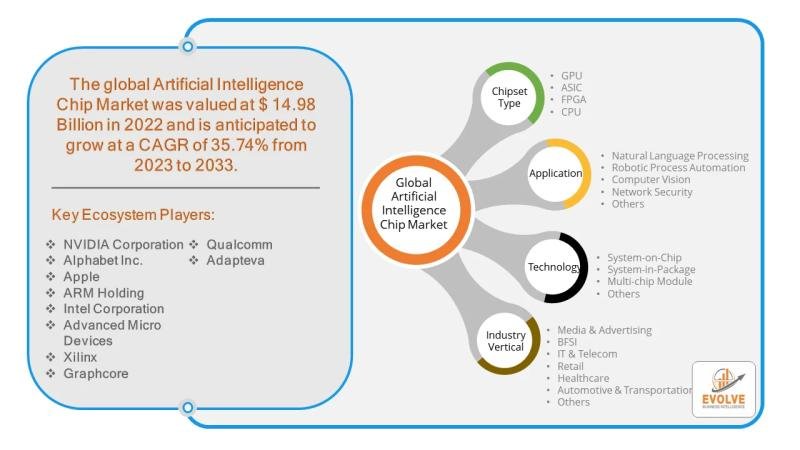
The global Artificial Intelligence (AI) chip market is experiencing explosive growth. According to EvolveBI, the market, valued at $18.33 billion in 2023, is projected to reach $117.07 billion by 2028. However, this rapid expansion comes with significant hurdles that threaten to slow down innovation and create market vulnerabilities. System-in-Package (SiP) technology presents a powerful opportunity to overcome these challenges, offering a path toward a more efficient, secure, and resilient future for AI hardware.
Download the full report now to discover market trends, opportunities, and strategies for success.
https://evolvebi.com/report/artificial-intelligence-chip-market-analysis/
Problems Faced in the AI Chip Market
The AI chip market faces three primary challenges: data privacy, cost, and supply chain volatility.
1. Data Privacy and Security Risks: A major concern for the AI chip market is ensuring the security of the sensitive data processed by these devices. Without robust security measures, vulnerabilities and breaches can compromise user privacy and the integrity of AI systems. Implementing strong encryption and access controls is critical for mitigating these risks.
2. Cost Escalation: The development of AI chips is incredibly expensive, and these costs are further exacerbated by US tariffs on key components. These tariffs, which can add tens of billions of dollars to the cost of AI infrastructure annually, squeeze profit margins for chipmakers and raise prices for end-users. This dynamic can price smaller AI labs and startups out of the market, leading to a dangerous concentration of power and innovation among only the largest tech companies.
3. Supply Chain Disruption: The global AI chip supply chain is heavily reliant on a few key regions, particularly Taiwan, which supplies over 60% of the world’s chips. This concentration makes the market vulnerable to geopolitical tensions and logistical disruptions. Tariffs and export restrictions can lead to shortages of critical components, delaying the deployment of new AI systems and slowing down the overall pace of development.
________________________________________
The System-in-Package (SiP) Solution
System-in-Package technology can be the key to overcoming these formidable challenges. Unlike a traditional System-on-Chip (SoC) where all components are integrated onto a single piece of silicon, SiP integrates multiple dies and passive components within a single package. This approach offers several advantages:
• Improved Security: By encapsulating multiple components in a single package, SiP can create a more secure and tamper-resistant environment, addressing the critical data privacy and security concerns within the industry.
• Cost-Effectiveness: SiP allows for the integration of pre-existing, specialized chips, rather than designing a new, fully integrated chip from scratch. This modular approach can significantly reduce design and manufacturing costs and time, making advanced AI hardware more accessible for a wider range of companies, including startups.
• Supply Chain Resilience: SiP technology promotes a more flexible and diversified supply chain. By sourcing different components from various manufacturers and regions, companies can reduce their dependence on a single source, mitigating the impact of tariffs and supply chain disruptions. This flexibility is crucial for navigating a volatile global market and ensuring consistent access to essential components.
Download the full report now to discover market trends, opportunities, and strategies for success.
https://evolvebi.com/report/artificial-intelligence-chip-market-analysis/
US Tariff Implications on the AI Chip Market
The AI chip market is not immune to the effects of international trade policies, particularly the US’s increasing use of tariffs. While some tariffs are aimed at protecting domestic manufacturing, they can have unintended consequences that ultimately undermine US competitiveness in the AI race. Tariffs on imported semiconductors, servers, and other data center components can dramatically increase the cost of building AI infrastructure, potentially making the US the most expensive place in the world to develop AI.
Major players like Nvidia and AMD have even negotiated revenue-sharing agreements with the US government to secure export licenses for sales to China, effectively a “tax” on their international business. This not only raises costs but also creates long-term uncertainty that makes it difficult for companies to plan and invest. While tariffs could incentivize domestic chip production, they could also accelerate the push for self-sufficiency in other countries, like China, and encourage companies to build their data centers abroad to avoid the elevated costs.
Download the full report now to discover market trends, opportunities, and strategies for success.
https://evolvebi.com/report/artificial-intelligence-chip-market-analysis/
To understand further and explore opportunities in Artificial Intelligence Chip Market or any related industry please share your queries/concern at info@evolvebi.com.
Evolve Business Intelligence
C-218, 2nd floor, M-Cube
Gujarat 396191
India
Email: sales@evolvebi.com
Website: https://evolvebi.com
Evolve Business Intelligence is a market research, business intelligence, and advisory firm providing
innovative solutions to challenging pain points of a business. Our market research reports include data
useful to micro, small, medium, and large-scale enterprises. We provide solutions ranging from mere
data collection to business advisory.
Evolve Business Intelligence is built on account of technology advancement providing highly accurate
data through our in-house AI-modelled data analysis and forecast tool – EvolveBI. This tool tracks real-
time data including, quarter performance, annual performance, and recent developments from
fortune’s global 2000 companies.
This release was published on openPR.