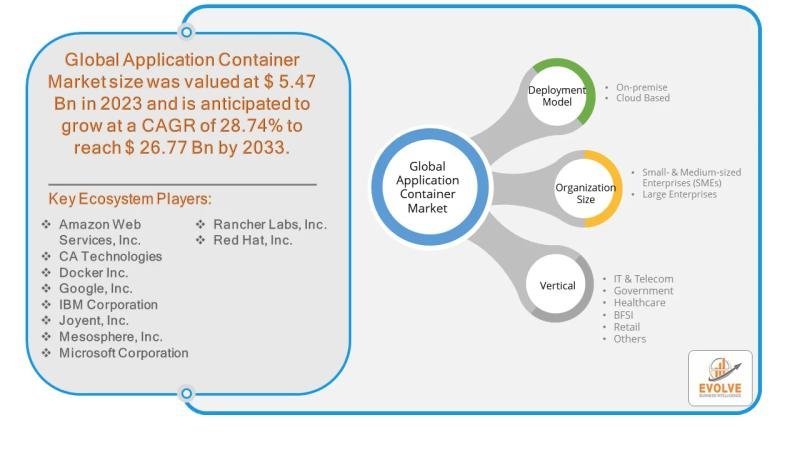
The application container market is experiencing a significant surge, fueled by the demand for agility, scalability, and efficiency in software development and deployment. Valued at an impressive USD 5.47 billion in 2023, the market is on a trajectory to reach USD 26.77 billion by 2033, growing at a robust compound annual growth rate (CAGR) of 28.74%. This rapid expansion is creating high-opportunity avenues, particularly within the cloud-based segment, where containerization is redefining modern application architecture.
Download the full report now to discover market trends, opportunities, and strategies for success.
https://evolvebi.com/report/application-container-market-analysis/
Cloud-Based Opportunities and the Power of Containerization
The integration of containers with cloud infrastructure is proving to be a game-changer. Cloud containers are lightweight software packages that include an application’s code, libraries, and dependencies, enabling them to run quickly and reliably in the cloud. This approach unlocks a host of benefits that drive market growth:
• Simplified Deployment and Portability: Containers allow applications to run on any underlying architecture, as long as the containerization platform is present. This eliminates the need for specific software versions for different operating systems, allowing a single production-grade container to be deployed anywhere, from a developer’s machine to a data center or a public cloud.
• Flexibility and Optimized Resource Use: Cloud instances, available in various configurations, can be spun up or down on demand. This flexibility, combined with containerization, enables organizations to optimize resource use by load-balancing applications across different cloud instances, reducing server and licensing costs.
• Resiliency and Scalability: In a distributed, containerized architecture, if one machine fails, another can quickly spin up the lost containers, enhancing application reliability and availability. Moreover, the distributed nature of cloud containers removes single-server limitations, allowing applications to scale almost infinitely to meet user demands.
Major cloud providers like AWS, Google Cloud, and Azure are at the forefront of this revolution, offering container-as-a-service (CaaS) solutions and orchestration tools like Kubernetes to automate the management and deployment of containerized applications. This widespread adoption is a testament to the immense opportunity that cloud-based solutions present.
Download the full report now to discover market trends, opportunities, and strategies for success.
https://evolvebi.com/report/application-container-market-analysis/
Problems Faced and Proposed Solutions
While the advantages are clear, the application container market is not without its challenges. The primary issues faced by organizations include:
• Security Concerns: Containers share the host machine’s operating system, which can introduce security vulnerabilities. A breach in one container could potentially affect others on the same system, expanding the attack surface for malicious actors.
• Resource Overhead: Despite being more lightweight than traditional virtual machines, containers still have some resource overhead. In high-density deployments, this can impact performance and require careful management to prevent resource contention.
• Integration Challenges: Integrating containerized applications with legacy systems and existing infrastructure can be complex due to insufficient documentation or outdated security standards in older applications.
The industry is actively addressing these issues with a range of solutions:
• Enhanced Security Practices: Implementing robust security best practices, such as regular vulnerability scans, using trusted container images, and following the principle of least privilege, is crucial. This helps to secure the container environment and minimize risks.
• Improved Resource Management: Advanced container orchestration tools and monitoring solutions provide a unified view of resources, allowing for better allocation, real-time performance tracking, and the prevention of bottlenecks.
• Legacy Integration Strategies: Companies are developing new APIs and bridging layers that enable containers to communicate with legacy systems without direct interaction. This approach, exemplified by companies like PayPal, allows for a phased migration and modernization of applications.
US Tariff Implications on the Application Container Market
The global trade environment, marked by recent US tariff policies, presents a complex layer of challenges for the application container market. While direct tariffs on container software itself may not be the primary concern, the broader economic impact on the technology sector is significant. Tariffs on imported goods like computer chips, electronics, and hardware components essential for data centers and cloud infrastructure can increase operational costs for businesses.
This can lead to:
• Increased Hardware Costs: Tariffs on hardware components directly affect the cost of building and maintaining the physical infrastructure that underpins cloud services. This can be passed on to customers, raising the price of cloud computing and containerized services.
• Supply Chain Volatility: The unpredictability of tariffs creates uncertainty and volatility in global supply chains. This can disrupt the procurement of necessary IT equipment, forcing companies to re-evaluate their sourcing strategies and potentially causing delays in infrastructure expansion.
• Shifting Investment Strategies: Companies may respond to tariffs by diversifying their supply chains, investing in domestic production, or shifting their regional warehouses to countries like Canada and Mexico to serve broader markets and avoid US tariff structures.
The ongoing tariff uncertainty underscores the need for businesses in the application container market to adopt flexible and adaptive strategies to mitigate economic risks and ensure operational continuity.
Download the full report now to discover market trends, opportunities, and strategies for success.
https://evolvebi.com/report/application-container-market-analysis/
To understand further and explore opportunities in the Application container market or any related industry please share your queries/concern at info@evolvebi.com.
Evolve Business Intelligence
C-218, 2nd floor, M-Cube
Gujarat 396191
India
Email: sales@evolvebi.com
Website: https://evolvebi.com/
Evolve Business Intelligence is a market research, business intelligence, and advisory firm providing
innovative solutions to challenging pain points of a business. Our market research reports include data
useful to micro, small, medium, and large-scale enterprises. We provide solutions ranging from mere
data collection to business advisory.
Evolve Business Intelligence is built on account of technology advancement providing highly accurate
data through our in-house AI-modelled data analysis and forecast tool – EvolveBI. This tool tracks real-
time data including, quarter performance, annual performance, and recent developments from
fortune’s global 2000 companies.
This release was published on openPR.