IOT Sensors Market
The Internet of Things (IoT) sensors market is poised for significant expansion in the coming years, driven by technological advancements and increasing adoption across various sectors. As smart infrastructure and connected devices become more prevalent, the demand for efficient and versatile sensors is set to rise sharply. Let’s explore the market size projections, key players, emerging trends, and segmentation details shaping this rapidly evolving industry.
Rapid Expansion Expected in the IoT Sensors Market Size by 2030
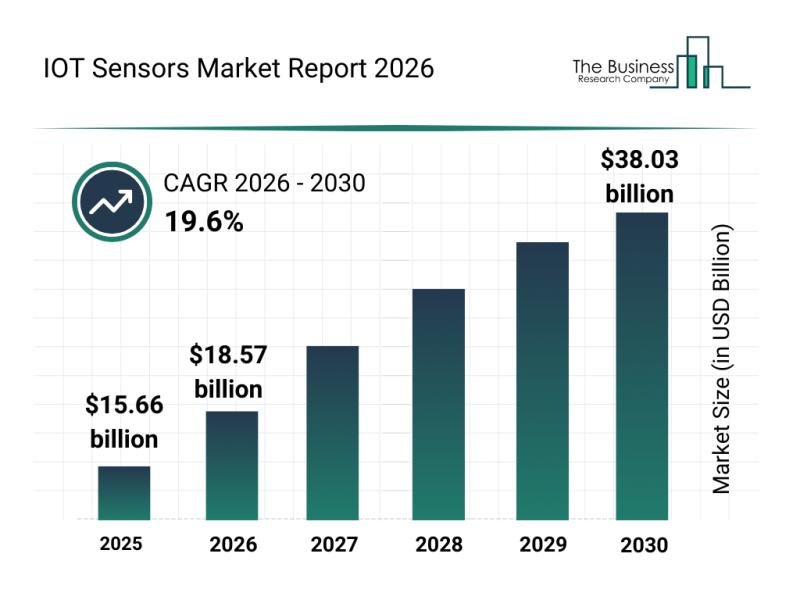
The IoT sensors market is forecasted to experience remarkable growth, reaching a valuation of $38.03 billion by 2030. This surge corresponds to a strong compound annual growth rate (CAGR) of 19.6%. Several factors are contributing to this expansion, including the development of smart city infrastructures, the swift rise of connected and autonomous systems, and an increasing reliance on predictive maintenance solutions. Additionally, the widespread adoption of edge IoT platforms, integration of sensors in healthcare diagnostics, and the growing complexity of sensor applications all play crucial roles in driving the market forward. Key trends during the forecast period will include multi-parameter sensing integrations powered by IoT, real-time analytics connected to cloud platforms, AI-enabled predictive sensing capabilities, energy-efficient sensor designs, and expanding sensor use within autonomous and robotic technologies.
Download a free sample of the iot sensors market report:
https://www.thebusinessresearchcompany.com/sample.aspx?id=2526&type=smp
Top Companies Leading the IoT Sensors Industry Landscape
The IoT sensors market features several dominant players that influence its competitive landscape. These include well-established companies such as Texas Instruments, TE Connectivity, NXP Semiconductors, STMicroelectronics, TDK Corporation, Honeywell International, Sensata Technologies, Broadcom Inc., Bosch, Analog Devices, Siemens AG, General Electric Company, Monnit Corporation, Murata Manufacturing Co., Ltd., Sensirion AG, Silicon Laboratories Inc., ABB Ltd., Schneider Electric SE, Qualcomm Incorporated, Canon Inc., Skyworks Solutions, Inc., Infineon Technologies AG, Omron Corporation, and Intel Corporation.
A notable development in this space occurred in January 2023 when Semtech Corporation, a U.S.-based semiconductor manufacturer, acquired Sierra Wireless for $1.2 billion. This merger combines Semtech’s low-power LoRa technology with Sierra Wireless’s expertise in cellular IoT solutions. The integration aims to create an all-encompassing cloud-to-chip platform that enhances connectivity across a wide range of IoT applications. Sierra Wireless, headquartered in Canada, specializes in modules that integrate seamlessly with sensors to facilitate efficient data transmission to cloud systems.
Emerging Technology Trends Shaping the Future of IoT Sensors
Leading companies in the IoT sensors sector are focusing on the adoption of Bluetooth 6.0 low-energy system-level modules driven by advanced system-on-chips (SoCs). These new modules enhance sensor performance, reduce power consumption, and simplify integration processes. By combining radio and microcontroller unit (MCU) capabilities, these modules support ultra-compact, multi-protocol operations compatible with Bluetooth 6.0, Thread, Matter, and Zigbee standards. This technological advancement enables the creation of smaller, energy-efficient IoT devices with extended battery life.
For example, in September 2025, MinewSemi, a Chinese wireless modules company, introduced ME54BS61 and ME54BS12 Bluetooth 6.0 low-energy modules. Built on Nordic Semiconductor’s nRF54L15 SoC, these modules are designed for space-constrained and ultra-low-power IoT endpoints. They feature compact packaging (with ME54BS61 targeting 6×6 mm designs), multi-protocol 2.4 GHz connectivity, and enhanced on-module processing powered by an Arm Cortex-M33 core. These capabilities allow for local edge processing, lower power consumption, and improved device integration, supporting next-generation IoT sensor applications.
View the full iot sensors market report:
https://www.thebusinessresearchcompany.com/report/iot-sensors-global-market-report
Detailed Segmentation of the Global IoT Sensors Market by Product Type, Application, and Region
This report segments the IoT sensors market into several categories to provide a comprehensive understanding of the industry landscape.
1) By Product Type: The market includes temperature sensors, pressure sensors, humidity sensors, flow sensors, accelerometers, magnetometers, gyroscopes, inertial sensors, image sensors, and other types of sensors.
2) By Application: Usage spans building automation, industrial applications, automotive applications, healthcare, retail and logistics, security, agriculture, and various other fields.
3) By End-user Industry: The primary industries include healthcare, automotive and transportation, manufacturing/industrial, and other end-users.
Further subcategories highlight specifics within each sensor type:
– Temperature sensors encompass thermocouples, resistance temperature detectors (RTDs), thermistors, infrared sensors, and bimetallic sensors.
– Pressure sensors include piezoresistive, capacitive, strain gauge, optical, and resonant types.
– Humidity sensors cover capacitive, resistive, thermal conductivity, and gravimetric technologies.
– Flow sensors involve electromagnetic, ultrasonic, thermal mass, Coriolis, and differential pressure flow meters.
– Accelerometers range from MEMS, piezoelectric to capacitive variants.
– Magnetometers consist of Hall effect, anisotropic magnetoresistive (AMR), and giant magnetoresistive (GMR) sensors.
– Gyroscopes are classified into MEMS, fiber optic, ring laser, and mechanical types.
– Inertial sensors include inertial measurement units (IMUs), MEMS sensors, and fiber optic gyroscopes.
– Image sensors feature CMOS, CCD, and infrared sensors.
– Other product types incorporate gas sensors, proximity sensors, light sensors, pH sensors, and soil moisture sensors.
With these detailed classifications and ongoing technological progress, the IoT sensors market is well-positioned for extensive growth and innovation in the years ahead.
Reach out to us:
The Business Research Company: https://www.thebusinessresearchcompany.com/,
Americas +1 310-496-7795,
Europe +44 7882 955267,
Asia & Others +44 7882 955267 & +91 8897263534,
Email us at info@tbrc.info.
Follow Us On:
LinkedIn: https://in.linkedin.com/company/the-business-research-company,
Twitter: https://twitter.com/tbrc_info,
YouTube: https://www.youtube.com/channel/UC24_fI0rV8cR5DxlCpgmyFQ
Learn More About The Business Research Company
With over 17500+ reports from 27 industries covering 60+ geographies, The Business Research Company has built a reputation for offering comprehensive, data-rich research and insights. Armed with 1,500,000 datasets, the optimistic contribution of in-depth secondary research, and unique insights from industry leaders, you can get the information you need to stay ahead.Our flagship product, the Global Market Model (GMM), is a premier market intelligence platform delivering comprehensive and updated forecasts to support informed decision-making.
This release was published on openPR.