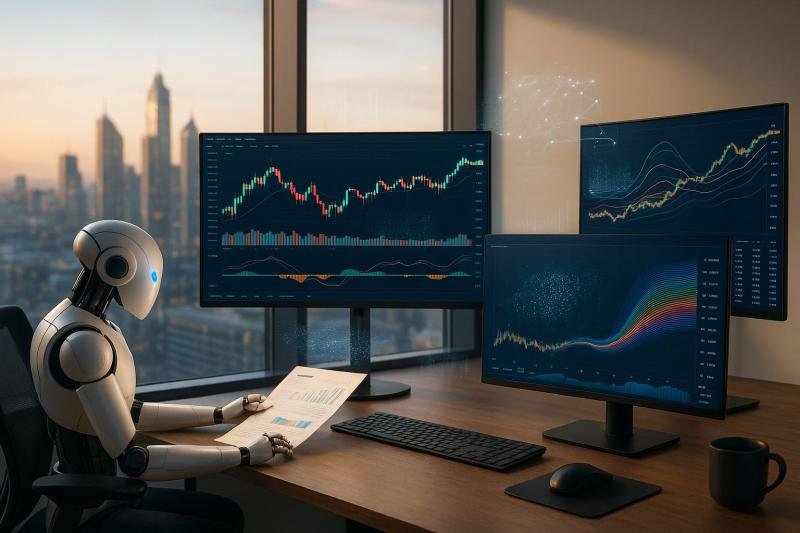
In the past decade, financial markets have undergone an extraordinary transformation. What was once the exclusive territory of institutional brokers and specialists is now a dynamic digital ecosystem accessible to a global audience. A key catalyst behind this evolution is artificial intelligence. AI-powered trading technologies are not just enhancing existing systems-they are fundamentally changing the way financial platforms operate, predict market movements, manage risk, and interact with participants of all kinds.
From automated execution to predictive analytics, AI is redefining financial infrastructure. Its influence spans high-frequency trading firms, institutional asset managers, retail platforms, and emerging markets where digital assets are playing an increasingly important role. As these technologies advance, they promise not only higher efficiency but also greater transparency, accessibility, and resilience in financial markets.
Intelligent Systems and Enhanced Execution
One of the most visible applications of AI in trading technology is improved execution. Traditional trading systems operate on predefined rules or require human intervention, which can be slow or suboptimal in fast-moving markets. AI changes that by processing vast amounts of data in real time and making decisions based on patterns that humans would be unable to identify manually.
Modern platforms increasingly leverage these intelligent capabilities to manage liquidity and match orders more efficiently. For example, OTC desks that facilitate large-volume trades now use machine learning to optimize trade execution. Platforms like https://aexchanger.com/otc integrate advanced analytics to ensure that institutional transactions occur discreetly and at favorable terms, reducing market impact and slippage.
AI-driven execution systems can:
Continuously analyze order books across multiple venues
Detect shifting liquidity conditions
Adapt execution strategies based on market volatility
By reducing latency and enhancing precision, these
technologies make markets more competitive and ensure that trades execute at optimal prices.
Improved execution doesn’t just benefit large institutions. Retail traders also gain from tighter spreads, faster fulfillment, and better price transparency. As AI-powered systems become industry standard, the gap between institutional and retail capabilities continues to narrow.
Predictive Analytics and Market Forecasting
Another major contribution of AI to trading technology is predictive analysis. Financial markets generate enormous volumes of data every second-from price movements and volume spikes to economic news and social sentiment indicators. Traditional statistical models struggle to incorporate such diverse and high-frequency inputs. Machine learning models, on the other hand, are designed to identify subtle correlations and patterns across complex data sets.
These predictive systems do not guarantee perfectly accurate forecasts-no model can. But they do offer probabilistic insights that help traders and portfolio managers make more informed decisions. For instance, predictive analytics can highlight emerging trends before they become evident in price charts, offering valuable context for both short-term tactical decisions and long-term strategic planning.
What’s more, AI models continually improve as they are exposed to new data. Unlike static algorithms, machine learning systems adapt over time, refining their internal models based on outcomes and shifting market dynamics.
Outside traditional asset markets, predictive tools are also influencing broader financial platforms. Investors now use these insights to evaluate digital assets, manage risk, and determine entry or exit points. As a result, predictive technology is playing a major role in the mainstreaming of digital financial solutions.
Accessibility and User Experience
AI doesn’t just optimize backend systems-it also improves how users interact with financial platforms. Intuitive interfaces, personalized recommendations, and automated alerts are increasingly common features driven by intelligent systems. These enhancements reduce barriers for new participants and make financial tools more approachable to a wider audience.
For example, many platforms now provide:
Customized dashboards based on trading behavior
Automated insights tailored to individual risk profiles
These features help users understand complex data without needing specialized expertise.
Moreover, intelligent support systems-such as advanced chatbots and virtual assistants-provide immediate help with questions ranging from technical issues to troubleshooting trades. Such responsiveness builds trust and loyalty among users, especially in high-stress scenarios such as volatile markets.
Risk Management and Security
Risk management is central to financial platforms, and AI significantly strengthens this function. Traditional risk models often rely on historical data and predefined scenarios. While useful, these approaches can lag when market conditions change rapidly.
AI introduces risk management tools that monitor activity at scale, detect anomalies in real time, and respond proactively. For example, if a platform detects unusual trading behavior-such as a sudden spike in orders from unfamiliar locations or patterns that resemble known attack vectors-machine learning systems can flag potential threats instantly. Some systems even trigger automated mitigation actions, such as temporarily restricting certain functions or requiring additional user verification.
These systems also enhance compliance frameworks. In a highly regulated global environment, platforms must track transactions and ensure compliance with requirements across jurisdictions. AI accelerates this process by identifying patterns that suggest non-compliance or suspicious activity, enabling teams to investigate before issues escalate.
Security and risk reduction are not only about preventing loss; they build confidence. As financial services become more digital and interconnected, trust becomes one of the most valuable assets platforms can offer.
Integration Across Financial Services
The impact of AI on trading platforms is not isolated-it’s part of a broader transformation in financial services. Payment networks, lending products, asset management tools, and even insurance services are increasingly integrated with intelligent systems that generate insights and automate decisions.
Platforms like https://aexchanger.com/, while primarily known for exchange services, illustrate how digital financial ecosystems are converging. Users accessing advanced exchange features benefit from AI-driven rate optimization, fraud detection, and dynamic liquidity management. The result is a smoother experience whether someone is trading assets, converting currencies, or managing multi-step processes involving multiple financial instruments.
This integration extends to regulatory technologies as well. Platforms can use AI to automate compliance reporting, ensure transaction transparency, and adapt to evolving legal frameworks faster than manual processes allow. As regulatory pressures grow worldwide, these capabilities become vital for sustainable expansion.
What the Future Holds
As AI continues to evolve, its influence on financial platforms will deepen. We can expect advancements such as:
Autonomous trading systems capable of executing complex strategies without human intervention
Predictive models that incorporate global economic
indicators and alternative data sources like social sentiment
Real-time adaptive compliance engines that adjust to new regulations instantly
Yet as powerful as AI is, human oversight remains critical. Ethical considerations, governance structures, and strategic judgment continue to require human involvement. The most successful platforms will balance machine intelligence with thoughtful human guidance.
AI-powered trading technologies are more than just an upgrade-they are reshaping the entire architecture of financial markets. They enhance efficiency, reduce risk, broaden access, and empower users. In doing so, they redefine what’s possible in global finance, making markets faster, smarter, and more inclusive.
Financial platforms that embrace these innovations are not just keeping up with change-they are helping to define the future of trading.
Company: AEX GROUP LTD
Email: support@aexchanger.com
Phone: +420 730 464 871
Website: aexchanger.com
Address: Rohacova 145/14, Zizkov, 130 00 Praha 3
AEX GROUP LTD
1001408263
ONTARIO, L4W 5A6
2800, Canada
491, 85 Dunstall Hill, Wolverhampton WV6 0SP, UK
I am a guest posting and link-building professional, helping businesses enhance their online visibility through high-quality backlinks. My services are designed to improve search rankings, drive targeted traffic, and support consistent sales growth.
This release was published on openPR.