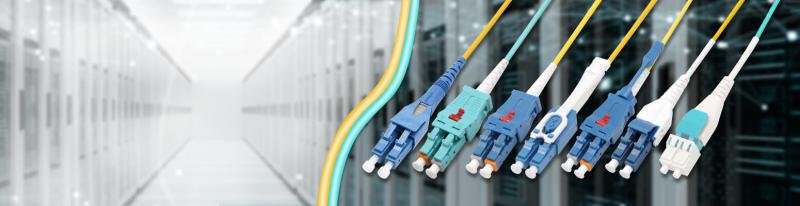
High Performance Uniboot Patch Cord for AI Future Data Center
1. Introduction: AI Is Reshaping Data Center Infrastructure
Artificial intelligence is driving one of the most significant transformations in data center architecture over the past decade. Large language models, generative AI systems, autonomous technologies, and real-time analytics platforms all require enormous computing power and ultra-fast data exchange. As organizations deploy increasingly complex AI workloads, traditional network infrastructures are being pushed to their limits.
Unlike conventional enterprise applications that primarily generate north-south traffic between clients and servers, AI environments produce massive east-west traffic inside the data center. Thousands of GPUs must communicate continuously during distributed training, parameter synchronization, and dataset processing. This shift dramatically increases the demand for high-bandwidth, low-latency optical interconnects.
In this evolving landscape, fiber optic patch cords are no longer simple passive components. They have become critical enablers of AI performance and scalability.
2. AI Clusters and GPU Interconnect Architecture
Modern AI data centers are built around large-scale GPU clusters. These clusters can consist of thousands or even tens of thousands of accelerators installed in tightly packed racks. The efficiency of these systems depends heavily on high-speed communication between GPUs across servers and switching layers.
To support such traffic volumes, operators increasingly deploy spine-leaf or Clos network topologies. These architectures are designed to provide non-blocking bandwidth, low latency, and high port density. However, they also significantly increase the number of optical links required within each rack and across the entire facility.
As port counts grow and link speeds rise, the performance consistency of each fiber connection becomes increasingly important. A single unstable link can affect synchronization efficiency and overall training time, especially in tightly coupled AI workloads.
3. High Bandwidth Requirements: From 400G to 800G and Beyond
The transition from 100G to 400G has already reshaped optical infrastructure. Today, 800G deployments are accelerating, and 1.6T interconnect solutions are under development. Higher data rates rely on advanced modulation schemes such as PAM4, which significantly reduce the margin for signal degradation.
As bandwidth increases, link budgets become tighter. Each connector pair, splice point, and cable segment contributes to total insertion loss. In high-speed environments, even small deviations can affect signal integrity and bit error rates.
This means that the quality of fiber patch cords, including connector geometry and polishing accuracy, directly influences overall network stability. AI data centers operating at 800G speeds cannot tolerate inconsistent optical performance.
4. Why Low Insertion Loss Is Critical in AI Environments
AI clusters demand predictable and stable connectivity. In high-density deployments, insertion loss and return loss are no longer minor technical specifications; they are operational factors.
Low insertion loss helps preserve signal strength across multiple connection points. Stable return loss reduces reflection and interference, which becomes increasingly important at higher data rates. As optical modules operate closer to their performance limits, maintaining tight tolerances across thousands of links is essential.
Achieving this level of consistency depends on manufacturing precision (https://www.fibermanialink.com/) . Connector alignment accuracy, fiber end-face geometry, and polishing quality all influence optical performance. The cumulative effect of small inconsistencies across large-scale AI clusters can become significant.
5. High-Density Cabling Challenges in AI Data Centers
AI infrastructure introduces new physical and thermal constraints. Rack space is limited, airflow must be carefully managed, and cable routing paths are often crowded. High-density optical modules increase the number of fiber connections per rack, complicating cable management.
In such environments, fiber solutions must support tight bend radii without compromising signal quality. Bend-insensitive fiber technology and optimized connector designs help maintain performance under constrained routing conditions. Additionally, consistent termination quality reduces troubleshooting time and simplifies maintenance in complex AI facilities.
As data centers continue to scale vertically and horizontally, fiber infrastructure must balance density, durability, and signal integrity.
6. Manufacturing Precision: The Hidden Driver of Network Stability
In AI data centers, optical reliability begins long before deployment; it starts in the production process. The stability of high-speed links depends on disciplined and repeatable manufacturing procedures.
Processes such as controlled fiber stripping and cleaning, accurate connector alignment, automated curing, multi-stage polishing, and detailed end-face inspection directly determine insertion loss and return loss performance. Small deviations in alignment or polishing geometry can result in measurable signal degradation, especially at 800G speeds.
Understanding how disciplined production workflows contribute to performance consistency is essential when evaluating optical connectivity solutions. Further insight into structured production methods and testing practices can be found through this overview of manufacturing process and quality assurance standards: (https://www.fibermanialink.com/quality-guarantee/)
By maintaining consistency in optical parameters and mechanical durability, carefully controlled manufacturing processes help reduce the risk of unexpected downtime in high-value AI infrastructure.
7. The Future Outlook: Optical Connectivity in the Age of AI
The growth of AI shows no signs of slowing. As model sizes expand and inference workloads spread globally, demand for higher bandwidth and greater interconnect density will continue to rise. 800G is rapidly becoming mainstream in advanced deployments, and 1.6T technology is emerging on the horizon.
Future AI data centers will require tighter loss budgets, greater connector density, and improved thermal efficiency. Fiber optic patch cords will play a central role in enabling these advancements. Rather than being treated as simple accessories, they must be recognized as performance-critical components within a highly optimized ecosystem.
As AI infrastructure evolves, the demand for low-loss, high-precision, and high-density fiber connectivity will grow in parallel. Reliable optical interconnect solutions will remain foundational to the scalability, efficiency, and stability of next-generation AI data centers.
3F, Building A2, Yinlong Industrial Park, Longdong, Longgang District,
FiberMania is a leading manufacturer of high-quality fiber optic patch cords and related products. Specializing in OEM and ODM services, FiberMania offers custom solutions, including private label production, precision assembly, and strict quality control to meet the demands of data centers, telecom networks, and enterprise applications. With years of experience in optical connectivity, FiberMania combines advanced manufacturing processes with reliable performance, helping clients worldwide deploy stable and high-speed fiber networks.
This release was published on openPR.