In 2026, AI search platforms are reshaping how customers discover businesses. Instead of navigating traditional search results, users are now asking questions directly to tools like ChatGPT and Gemini, which instantly generate summaries and brand recommendations. This shift has created a critical challenge for brands: without monitoring, it’s increasingly difficult to know how AI systems are interpreting their business and how they compare with competitors.
That’s why AI search monitoring has become essential. Brands must track how often they are mentioned, what AI says about them, and which sources influence those answers. Without monitoring, errors and gaps can quietly reduce visibility across markets and locations.
For multi-location businesses, the impact is even greater. One data issue can affect hundreds of locations at once, making monitoring the foundation for staying visible and competitive.
This blog reviews five of the best AI search monitoring tools for 2026 and explains why platforms like Birdeye go beyond monitoring to help brands act on what they learn.
What to look for in an AI search monitoring software?
When evaluating AI search monitoring tools, focus on capabilities that help you understand and respond to AI-driven visibility:
●AI mention tracking: You should be able to see how often your brand appears in AI-generated answers and which platforms mention you.
●Competitive benchmarking: Monitoring is more useful when you can compare your visibility against competitors across locations or topics.
●Citations and sources: Good tools show which websites, listings, and content influence AI-generated answers so you know what shapes visibility.
●Accuracy monitoring: AI systems rely on structured data, so tracking incorrect or missing information is critical for staying visible.
●Scalability and reporting: Enterprise teams need dashboards and reports that work across many locations without manual effort.
The best tools help teams spot issues early and decide where to take action, not just collect data.
Top 5 AI search monitoring tools for 2026
1. Birdeye Search AI
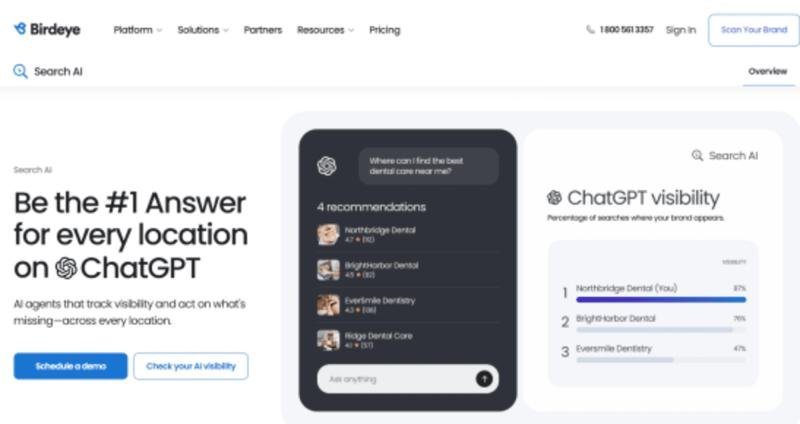
Birdeye Search AI https://birdeye.com/search-ai/ helps enterprise and multi-location brands monitor how AI search platforms reference their business across locations. It tracks how often brands appear in AI-generated answers like ChatGPT, Perplexity, and Gemini, how visibility changes over time, and how performance compares to competitors, giving teams a clear view of how AI systems interpret their brand at scale.
Search AI also reveals what shapes AI responses. Teams can see which websites and listings influence AI answers, how accurately AI platforms present business information, and how AI describes their brand through sentiment and recurring themes. This makes it easier to identify issues that quietly reduce visibility before they impact multiple locations.
Core Search AI capabilities
●Generative visibility monitoring: Track brand and location mentions across AI-generated answers and benchmark against competitors.
●Citation and source insights: Identify the websites and listings AI engines rely on when forming answers.
●Business data accuracy monitoring: Detect incorrect or missing information that can affect AI visibility.
●Sentiment and message analysis: Understand how AI describes your brand, including tone and recurring themes.
●Location-level reporting: Monitor visibility trends across regions and individual locations.
●Actionable recommendations: Surface prioritized issues that can be addressed through connected AI agents.
Birdeye AI agents that keep your answers accurate at scale
●Listings AI Agents fix inaccurate or missing data across maps and directories.
●Reviews AI Agents help generate and respond to reviews at scale to strengthen trust signals.
●Social AI Agents support consistent content publishing and engagement to reinforce relevance.
Why Birdeye stands out
Birdeye is the #1 agentic marketing platform built for multi-location and enterprise brands that need control over how AI systems represent their business. It brings listings, reviews, customer interactions, and location data into a single platform, then uses AI agents trained on each brand and industry to keep information accurate and consistent wherever AI looks for answers.
Trusted by the biggest brands globally, Birdeye integrates with over 3,000 CRM, POS, and operational systems. This makes it easy for large teams to monitor AI visibility and act on issues without disrupting existing workflows.
Best fit: Multi-location and enterprise brands that need a single platform for AI search monitoring, execution, and governance at scale.
G2 ratings: 4.7/5 (3,800+ reviews)
2. Profound
Profound is an AI search intelligence platform designed to help brands understand how they are referenced by generative AI systems. It focuses on analyzing AI-generated answers, citations, and sentiment so teams can see how AI models interpret their brand and how that perception changes over time. Profound is built primarily for insight and analysis, not execution.
Key features
●Tracks brand mentions and visibility across AI-generated search results
●Identifies citations and sources that influence AI answers
●Analyzes sentiment and recurring themes in AI-generated brand descriptions
Best for: Businesses that need deep visibility and competitive insights into AI search, but do not require automated execution or agent-led fixes.
G2 rating: 4.6/5 (153 reviews)
3. Nudge AI
Nudge is an AI discovery intelligence platform focused on helping brands understand how their products and content appear in AI-driven shopping and discovery experiences. It is especially useful for teams that want visibility into how AI assistants surface products, categories, and brand recommendations during purchase-related queries.
Key features
●Tracks brand and SKU mentions in AI-generated answers
and identifies where visibility is occurring or lacking
●Provides insights into which prompts and sources influence AI discovery of products and services
●Helps teams build adaptive shopping and content experiences based on AI visibility trends
Best for: Product and marketing teams that want insight into AI-driven product discovery, but do not need enterprise-level execution or automation.
G2 rating: 4.5/5 (10 reviews)
4. Scrunch
Scrunch is an AI search optimization and monitoring platform that helps brands understand how they appear across generative AI engines. It focuses on tracking brand mentions, visibility trends, and competitive positioning in AI-generated answers, helping teams measure how often and how favorably they are represented by AI systems.
Key features
●Tracks brand mentions and visibility patterns across major AI platforms such as ChatGPT, Gemini, Perplexity, and more.
●Identifies key prompts, citations, and sources that influence how AI search engines reference a brand.
●Provides insights into sentiment, positioning, and trends in how AI describes a brand relative to competitors.
Best for: Teams focused on understanding and benchmarking brand visibility in AI search environments that need detailed monitoring and insight reports.
G2 rating: 4.6/5 (55 reviews)
5. BrandLight
BrandLight is an AI brand visibility platform that helps companies measure and understand how their brand is represented across AI-generated search and answer engines. It focuses on cross-engine monitoring, showing how brands are referenced, compared, and cited across different AI platforms.
Key features
●Monitors brand mentions, citations, and visibility trends across major AI engines and generative search platforms.
●Provides insight into which sources and prompts influence AI-generated answers and visibility patterns.
●Offers sentiment and share-of-voice analysis to help teams understand how AI systems describe and compare brands.
Best for: Marketing and analytics teams that need cross-engine AI visibility insights without automated execution.
G2 rating: 4.6/5 (5 reviews)
How to choose the right AI search monitoring tool
The right AI search monitoring tool should match the complexity of your business and what you plan to do with the insights it provides. Some teams need visibility into how AI systems reference their brand, while others need monitoring that directly drives action.
When evaluating tools, consider the following:
●Depth of monitoring: Can you track mentions, sentiment, citations, and visibility trends across AI platforms?
●Competitive context: Does the tool show how you compare to competitors across markets or locations?
●Ability to act on insights: Can issues be fixed automatically, or will your team need manual workflows?
●Scalability: Does the tool support hundreds or thousands of locations without added overhead?
●Governance and reporting: Are there controls, dashboards, and integrations that work for enterprise teams?
The best tool is one that not only shows how AI sees your brand today but also helps you improve how you are represented tomorrow.
Final Thoughts: Monitoring is only the starting point
AI search has changed how brands are discovered. Today, businesses need to know how often they appear in AI-generated answers, how AI describes them, and which sources influence those results. Monitoring these signals is essential, but it’s only the starting point.
Birdeye stands out as the best option for multi-location brands among the tools mentioned in this list because it connects visibility insights directly to action. It helps teams fix inaccurate data, strengthen trust signals, and keep every location consistently represented across AI-driven discovery channels.
For enterprises managing hundreds or thousands of locations, this is critical. Birdeye provides the control, automation, and scale needed to manage AI visibility as an ongoing business function. As AI search continues to evolve, brands using platforms like Birdeye are better positioned to stay visible, trusted, and chosen wherever AI influences customer decisions.
491, 85 Dunstall Hill, Wolverhampton WV6 0SP, UK
I am a guest posting and link-building professional, helping businesses enhance their online visibility through high-quality backlinks. My services are designed to improve search rankings, drive targeted traffic, and support consistent sales growth.
This release was published on openPR.