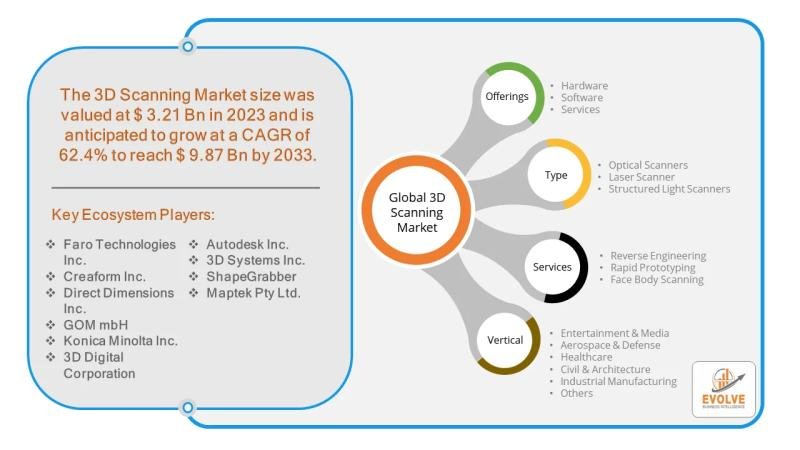
The 3D scanning market is experiencing rapid growth, with the global market size projected to reach over $7 billion by 2034. While laser scanners have historically held a dominant market share, optical scanners are emerging as a high-opportunity segment. Their rapid growth is fueled by their affordability, user-friendliness, and ability to provide high-resolution data through non-contact scanning. This makes them particularly appealing for industries like healthcare and entertainment.
Download the full report now to discover market trends, opportunities, and strategies for success.
https://evolvebi.com/report/3d-scanning-market-analysis/
Problems Faced and Proposed Solutions
Despite its growth, the 3D scanning industry faces several challenges, including:
• Cost and Accessibility: High-precision 3D scanners can be expensive, often ranging from tens of thousands of dollars, which acts as a major barrier to adoption for small and medium-sized enterprises (SMEs).
• Material Constraints: Traditional optical scanners struggle to accurately capture data from shiny, transparent, or black surfaces due to light reflection and absorption issues.
• Data Processing and Volume: High-resolution scans generate massive amounts of data, requiring expensive, high-performance computers and advanced software for processing.
• Complex Geometries: Scanning objects with intricate details, deep cavities, or occluded areas is challenging and time-consuming, as it requires multiple scans and significant post-processing.
A solution lies in the development of more advanced, hybrid systems that combine different scanning technologies. These systems, along with improvements in sensor technology and AI-driven software, can overcome the limitations of single-method scanners. For instance, specialized vanishing sprays can be used on difficult surfaces to make them scannable without leaving residue. Moreover, a shift towards cloud-based data processing and on-demand manufacturing services (MaaS) can significantly reduce the need for costly in-house hardware and expertise, making 3D scanning more accessible and cost-effective for a wider range of users.
Download the full report now to discover market trends, opportunities, and strategies for success.
https://evolvebi.com/report/3d-scanning-market-analysis/
US Tariff Implications on the 3D Scanning Market
The recent implementation of tariffs, particularly on imported goods from countries like China and the EU, presents a dual-edged sword for the US 3D scanning and 3D printing markets.
Negative Impacts:
• Tariffs have increased the cost of imported 3D scanning equipment and components by up to 20-30%.
• This has led to price inflation for end-consumers and may slow down the adoption of this technology, especially among budget-conscious SMEs and educational institutions.
• It also disrupts global supply chains, forcing companies to find new suppliers.
Positive Impacts:
• The increased cost of imported goods incentivizes companies to invest in domestic manufacturing and sourcing. This could lead to a growth in US-based production of 3D scanning hardware and components.
• Tariffs also highlight the value of localized production through on-demand manufacturing and 3D printing. By producing parts in-house, companies can bypass import duties, reduce shipping times, and create a more resilient supply chain.
Ultimately, while the tariffs pose a challenge, they are also encouraging domestic innovation and a shift toward more agile, in-house manufacturing models, creating new opportunities for the 3D scanning industry within the United States.
Download the full report now to discover market trends, opportunities, and strategies for success.
https://evolvebi.com/report/3d-scanning-market-analysis/
To understand further and explore opportunities in the 3D Scanning Market or any related industry, please share your queries/concerns at info@evolvebi.com.
Evolve Business Intelligence
C-218, 2nd floor, M-Cube
Gujarat 396191
India
Email: sales@evolvebi.com
Website: https://evolvebi.com
Evolve Business Intelligence is a market research, business intelligence, and advisory firm providing
innovative solutions to challenging pain points of a business. Our market research reports include data
useful to micro, small, medium, and large-scale enterprises. We provide solutions ranging from mere
data collection to business advisory.
Evolve Business Intelligence is built on account of technology advancement providing highly accurate
data through our in-house AI-modelled data analysis and forecast tool – EvolveBI. This tool tracks real-
time data including, quarter performance, annual performance, and recent developments from
fortune’s global 2000 companies.
This release was published on openPR.