3D CAD Software Market
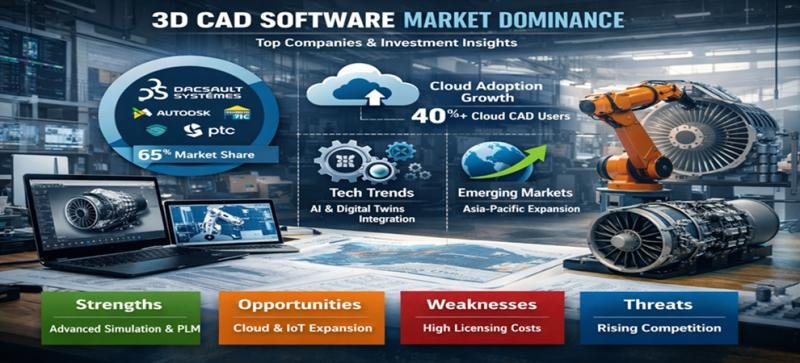
The 3D CAD software market remains a linchpin for product development and engineering workflows across industries such as automotive, aerospace, consumer electronics, industrial machinery, and construction. As organizations globally intensify their digital transformation efforts, 3D CAD tools have evolved from standalone drafting utilities to integrated platforms supporting simulation, collaboration, and data management. This strategic analysis examines the top companies shaping the 3D CAD landscape, provides a consolidated SWOT analysis for leading players, and identifies the most compelling investment opportunities and trends within the market.
➤ Request Free Sample PDF Report @ https://www.researchnester.com/sample-request-8402
Top Companies & Their Strategies
The 3D CAD software market features a mix of long‐established incumbents and rapidly emerging challengers. These companies differentiate themselves through innovation, industry focus, regional reach, and strategic partnerships.
Dassault Systèmes
A pioneer in 3D CAD software, Dassault Systèmes’ flagship product CATIA continues to dominate industries requiring advanced surface modeling and systems engineering, such as aerospace and automotive. The company’s 3DEXPERIENCE platform integrates CAD with simulation, data management, and collaboration tools, positioning it as a holistic solution provider. Dassault’s regional strength in Europe and partnerships with major OEMs underscore its market leadership. Its focus on scalable cloud solutions expands accessibility to mid‐size manufacturers.
Autodesk
Autodesk is a leader in the 3D CAD software market with solutions like Fusion 360 and Inventor, appealing to both enterprise and small‐medium business segments. Autodesk’s strategy emphasizes cloud‐native development and subscription‐based licensing, reducing upfront investment barriers for users. The company effectively targets makers, startups, and educational institutions, bolstering future user adoption. Autodesk’s interoperability across design and construction workflows strengthens its position in the AEC (Architecture, Engineering, Construction) space.
PTC
PTC’s Creo portfolio anchors its presence in the 3D CAD software market with a strong focus on parametric design and scalability for complex assemblies. PTC’s competitive edge lies in its early integration of Internet of Things (IoT) insights and augmented reality (AR) visualization. Strategic alignment with PLM (Product Lifecycle Management) workflows enhances end‐to‐end product development capability. PTC’s diverse customer base, especially in heavy machinery and industrial automation, demonstrates its broad market appeal.
➤ Get deeper insights into competitive positioning and strategic benchmarking: Download our sample 3D CAD Software Market report here → https://www.researchnester.com/sample-request-8402
Siemens Digital Industries Software
Siemens competes aggressively in the 3D CAD software market through NX and Solid Edge, enabling design excellence across industries with advanced simulation and digital twin support. Siemens’ strength is its strong footprint in industrial automation and digital manufacturing, linking CAD with production execution systems. Its emphasis on data continuity and closed‐loop engineering positions Siemens as a strategic partner for smart factory initiatives. Regional penetration in Europe and North America remains significant, though software modularity makes it adaptable worldwide.
Hexagon AB
Hexagon’s acquisition and development strategy has strengthened its position in 3D CAD and metrology software. Solutions such as MSC Software and integration with manufacturing execution systems support simulation and additive manufacturing workflows. Hexagon’s competitive advantage includes strong synergies between CAD, quality measurement, and plant design. The company leverages cross‐industry data analytics to enhance design‐to‐manufacturing traceability.
Bricsys (Hexagon subsidiary)
Bricsys, now part of the Hexagon portfolio, offers BricsCAD – a versatile 3D CAD platform compatible with DWG standards and appealing to cost‐conscious segments. BricsCAD’s strategy centers on flexibility, customization through APIs, and integration with BIM and mechanical design. This value proposition draws small engineering firms and design studios that require 3D CAD capabilities without premium licensing costs. Bricsys continues to expand its ecosystem through third‐party add‐ons and developer support.
Onshape (PTC)
As a cloud‐native 3D CAD solution, Onshape distinguishes itself in the 3D CAD software market with real‐time collaboration, version control, and remote accessibility built into the core product. Onshape’s subscription model aligns with distributed engineering teams and early‐stage companies that prioritize cloud workflows. The solution’s tight integration with data management reduces IT overhead and accelerates design iterations. Onshape’s collaborative focus attracts teams working across multiple geographies.
Siemens Solid Edge
Though part of Siemens Digital Industries Software, Solid Edge merits attention as a separate competitive force due to its synchronous technology that combines parametric and direct modeling. This hybrid approach accelerates design changes and enhances flexibility for manufacturers with complex part geometries. By catering to mid‐sized enterprises with scalable modules, Solid Edge remains a strategic offering within the 3D CAD software landscape.
➤ View our 3D CAD Software Market Report Overview here: https://www.researchnester.com/reports/3d-cad-software-market/8402
SWOT Analysis
Below is a consolidated SWOT analysis highlighting strengths, weaknesses, opportunities, and threats relevant to leading companies within the 3D CAD software market.
Strengths
Leading 3D CAD companies benefit from established brand recognition, deep product portfolios, and extensive integration with adjacent engineering and PLM ecosystems. Their long‐standing relationships with OEMs and Tier 1 suppliers ensure continuous adoption across mission‐critical sectors like aerospace, automotive, and industrial equipment. Multi‐platform support (desktop, cloud, hybrid) enables flexible deployment and scalability to meet diverse customer workflows. Continued investments in R&D fortify competitive advantages by embedding simulation, collaboration, and digital twin capabilities within core CAD solutions.
Weaknesses
Complex pricing models and high total cost of ownership can deter smaller businesses or low‐budget startups from adopting enterprise‐grade 3D CAD software. Legacy players sometimes face challenges in modernizing older codebases to fully exploit cloud‐native architectures, leading to slower innovation cycles versus newer entrants. Integration barriers between disparate product modules or third‐party tools may create implementation friction and necessitate costly consulting services. Dependence on perpetual licensing revenue in some segments slows transition to subscription models, impacting long‐term predictable revenue.
Opportunities
The shift toward cloud‐based design platforms and remote collaboration tools presents fertile ground for expanding user bases beyond traditional engineering teams to include distributed design and maker communities. Growing demand for digital twins, generative design, and AI‐assisted modeling functionality offers avenues for differentiation and premium service offerings. Regional expansion into Asia Pacific, Latin America, and emerging markets can capture manufacturers prioritizing digital transformation. Increased interoperability standards and ecosystem partnerships with simulation, PLM, and IoT providers enable bundled solutions that deliver end‐to‐end value.
Threats
Rising competition from open‐source CAD alternatives and low‐cost SaaS platforms could erode market share, particularly in price‐sensitive segments. Economic volatility and tightening IT budgets may delay enterprise software purchases or renewals, reducing immediate revenue opportunities. Cybersecurity concerns related to cloud deployment and intellectual property protection could slow enterprise adoption of cloud‐native 3D CAD solutions. Regulatory pressures around data governance and cross‐border data flows may complicate global deployments and compliance.
➤ Access a complete SWOT breakdown with company-specific scorecards: Claim your sample report → https://www.researchnester.com/sample-request-8402
Investment Opportunities & Trends
The 3D CAD software market is witnessing a convergence of strategic investment themes shaped by technology evolution, industry consolidation, and shifting user preferences. While avoiding speculative forecasts, several actionable trends underscore areas of investor interest.
M&A and Strategic Alliances
Mergers and acquisitions continue to reshape competitive dynamics within the 3D CAD software market. Larger incumbents have pursued acquisitions to broaden portfolios, integrate complementary technologies (e.g., simulation or PLM), and accelerate cloud transformation. Strategic partnerships with cloud infrastructure providers extend distribution reach and reinforce cloud adoption pathways for enterprise customers. These consolidation moves streamline offerings and can unlock cross‐sell opportunities across design and manufacturing solution suites.
Funding Activity in Startups
Investment flows toward startups that innovate on niche or emerging aspects of the 3D CAD experience – such as real‐time collaboration, AI‐assisted design, and vertical‐specific modular tools – highlight the market’s appetite for differentiated capabilities. Seed and growth funding rounds targeting companies offering cloud‐first 3D CAD alternatives signal confidence in demand for flexible, subscription‐based platforms. Continued venture interest in companies enhancing CAD workflows with machine learning or generative design reinforces the strategic value of innovation beyond core modeling functions.
Technology Integration
The integration of simulation, digital twin, AR/VR visualization, and PLM capabilities within 3D CAD environments reflects an industry‐wide trend toward unified product development platforms. Investment opportunities lie in companies that bridge design with real‐world data through IoT connectivity, enabling predictive analytics and performance optimization early in the development cycle. Interoperability standards and open APIs have fostered robust ecosystems where best‐of‐breed tools coalesce, expanding monetization avenues for integrated service offerings.
Regional Expansion
Regions investing heavily in manufacturing modernization – particularly in Asia Pacific and parts of Europe – represent compelling zones for geographic expansion within the 3D CAD market. Localization of software, strategic reseller partnerships, and targeted marketing efforts to address language and regulatory nuances enhance adoption prospects. Investors tracking deployment trends can identify software providers with strong on‐ground partnerships and local support infrastructures as attractive candidates for regional growth.
Major Product Launches and Investments in the Last 12 Months
Over the past year, several leading companies in the 3D CAD software market have introduced enhancements and releases that underscore competitive priorities. These initiatives commonly emphasize cloud deployment, real‐time collaboration, and expanded simulation functionality integrated directly with CAD workflows. Corporate investments have been directed toward platform modernization, ecosystem integration, and user experience refinement. Additionally, policy changes in key markets to incentivize digital transformation initiatives within manufacturing sectors have created a supportive environment for software adoption.
➤ Request Free Sample PDF Report @ https://www.researchnester.com/sample-request-8402
Related News:
Contact Data
AJ Daniel
Corporate Sales, USA
Research Nester
77 Water Street 8th Floor, New York, 10005
Email: info@researchnester.com
USA Phone: +1 646 586 9123
Europe Phone: +44 203 608 5919
About Research Nester
Research Nester is a one-stop service provider with a client base in more than 50 countries, leading in strategic market research and consulting with an unbiased and unparalleled approach towards helping global industrial players, conglomerates and executives for their future investment while avoiding forthcoming uncertainties. With an out-of-the-box mindset to produce statistical and analytical market research reports, we provide strategic consulting so that our clients can make wise business decisions with clarity while strategizing and planning for their forthcoming needs and succeed in achieving their future endeavors. We believe every business can expand to its new horizon, provided a right guidance at a right time is available through strategic minds.
This release was published on openPR.