Smart Glasses Market
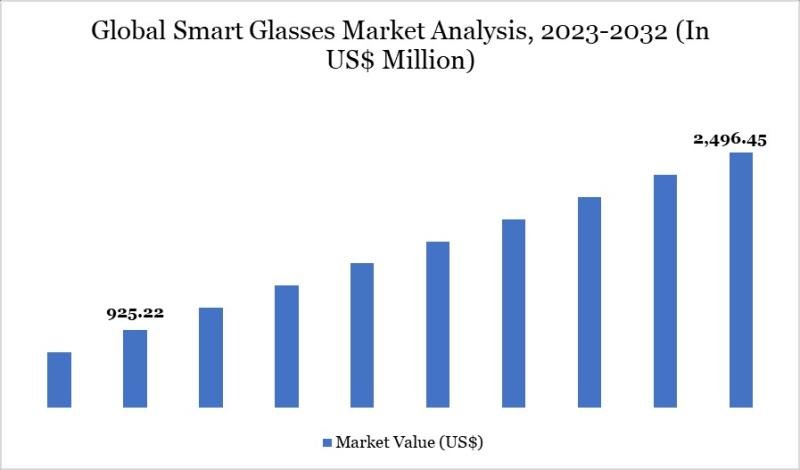
The Global Smart Glasses Market reached US$ 925.22 million in 2024 and is projected to surge to US$ 2,496.45 million by 2032, expanding at a CAGR of 13.21% during 2025-2032. The market is gaining remarkable traction as smart glasses evolve from niche gadgets into powerful enterprise and consumer technologies. Advancements in augmented reality (AR), artificial intelligence (AI), and lightweight optical systems are enabling hands-free navigation, immersive visualization, and seamless human-machine interaction. With industries increasingly adopting AR-enabled workflows for training, remote support, and quality inspections, smart glasses are quickly becoming a critical component of next-generation digital transformation.
Market momentum is further accelerated by rising demand across healthcare, manufacturing, logistics, and defense sectors, where smart glasses enhance efficiency, accuracy, and real-time decision-making. Innovations such as voice-controlled interfaces, enhanced battery life, and embedded AI assistants are expanding their utility across professional environments. As tech giants and AR hardware leaders continue to invest in miniaturization, comfort, and wider field-of-view optics, smart glasses are expected to transition from enterprise dominance to mainstream consumer adoption, powering the future of immersive communication, connected workplaces, and wearable computing.
Get a Free Sample PDF Of This Report (Get Higher Priority for Corporate Email ID):- https://www.datamintelligence.com/download-sample/smart-glasses-market?saikumar
The Smart Glasses Market comprises wearable augmented reality devices that integrate displays, sensors and connectivity features to deliver hands-free information, enhanced visualization and real-time assistance across consumer, enterprise and industrial applications.
Key Developments
United States
✅ October 2025: U.S. consumer electronics brands launched advanced AR-enabled smart glasses featuring gesture control, micro-OLED displays, and integrated multimodal sensors for immersive user experiences.
✅ August 2025: American enterprises expanded deployment of industrial smart glasses for remote assistance, workflow automation, and real-time data visualization across manufacturing and logistics operations.
✅ April 2025: U.S.-based healthcare providers adopted medical-grade smart glasses to support telemedicine, remote surgery assistance, and hands-free clinical documentation.
Global
✅ September 2025: European tech companies introduced lightweight AR smart glasses with enhanced battery efficiency and improved optical engines for enterprise and consumer applications.
✅ June 2025: Asia-Pacific manufacturers integrated AI-powered contextual computing features into smart glasses to support multilingual translation, object detection, and real-time navigation.
✅ February 2025: Global eyewear and electronics firms collaborated to develop ergonomic smart glasses with advanced eye-tracking, spatial mapping, and open-platform app ecosystems.
Mergers & Acquisitions
United States
✅ May 2025: A leading U.S. AR/VR solutions provider acquired a smart optics startup to enhance its next-generation AR lens technologies and expand its consumer wearables portfolio.
Global
✅ January 2025: A European augmented reality hardware company acquired a software firm specializing in spatial computing engines to strengthen its smart glasses performance and developer ecosystem.
✅ March 2025: A Japanese electronics manufacturer formed a strategic alliance with a global semiconductor company to co-develop low-power AR processors optimized for smart glasses.
Key Players
Google LLC | Microsoft Corporation | Vuzix Corporation | Magic Leap, Inc. | Lenovo Group Limited | Sony Group Corporation | RealWear, Inc. | Epson America, Inc. | Meta Platforms, Inc. | Samsung Electronics Co., Ltd.
Key Highlights
• Google LLC – Holds an estimated 15.7% share, driven by its ARCore platform, enterprise-focused AR solutions, and continuous innovation in immersive technologies.
• Microsoft Corporation – Accounts for around 17.9% share, supported by its industry-leading HoloLens mixed reality headset, strong enterprise adoption, and integration with Azure cloud services.
• Vuzix Corporation – Maintains approximately 6.8% share, recognized for its smart glasses used across industrial, medical, and field service applications.
• Magic Leap, Inc. – Represents nearly 8.5% share, fueled by its advanced spatial computing platform and strategic enterprise-focused mixed reality deployments.
• Lenovo Group Limited – Holds about 7.4% share, driven by its ThinkReality AR solutions, enterprise XR devices, and growing partnerships in industrial and commercial sectors.
• Sony Group Corporation – Accounts for around 10.3% share, supported by its optical technologies, sensors, and role in enabling AR/VR hardware ecosystems globally.
• RealWear, Inc. – Maintains about 5.9% share, known for its rugged industrial-grade AR headsets widely used in manufacturing, oil & gas, and remote assistance operations.
• Epson America, Inc. – Holds an estimated 4.7% share, driven by its Moverio smart glasses portfolio and adoption in enterprise training, maintenance, and educational environments.
• Meta Platforms, Inc. – Represents roughly 14.8% share, supported by its AR/VR ecosystem expansion, development of AR glasses, and metaverse-driven hardware investments.
• Samsung Electronics Co., Ltd. – Accounts for approximately 7.0% share, backed by its AR-enabled mobile devices, advanced display technologies, and strong involvement in next-generation wearable AR development.
Buy Now & Unlock 360° Market Intelligence: https://www.datamintelligence.com/buy-now-page?report=smart-glasses-market?saikumar
Market Drivers
– Rising adoption of augmented reality (AR) and mixed reality (MR) technologies across enterprise, industrial, and consumer applications.
– Growing demand for hands-free data access, remote assistance, and workflow automation in manufacturing, logistics, and healthcare.
– Expansion of wearable technologies driven by digital transformation, smart workplaces, and connected ecosystems.
– Increased use of smart glasses for training, field services, maintenance, and real-time collaboration.
– Advancements in micro-displays, sensors, processors, and lightweight optics enhancing user experience and comfort.
– Growing interest in consumer AR wearables for gaming, fitness, navigation, and immersive multimedia experiences.
– Rising integration of AI, voice assistants, and gesture recognition improving interaction and usability.
Industry Developments
– Launch of next-generation enterprise AR smart glasses with improved battery life, wider field of view, and ruggedized design.
– Development of consumer-grade smart glasses by major tech companies integrating voice control, camera functions, and smart notifications.
– Strategic partnerships between AR hardware providers and software platforms to deliver industry-specific solutions.
– Increasing adoption of remote support solutions combining smart glasses with AR overlays for field inspections and repairs.
– Advancements in waveguide optics and holographic displays enabling compact, high-brightness visual output.
– Growth in the use of smart glasses for training simulations, telemedicine, and warehouse operations.
– Introduction of AI-powered vision analytics, enabling object recognition, real-time translation, and the display of contextual information.
Regional Insights
North America – 38% driven by “strong adoption of AR technologies, high enterprise investment in digital transformation, and early deployment of smart glasses in industrial and healthcare sectors.”
Europe – 30% supported by “growing demand for industrial AR solutions, rising automation initiatives, and increasing adoption of wearable devices in manufacturing and logistics.”
Asia Pacific – 27% fueled by “rapid expansion of consumer electronics, rising AR/VR adoption, and growing investments in smart manufacturing across China, Japan, and South Korea.”
Latin America – 3% driven by “gradual adoption of digital workflow tools, expanding industrial modernization, and increasing interest in AR-based remote support.”
Middle East & Africa – 2% supported by “growth of smart city programs, rising enterprise digitization, and adoption of AR wearables in utilities and energy sectors.”
Speak to Our Analyst and Get Customization in the report as per your requirements: https://www.datamintelligence.com/customize/smart-glasses-market?saikumar
Key Segments
➥ By Type
Standalone smart glasses feature built-in processors, displays, and sensors, enabling independent operation without external devices. Tethered smart glasses rely on smartphones, PCs, or wearable processors for enhanced power and computing capabilities. Integrated smart glasses are embedded within helmets or specialized equipment, offering advanced functionality for industrial, military, and professional use cases.
➥ By Technology
Augmented Reality (AR) glasses overlay digital information onto the real world, supporting hands-free workflows in healthcare, manufacturing, and training. Virtual Reality (VR) glasses deliver fully immersive environments ideal for simulation, gaming, and education. Mixed Reality (MR) glasses combine real and virtual elements with interactive 3D visualization for enterprise, design, and defense applications. Others include emerging optical, holographic, and smart lens technologies.
➥ By Mode of Control
Touchpad-based control offers simple navigation through built-in touch interfaces. Voice command enables hands-free operation, improving accessibility and efficiency in professional settings. Gesture recognition provides intuitive interaction by tracking hand movements and spatial inputs. Remote control options support precision handling using companion devices or external controllers. Others include eye-tracking, motion sensors, and AI-assisted interaction modes.
Unlock 360° Market Intelligence with DataM Subscription Services: https://www.datamintelligence.com/reports-subscription
Power your decisions with real-time competitor tracking, strategic forecasts, and global investment insights all in one place.
✅ Competitive Landscape
✅ Sustainability Impact Analysis
✅ KOL / Stakeholder Insights
✅ Unmet Needs & Positioning, Pricing & Market Access Snapshots
✅ Market Volatility & Emerging Risks Analysis
✅ Quarterly Industry Report Updated
✅ Live Market & Pricing Trends
✅ Import-Export Data Monitoring
Have a look at our Subscription Dashboard: https://www.youtube.com/watch?v=x5oEiqEqTWg
Contact Us –
Company Name: DataM Intelligence
Contact Person: Sai Kiran
Email: Sai.k@datamintelligence.com
Phone: +1 877 441 4866
Website: https://www.datamintelligence.com
About Us –
DataM Intelligence is a Market Research and Consulting firm that provides end-to-end business solutions to organizations from Research to Consulting. We, at DataM Intelligence, leverage our top trademark trends, insights and developments to emancipate swift and astute solutions to clients like you. We encompass a multitude of syndicate reports and customized reports with a robust methodology.
Our research database features countless statistics and in-depth analyses across a wide range of 6300+ reports in 40+ domains creating business solutions for more than 200+ companies across 50+ countries; catering to the key business research needs that influence the growth trajectory of our vast clientele.
This release was published on openPR.