Real-Time Payments Market
Market Growth Drivers
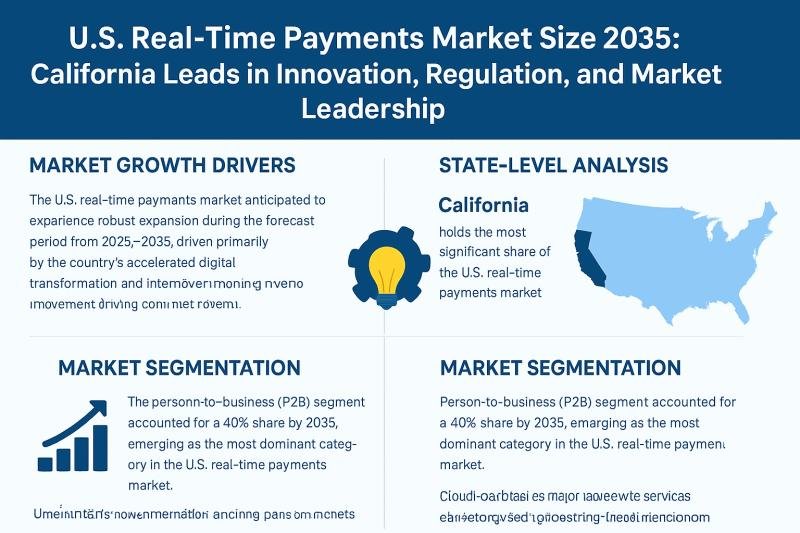
The U.S. real-time payments market is anticipated to experience robust expansion during the forecast period from 2026 to 2035, driven primarily by the country’s accelerated digital transformation and demand for instant financial transactions. The convergence of advanced payment infrastructure, fintech innovation, and regulatory modernization is redefining how individuals and enterprises manage money movement. The adoption of ISO 20022 standards and the Federal Reserve’s FedNow initiative have significantly enhanced interoperability and transparency across payment systems, driving confidence among financial institutions and end-users. Moreover, the rising adoption of mobile banking and API-based ecosystems is fueling rapid innovation in payment gateways and settlement mechanisms. Over the next decade, the U.S. market is expected to evolve toward a highly interconnected, transparent, and efficient real-time transaction environment, reinforcing its leadership in financial innovation and digital competitiveness.
Request Free Sample Report @ https://www.researchnester.com/sample-request-5157
State-Level Analysis
California holds the most significant share of the U.S. real-time payments market, underpinned by its dominant fintech ecosystem and concentration of technology-driven financial enterprises. Silicon Valley’s extensive network of payment startups, cloud service providers, and digital infrastructure companies has established the state as the innovation hub of U.S. financial technology. Major players such as PayPal, Square, and Stripe continue to pioneer API-driven payment systems and real-time transaction capabilities, integrating artificial intelligence and blockchain for enhanced speed and security. California’s robust digital infrastructure, venture funding environment, and regulatory openness toward fintech experimentation further consolidate its leading position. Over the forecast period, the state’s financial ecosystem is expected to deepen its real-time integration across sectors such as e-commerce, digital banking, and P2B transactions.
Texas is emerging as the fastest-growing state in the U.S. real-time payments landscape, benefiting from a surge in financial services investments, cloud infrastructure expansion, and a thriving digital commerce environment. The state’s strategic position as a logistics and business hub has encouraged large retailers, utilities, and service providers to integrate instant payment solutions for enhanced customer engagement and cash flow management. Additionally, Texas has attracted major data centers and fintech firms due to its favorable tax environment and expanding technology workforce. Over the forecast period, Texas is expected to lead in innovation-driven adoption of real-time payments across small businesses, regional banks, and emerging fintech platforms. Its growing focus on digital inclusion and modernization of financial services positions it as a key growth frontier within the national market.
Access our detailed report at: https://www.researchnester.com/reports/real-time-payments-market/5157
Market Segmentation
The person-to-business (P2B) segment accounted for a 40% share by 2035, emerging as the most dominant category in the U.S. real-time payments market. This dominance stems from the rapid digitization of consumer payments and the shift toward frictionless transactions in retail, utilities, and service industries. Businesses are increasingly adopting instant payment frameworks to improve cash flow, reduce settlement delays, and enhance customer satisfaction. The integration of QR-based systems, mobile payment apps, and digital wallets has further accelerated P2B adoption. Companies such as PayPal, Visa, and Mastercard are actively innovating real-time processing solutions tailored to business transactions, while retailers and service providers are leveraging these capabilities for enhanced customer engagement. The segment’s leadership reflects a fundamental shift in payment behavior toward immediacy, transparency, and efficiency.
The cloud segment held a major revenue share over the forecast period, driven by the growing reliance on scalable, secure, and flexible infrastructure to support real-time transaction volumes. Cloud-based architectures enable faster deployment of payment platforms, cost efficiency, and seamless integration with API-driven ecosystems. Financial institutions and payment service providers are increasingly migrating to cloud environments to leverage advanced analytics, fraud detection, and compliance automation. Major technology firms like Amazon Web Services (AWS), Google Cloud, and Microsoft Azure are providing foundational support for real-time payment networks, offering high-performance computing and secure transaction processing. This transition toward cloud-native infrastructure is reshaping the competitive dynamics of the payments ecosystem, empowering banks and fintech firms to innovate rapidly while maintaining operational resilience.
Request Free Sample Report @ https://www.researchnester.com/sample-request-5157
Market Opportunities
1. Expansion of Cross-Border Real-Time Payments: The acceleration of cross-border real-time payments presents one of the most transformative opportunities in the U.S. market. As globalization intensifies digital trade and e-commerce, demand for instant international transactions has surged. Initiatives integrating U.S. payment systems with global instant payment networks are gaining traction, enabling faster settlements and improved liquidity management for businesses. Financial institutions are investing in interoperable platforms and blockchain-based solutions to streamline cross-border transfers. Companies such as Ripple and Mastercard are spearheading innovations that reduce friction in international payments. Businesses can capitalize on this trend by forming global partnerships, enhancing compliance with regional payment regulations, and deploying technology that ensures transparency and traceability across borders.
2. Integration of AI and Data Analytics in Payment Systems: The integration of artificial intelligence (AI) and advanced analytics into real-time payment systems is unlocking new dimensions of efficiency and customer experience. AI-driven fraud detection, predictive transaction monitoring, and personalized payment recommendations are redefining operational intelligence within the financial ecosystem. Fintech leaders and banks are deploying machine learning models to analyze transaction patterns, detect anomalies, and enhance decision-making in real time. Moreover, AI-powered chatbots and virtual assistants are streamlining payment support and dispute resolution processes. The strategic use of AI enables payment providers to optimize risk management and improve service agility. To leverage this opportunity, companies should invest in data-driven platforms that combine automation with compliance precision, thereby strengthening their competitive advantage in the evolving digital payments landscape.
Competitive Landscape
The U.S. real-time payments market is shaped by an increasingly dynamic and competitive ecosystem comprising established financial institutions, fintech innovators, and technology providers. Leading players such as The Clearing House, FIS, Fiserv, and Mastercard are driving market expansion through strategic partnerships, platform modernization, and investments in instant payment infrastructure. Emerging fintech startups are introducing niche payment solutions tailored to specific industries, such as gig economy platforms and subscription-based businesses. This diversification is intensifying competition and fostering innovation across multiple payment touchpoints.
Strategically, incumbents are focusing on interoperability, API development, and cybersecurity to strengthen customer trust and regulatory compliance. Consolidation trends are also visible, as mergers and alliances help companies enhance service capabilities and geographic coverage. Meanwhile, new entrants are differentiating through specialized offerings such as embedded finance, digital wallet integration, and real-time data analytics. By 2035, competitive success in the U.S. real-time payments sector will hinge on agility, transparency, and ecosystem collaboration, with leading firms prioritizing innovation-led partnerships and sustainable payment solutions.
Request Free Sample Report @ https://www.researchnester.com/sample-request-5157
Related News –
https://www.linkedin.com/pulse/what-emerging-trends-shaping-supply-chain-finance-market-bj3if
https://www.linkedin.com/pulse/what-future-narrowband-iot-market-era-smart-connectivity-d62xf
Contact Data
AJ Daniel
Corporate Sales, USA
Research Nester
77 Water Street 8th Floor, New York, 10005
Email: info@researchnester.com
USA Phone: +1 646 586 9123
Europe Phone: +44 203 608 5919
About Research Nester
Research Nester is a one-stop service provider with a client base in more than 50 countries, leading in strategic market research and consulting with an unbiased and unparalleled approach towards helping global industrial players, conglomerates and executives for their future investment while avoiding forthcoming uncertainties. With an out-of-the-box mindset to produce statistical and analytical market research reports, we provide strategic consulting so that our clients can make wise business decisions with clarity while strategizing and planning for their forthcoming needs and succeed in achieving their future endeavors. We believe every business can expand to its new horizon, provided a right guidance at a right time is available through strategic minds.
This release was published on openPR.