Product Lifecycle Management Market
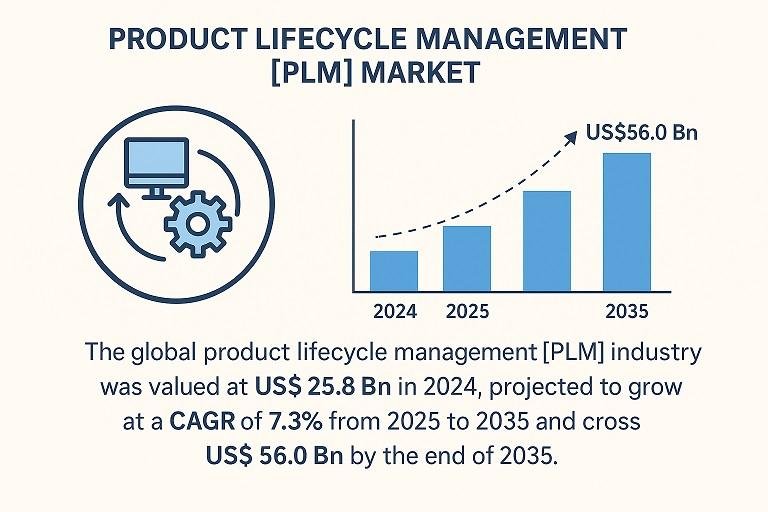
The global Product Lifecycle Management (PLM) market was valued at approximately US$ 25.8 billion in 2024 and is projected to grow at a CAGR of 7.3% from 2025 to 2035, reaching US$ 56.0 million by the end of 2035. This growth is driven by increasing demand for automation, digitalization, and collaboration across industries such as automotive, aerospace, and healthcare, where the complexity of products is rapidly rising. PLM solutions provide businesses with tools to streamline the entire product development lifecycle, from design and engineering to production and end-of-life management, ensuring efficiency, compliance, and innovation.
Product Lifecycle Management (PLM) refers to the process of managing the entire lifecycle of a product from its initial concept and design through production, service, and disposal. It encompasses the systems, strategies, tools, and processes involved in the management of product information and processes, ensuring that an organization can optimize the creation, design, and manufacturing of products while complying with industry standards.
Access the Sample Report – Discover Key Market Highlights: https://www.transparencymarketresearch.com/sample/sample.php?flag=S&rep_id=4548
Key Players:
• Siemens
• Dassault Systèmes
• PTC
• Autodesk Inc.
• SAP SE
• Oracle
• Aras
• Infor
• Vital Proteins LLC.
• IBM
• Cadence Design Systems, Inc.
• OpenBOM
• Propel Software Solutions, Inc.
• Centric Software, Inc.
• Coats Digital
• ABB
Market Drivers
The PLM market is being driven by several factors:
Increasing Demand for Automation and Digitalization: As businesses strive for higher productivity and reduced operational costs, the adoption of digital tools like PLM becomes more crucial. Automation and digital transformation help improve efficiency, streamline workflows, and eliminate errors in the design and production processes.
Rising Complexity of Products: With the increasing complexity of products, particularly in industries like aerospace, automotive, and consumer electronics, companies need systems that can manage the entire lifecycle efficiently. PLM tools allow companies to handle the growing complexity of product designs, components, and manufacturing processes.
Collaborative Work Culture: The demand for global collaboration is on the rise, with teams often working across geographies and time zones. PLM systems provide a central platform for teams to collaborate in real-time, facilitating the sharing of information, updates, and changes without the need for physical meetings or email exchanges.
Compliance and Regulatory Requirements: With industries facing strict regulations, especially in sectors like healthcare, automotive, and aerospace, businesses are increasingly using PLM solutions to ensure compliance with international standards. PLM systems can track product changes, document approvals, and generate reports required for audits and certifications.
Need for Data Management: As businesses generate more data than ever before, proper data management becomes crucial. PLM solutions enable the integration of different types of data, such as engineering designs, manufacturing processes, and customer feedback, into a single platform, ensuring better decision-making and reducing risks.
Key Features of PLM Solutions
Modern PLM systems come with a wide range of features that enable organizations to manage product development efficiently. Some of the key features include:
Product Data Management (PDM): PDM is one of the core components of PLM, allowing businesses to manage product data such as CAD drawings, specifications, and bills of materials (BOM). It ensures that the right people have access to the correct version of a design at any given time, which minimizes errors and improves decision-making.
Collaborative Product Development: PLM systems enable collaboration across departments, helping to manage communication between R&D, engineering, procurement, production, and sales teams. This improves product development cycles and ensures that all stakeholders are aligned throughout the product lifecycle.
Configuration Management: PLM systems manage configurations, making sure that product variations are properly documented and maintained. This feature is especially important in industries where products are customized to meet specific customer requirements.
Change Management: PLM software includes tools to track and manage product changes, whether they are related to design, materials, or processes. This ensures that product changes are documented, controlled, and implemented in an orderly manner, preventing costly mistakes and delays.
Supply Chain Management Integration: PLM systems are increasingly integrating with supply chain management (SCM) systems, providing end-to-end visibility and control over the entire product lifecycle, from concept to delivery.
Regulatory Compliance Management: As global regulations become more stringent, PLM systems are designed to help businesses maintain compliance with product safety, environmental standards, and quality certifications. This is particularly important in highly regulated industries like automotive, healthcare, and pharmaceuticals.
Sustainability Management: With a growing emphasis on environmental responsibility, PLM systems are incorporating sustainability management tools. These tools help organizations evaluate the environmental impact of their products, from raw material sourcing to end-of-life disposal, ensuring they meet sustainability standards.
Get Exclusive Access to Detailed Market Analysis – Click Here to Download: https://www.transparencymarketresearch.com/product-lifecycle-management-market.html
Key Developments in Product Lifecycle Management [PLM] Market
In June 2025, PTC unveiled its Arena product lifecycle management (PLM) and quality management system (QMS) solution as a part of its newly launched supply chain intelligence (SCI) offering. Arena SCI continuously detects incoming threats from evolving supply chain conditions by integrating real-time, AI-powered component tracking, and risk reduction visibility into product development pipelines.
In August 2024, SAP SE introduced new cloud capabilities for SAP Product Lifecycle Management (SAP PLM) solutions. In cooperation with Hilti AG, through a strategic co-innovation partnership, SAP was assisting customers in linking their business data with engineering and research and development groups, thereby allowing businesses to be more cost-effective and efficient.
Conclusion
The Product Lifecycle Management (PLM) market is at the forefront of digital transformation in industries across the globe. With rising complexity in product design, growing demand for collaboration, and the need for regulatory compliance, PLM solutions are becoming indispensable tools for businesses seeking to optimize their product development processes. As technologies like AI, IoT, and blockchain continue to evolve, the PLM market is poised for substantial growth, offering businesses new ways to streamline operations, innovate, and meet the demands of the future.
More Trending Reports by Transparency Market Research –
Managed Security Services Market – https://www.transparencymarketresearch.com/managed-security-services-market.html
Industrial Artificial Intelligence [AI] Market – https://www.transparencymarketresearch.com/industrial-artificial-intelligence-ai-market.html
Free Space Optics (FSO) Communication Market – https://www.transparencymarketresearch.com/free-space-optics-market.html
About Transparency Market Research
Transparency Market Research, a global market research company registered at Wilmington, Delaware, United States, provides custom research and consulting services. Our exclusive blend of quantitative forecasting and trends analysis provides forward-looking insights for thousands of decision makers. Our experienced team of Analysts, Researchers, and Consultants use proprietary data sources and various tools & techniques to gather and analyses information.
Our data repository is continuously updated and revised by a team of research experts, so that it always reflects the latest trends and information. With a broad research and analysis capability, Transparency Market Research employs rigorous primary and secondary research techniques in developing distinctive data sets and research material for business reports.
Contact:
Transparency Market Research Inc.
CORPORATE HEADQUARTER DOWNTOWN,
1000 N. West Street,
Suite 1200, Wilmington, Delaware 19801 USA
Tel: +1-518-618-1030
USA – Canada Toll Free: 866-552-3453
Website: https://www.transparencymarketresearch.com
Email: sales@transparencymarketresearch.com
This release was published on openPR.