eSports Market
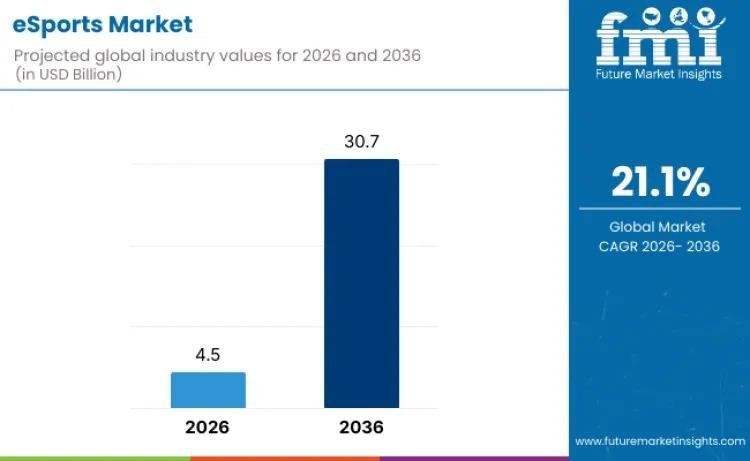
The global eSports market is entering a transformative decade of accelerated expansion, with total industry valuation projected to rise from USD 4.5 billion in 2026 to USD 30.7 billion by 2036, reflecting a compelling compound annual growth rate (CAGR) of 21.1%. The growth trajectory is underpinned by surging fan engagement, expanding tournament ecosystems, rapid mobile gaming penetration, and unprecedented inflows from sponsorship and advertising channels.
Competitive gaming has evolved from a niche subculture into a mainstream digital entertainment powerhouse, driven by professional league structures, franchise-based team models, and integrated streaming platforms that connect millions of viewers globally. The convergence of media, gaming, and digital commerce continues to unlock new monetization pathways, positioning eSports as one of the fastest-growing segments within the broader entertainment and technology landscape.
Request For Sample Report | Customize Report | Purchase Full Report
https://www.futuremarketinsights.com/reports/sample/rep-gb-1911
Market Overview and Revenue Acceleration
Between 2026 and 2036, the industry is expected to add more than USD 26 billion in incremental value, reflecting structural shifts in consumer entertainment habits and brand marketing strategies. Sponsorships and advertising remain the dominant revenue stream, expanding at an estimated 45% CAGR, fueled by global brands seeking direct access to digitally native audiences.
Media rights, streaming revenue, merchandise, ticket sales, and publisher fees are also contributing to diversified income generation. As tournaments grow in scale and production quality, premium broadcasting deals and exclusive streaming partnerships are becoming central to long-term revenue sustainability.
Mobile eSports is projected to be the fastest-growing platform segment, expanding at 27.6% CAGR, significantly outpacing PC and console-based competitive gaming.
Regional Leadership and Competitive Ecosystems
Asia Pacific: The Global Epicenter
Asia Pacific continues to dominate the global eSports market, led by China, South Korea, and Japan. China alone accounts for hundreds of millions of online gamers, supported by a deeply integrated digital ecosystem and strong domestic publishing capabilities from companies such as Tencent Holdings Ltd. and NetEase Inc..
Franchised leagues and world-class tournaments, including the League of Legends Pro League, set benchmarks for global production quality and audience engagement.
North America: Media Rights and Franchise Model Strength
North America benefits from established infrastructure, high broadband penetration, and structured professional leagues such as the Call of Duty League and Overwatch League. Streaming platforms like Twitch and YouTube Gaming continue to expand reach and monetization efficiency.
Europe: Infrastructure and Institutional Integration
Europe is steadily scaling through investments in gaming arenas, collegiate programs, and flagship events such as Gamescom. Government-backed digital initiatives and public-private partnerships are strengthening competitive circuits across Germany, the UK, and Nordic markets.
Segment Analysis: Genres, Platforms, and Revenue Streams
Game Genre Leadership: MOBA Dominance
Multiplayer Online Battle Arena (MOBA) titles are projected to command 28.7% of global revenue in 2026, maintaining leadership through 2036. Flagship titles such as League of Legends and Dota 2 anchor international tournaments that attract multi-million concurrent viewership.
The League of Legends World Championship and The International consistently generate record-breaking prize pools and media rights valuations, reinforcing MOBA’s central role in the competitive gaming economy.
Fastest-Growing Platform: Mobile eSports
Mobile-first titles including PUBG Mobile, Free Fire, and Arena of Valor are accelerating adoption in high-growth markets such as India, Southeast Asia, and Latin America. Lower entry barriers, smartphone affordability, and 5G rollout are enabling large-scale participation and audience expansion.
Country-Level Growth Highlights
• India (26.7% CAGR): Driven by mobile gaming adoption, 5G expansion, and supportive digital policies including Digital India initiatives.
• Saudi Arabia (25.2% CAGR): Fueled by Vision 2030 investments, flagship tournaments such as Gamers8, and infrastructure development.
• China (24.3% CAGR): Sustained by professional leagues, publisher dominance, and large-scale streaming ecosystems.
• Germany (21.0% CAGR): Anchored by infrastructure investments and a mature gaming consumer base.
• USA (20.3% CAGR): Supported by media rights growth, franchise leagues, and diversified platform penetration.
Technology Trends Reshaping Competitive Gaming
The integration of augmented reality (AR), virtual reality (VR), and blockchain-enabled digital assets is redefining fan engagement. Immersive viewing experiences and interactive digital collectibles are expanding monetization models beyond traditional advertising frameworks.
Cloud gaming infrastructure, advanced data analytics, and AI-driven performance tools are enhancing competitive integrity and operational efficiency. These innovations are elevating tournament production standards and strengthening the professionalization of global leagues.
Exhaustive Market Report: A Complete Study
https://www.futuremarketinsights.com/reports/esports-market
Competitive Landscape and Industry Leaders
The global eSports ecosystem is shaped by publishers, event operators, and professional team organizations. Key market participants include:
• Activision Blizzard, Inc.
• Electronic Arts Inc.
• Riot Games, Inc.
• Take-Two Interactive Software, Inc.
• ESL FACEIT Group
Professional organizations such as Team SoloMid, Cloud9, Fnatic, G2 Esports, and FaZe Clan are strengthening global fan bases through diversified revenue streams, branded content, and cross-industry partnerships.
Corporate collaborations with global brands such as Adidas AG and PepsiCo, Inc. further validate eSports as a strategic marketing platform.
Risk Factors and Strategic Imperatives
Despite rapid expansion, the market faces challenges including sponsorship dependency, cybersecurity vulnerabilities, and increasing competitive fragmentation. Organizations prioritizing diversified revenue models, operational resilience, and data security frameworks are better positioned to sustain long-term profitability.
Outlook Through 2036
With mobile platforms accelerating adoption, sponsorship revenues expanding at record pace, and emerging regions investing heavily in infrastructure, the global eSports market is transitioning into a mature, multi-billion-dollar digital entertainment economy.
Comprehensive analysis of segment performance, regional strategies, competitive positioning, and emerging monetization channels is available in the full market report. The findings provide critical insights into the structural drivers shaping the next decade of global eSports expansion and the strategic opportunities emerging across this high-growth ecosystem.
Similar Industry Reports
eSports & Games Streaming Market
https://www.futuremarketinsights.com/reports/e-sports-and-games-streaming-market
Future Market Insights Inc.
Christiana Corporate, 200 Continental Drive,
Suite 401, Newark, Delaware – 19713, USA
T: +1-845-579-5705
For Sales Enquiries: sales@futuremarketinsights.com
Website: https://www.futuremarketinsights.com
Future Market Insights, Inc. (FMI) is an ESOMAR-certified, ISO 9001:2015 market research and consulting organization, trusted by Fortune 500 clients and global enterprises. With operations in the U.S., UK, India, and Dubai, FMI provides data-backed insights and strategic intelligence across 30+ industries and 1200 markets worldwide.
This release was published on openPR.