Market Overview
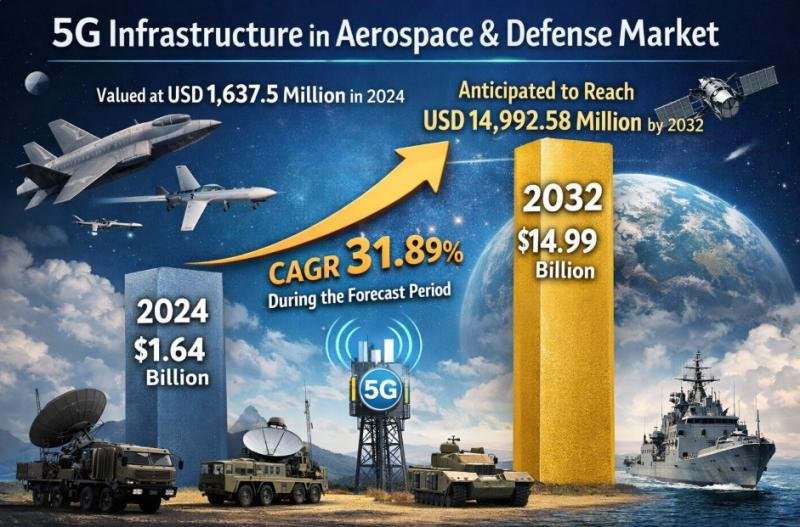
The 5G Infrastructure in Aerospace and Defense Market is witnessing unprecedented growth, driven by rapid digital transformation, real-time data requirements, and mission-critical connectivity across military and aviation ecosystems. Valued at USD 1,637.5 million in 2024, the market is anticipated to reach USD 14,992.58 million by 2032, expanding at a remarkable CAGR of 31.89% during the forecast period.
5G technology is revolutionizing aerospace and defense operations by enabling ultra-low latency communication, high-speed data transfer, network slicing, edge computing, and secure communication networks. As defense agencies, aerospace manufacturers, and commercial aviation stakeholders adopt Industry 4.0 principles, the need for robust and secure wireless infrastructure has intensified.
From smart military bases and connected aircraft systems to autonomous drones and advanced battlefield communication systems, 5G is redefining operational efficiency, situational awareness, and mission execution capabilities.
Browse the full Report at https://www.credenceresearch.com/report/5g-infrastructure-in-aerospace-and-defense-market
Market Dynamics
Key Growth Drivers
Rising Demand for Real-Time Battlefield Communication
Modern warfare relies heavily on real-time intelligence, surveillance, and reconnaissance (ISR). 5G infrastructure supports seamless integration of unmanned aerial vehicles (UAVs), ground vehicles, radar systems, and satellite communications, enabling instant data transmission and enhanced situational awareness.
Smart Military Bases and Private 5G Networks
Governments across North America, Europe, and Asia Pacific are investing in private 5G networks for military bases. These networks ensure secure communications, enhanced cybersecurity, and dedicated bandwidth for mission-critical operations.
Growth in Autonomous Systems and Drones
5G’s ultra-reliable low-latency communication (URLLC) is crucial for controlling drones, robotic systems, and autonomous defense platforms. Aerospace companies are integrating 5G to enhance aircraft health monitoring, predictive maintenance, and real-time diagnostics.
Modernization of Commercial Flight Lines
Airports and aircraft maintenance facilities are increasingly deploying 5G to support automated ground operations, digital twin modeling, and IoT-based asset tracking systems.
Get Free PDf Sample Request: https://www.credenceresearch.com/report/5g-infrastructure-in-aerospace-and-defense-market#request_sample
Market Challenges
Despite its strong growth trajectory, the market faces certain challenges:
High infrastructure deployment costs
Spectrum allocation complexities
Cybersecurity threats in defense networks
Interoperability issues with legacy systems
However, ongoing technological advancements and strong government funding are expected to mitigate these constraints.
Market Segmentation Analysis
By Network Architecture
5G NR Non-Standalone (LTE Combined)
Non-Standalone (NSA) architecture leverages existing LTE infrastructure combined with 5G New Radio (NR). This segment is witnessing strong adoption in early deployment phases due to:
Lower implementation costs
Faster deployment timelines
Compatibility with existing systems
Defense organizations prefer NSA architecture for phased modernization without complete overhaul of legacy networks.
5G Standalone (NR + Core)
Standalone (SA) architecture integrates a dedicated 5G core network, offering:
Ultra-low latency
Network slicing
Enhanced security
Full 5G capabilities
The SA segment is expected to grow at a higher rate during the forecast period as aerospace and defense agencies prioritize secure, mission-critical operations requiring autonomous functionality.
By Operational Frequency
Sub-6 GHz
Sub-6 GHz frequencies dominate current deployments due to:
Wider coverage range
Better signal penetration
Lower infrastructure complexity
Military bases and large aerospace facilities benefit from broad coverage and stable connectivity offered by Sub-6 GHz networks.
Above 6 GHz (mmWave)
Above 6 GHz frequencies provide:
Extremely high data speeds
Ultra-low latency
High bandwidth capacity
This segment is particularly useful in high-density operational environments such as aircraft assembly lines, command centers, and drone testing facilities.
Browse the full Report at https://www.credenceresearch.com/report/5g-infrastructure-in-aerospace-and-defense-market
By End-Use Vertical
Aerospace
In aerospace, 5G infrastructure supports:
Connected aircraft systems
Real-time fleet management
Aircraft predictive maintenance
Smart manufacturing and assembly lines
Digital twins for aircraft simulation
Aerospace manufacturers are leveraging 5G-enabled IoT sensors to improve safety standards and optimize operational workflows.
Defense
The defense segment represents a significant share of the market. Applications include:
Tactical communication networks
Smart surveillance systems
Autonomous military vehicles
Battlefield data streaming
Secure encrypted communication
Governments are prioritizing defense digitization initiatives, fueling demand for secure and resilient 5G networks.
Commercial Flight Line
Commercial aviation is increasingly adopting 5G for:
Aircraft turnaround optimization
Smart baggage handling
Ground crew coordination
Real-time aircraft monitoring
Airports are becoming connected ecosystems, relying on 5G for operational efficiency and passenger safety.
Get Free PDf Sample Request: https://www.credenceresearch.com/report/5g-infrastructure-in-aerospace-and-defense-market#request_sample
Regional Analysis
North America
North America dominates the 5G Infrastructure in Aerospace and Defense Market due to:
Strong defense budgets
Early adoption of private 5G networks
Presence of major telecom and networking players
Government-led 5G military trials
The United States leads the region with extensive 5G pilot projects across military bases and aerospace manufacturing hubs.
Europe
European nations are investing in defense modernization and aerospace innovation. NATO collaborations and increasing cybersecurity initiatives are accelerating regional adoption.
Asia Pacific
Asia Pacific is projected to witness the fastest growth rate due to:
Expanding aerospace manufacturing capabilities
Rising defense expenditure
Government-backed 5G infrastructure programs
China, Japan, South Korea, and India are key contributors to regional growth.
Rest of the World
Latin America and the Middle East & Africa are gradually adopting 5G in defense and aviation sectors, supported by smart city initiatives and airport modernization projects.
Competitive Landscape and Key Player Analysis
The competitive landscape is characterized by strategic partnerships, defense contracts, spectrum licensing agreements, and R&D investments.
CommScope Inc
CommScope Inc
CommScope specializes in advanced network infrastructure solutions including antennas, fiber optics, and wireless connectivity. The company is expanding its presence in defense-grade private 5G deployments.
China Mobile
China Mobile
China Mobile plays a critical role in large-scale 5G deployment projects and is collaborating with aerospace and defense entities to develop secure communication frameworks.
Ericsson
Ericsson
Ericsson provides end-to-end 5G solutions including radio access networks and core infrastructure. The company actively participates in defense-focused 5G trials and military communication modernization programs.
Ciena Corporation
Ciena Corporation
Ciena offers advanced optical networking solutions essential for high-capacity 5G backbone infrastructure used in aerospace and defense applications.
Airspan Networks
Airspan Networks
Airspan Networks focuses on private 5G and Open RAN solutions, making it a strong contender in defense-grade network deployment.
AT&T
AT&T
AT&T collaborates with U.S. defense agencies to deploy secure 5G networks for smart military bases and advanced aerospace facilities.
Cisco Systems
Cisco Systems
Cisco provides secure networking hardware, edge computing platforms, and cybersecurity solutions integrated within aerospace and defense 5G infrastructure.
Comba Telecom
Comba Telecom
Comba Telecom offers advanced antenna systems and RF solutions critical for high-frequency 5G deployments in aerospace and defense sectors.
Technological Trends Shaping the Market
Edge Computing Integration
5G combined with edge computing enhances mission-critical data processing at local nodes, reducing latency in combat scenarios and flight operations.
Network Slicing for Defense Applications
Network slicing enables defense agencies to allocate dedicated bandwidth for specific missions without interference from commercial traffic.
Artificial Intelligence and 5G Convergence
AI-powered predictive analytics combined with 5G connectivity improves aircraft maintenance, threat detection, and logistics optimization.
Cybersecurity-First Architecture
Given the sensitivity of defense data, companies are embedding advanced encryption, zero-trust security frameworks, and blockchain-based authentication systems within 5G infrastructure.
Future Outlook
The 5G Infrastructure in Aerospace and Defense Market is positioned for exponential growth over the next decade. As geopolitical tensions rise and defense modernization accelerates globally, the demand for secure, high-speed communication networks will intensify.
Standalone 5G architecture is expected to dominate long-term deployments due to enhanced performance and security capabilities. Meanwhile, mmWave adoption will expand in high-density operational environments.
Government initiatives supporting digital transformation, smart airports, and autonomous defense systems will continue to fuel investments. Partnerships between telecom operators, defense contractors, and aerospace manufacturers will shape the competitive landscape.
By 2032, the market is projected to reach nearly USD 15 billion, marking a transformative shift in how aerospace and defense sectors operate in an increasingly connected world.
Conclusion
The 5G Infrastructure in Aerospace and Defense Market represents one of the fastest-growing segments within advanced communication technologies. With a projected CAGR of 31.89%, the market’s expansion from USD 1,637.5 million in 2024 to USD 14,992.58 million by 2032 underscores the strategic importance of next-generation connectivity.
From smart military bases and autonomous drones to connected aircraft ecosystems and digital airports, 5G is becoming the backbone of aerospace and defense modernization. As technological innovation accelerates and governments prioritize secure communication networks, the market is set to redefine operational capabilities across global aerospace and defense industries.
Browse the full Report at https://www.credenceresearch.com/report/5g-infrastructure-in-aerospace-and-defense-market
Contact US:
Credence Research Inc, Tower C-1105 , S 25, Akash Tower,
Vishal Nahar, Pimple Nilakh, Haveli,
Pune – 411027, India
India – +91 6232 49 3207
sales@credenceresearch.com
http://www.credenceresearch.com
About US:
Credence Research is a leading international provider of market intelligence and a key component in the due diligence process. We deliver high-quality, extensive, deep-dive reports that empower leaders and investors to make informed decisions and mitigate risks. Our strategic insights, based on extensive research frameworks and advanced data modeling, provide authoritative primary sources for evaluating market performance and potential across a wide range of industries.
This release was published on openPR.