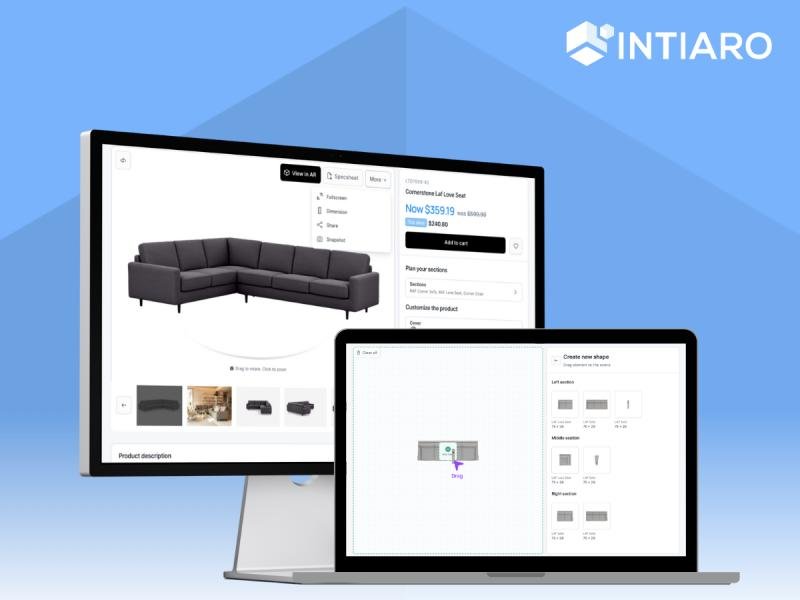
Product visualization has become an ecosystem, not a tool-built for scale, accuracy, and customization.
Furniture brands increasingly rely on digital tools to present products accurately, efficiently, and at scale. As assortments grow and customers expect more interactive and customizable experiences, product visualization has become a core part of how furniture is marketed, sold, and configured across channels.
Rather than using a single solution, most furniture brands work with a combination of tools, each addressing a different part of the visualization workflow.
At the foundation are 3D modeling tools, which are used to create the core digital representation of furniture products. These models capture geometry, materials, and construction logic and serve as the basis for all downstream visual content. Centralized management of 3D assets is especially important for brands with large or configurable catalogs, where consistency and reuse directly impact efficiency.
On top of 3D assets, brands typically use rendering and image production tools to generate photorealistic visuals for e-commerce, catalogs, and marketing materials. While this process was traditionally manual and time-intensive, many brands are now adopting more automated or AI-assisted pipelines to handle high volumes of imagery across finishes, fabrics, and product variants.
Another key category is product configuration tools. Configurators allow users to customize products by selecting options such as size, layout, materials, or components, while ensuring that configurations remain technically and commercially valid. These tools are commonly used in B2B sales environments, retail showrooms, and online channels, particularly for modular or made-to-order furniture.
Learn more about product configuration tools here: https://en.intiaro.com/solutions/product-configurator
To support consistent delivery across channels, visualization tools are often connected to content management, PIM, and e-commerce systems. This integration helps ensure that visuals, configurations, and product data remain aligned across websites, dealer platforms, and internal sales tools. Without this connection, brands often face delays caused by manual updates and duplicated work.
More recently, AI-driven visualization tools have begun to play a larger role. These solutions can automate parts of image generation, scene creation, and variation management, reducing production time and cost when launching or updating collections.
Explore AI-driven visualization approaches here: https://en.intiaro.com/solutions/generative-augmented-reality
In response to growing complexity, some furniture brands are moving toward platform-based visualization solutions that combine multiple capabilities, such as 3D asset management, configuration logic, rendering, and publishing workflows. Platforms like Intiaro are examples of how these functions can be brought together to support scalable visualization processes.
As digital expectations continue to rise, furniture brands are increasingly focused on building connected visualization ecosystems rather than relying on isolated tools. This shift reflects a broader need for flexibility, speed, and consistency across every customer and sales touchpoint.
Intiaro, Inc.
806 Green Valley Road, Suite 200
GREENSBORO
27408, NORTH CAROLINA
UNITED STATES
business@intiaro.com
+1 336 697 6677
Intiaro Inc. is a leading provider of 3D and AI solutions and augmented reality technology, specializing in the home furnishings industry. We partner with furniture brands, retailers and interior designers to integrate cutting-edge technology into their businesses in ways that lead to increased sales, higher efficiencies and more engaged, loyal customers. Based in Greensboro, N.C, we also have technology and support teams in Poland.
This release was published on openPR.