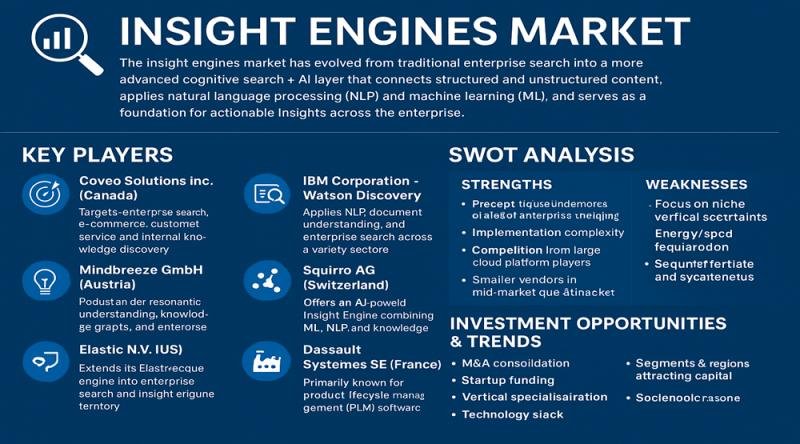
Insight Engines Market
Top Companies & Their Strategies
The insight engines market has evolved from traditional enterprise search into a more advanced cognitive ¬search + AI layer that connects structured and unstructured content, applies natural language processing (NLP) and machine learning (ML), and serves as a foundation for actionable insights across the enterprise. Below are six leading or emerging companies whose strategies shed light on competitive positioning in the insight engines space.
➤ Request Free Sample PDF Report @ https://www.researchnester.com/sample-request-8172
Coveo Solutions Inc. (Canada)
Coveo is a well‐recognized vendor in the insight engines market: its AI-RelevanceTM Platform targets enterprise search, e-commerce, customer service and internal knowledge discovery. The company emphasises: integrating relevance, personalization and generative AI into enterprise search workflows. This gives it a strength in commercialising the “search + insight” value for non-IT users, such as customer service agents and sales portals. Its product line is broad (search, recommendation, personalization) and its ability to embed into existing stacks aids stickiness.
Strategy highlight: Focus on business outcome (revenue per visit, self-service success) rather than pure search technology; targeting both B2B and B2C domains; strong SaaS/cloud‐native orientation.
IBM Corporation – Watson Discovery
IBM has long been positioned as a leader in insight engines, with its Watson Discovery product applying NLP, document understanding and enterprise search across a variety of sectors including financial services, public sector and industrial. IBM’s strategy plays to its strengths in AI/ML research, global enterprise presence, systems integration capability and a full stack approach (hardware, software, services).
Strategy highlight: Leverage deep enterprise relationships and large data environments, exploit its broad consulting and services arm to deploy insight engine solutions at scale, especially in large enterprise/mission-critical use-cases.
Mindbreeze GmbH (Austria)
Mindbreeze InSpire has earned recognition for ability to execute in the insight engines market. Mindbreeze focuses on semantic understanding, knowledge graphs and enterprise grade use-cases (for example manufacturing, regulated industries). Their European roots give them strength in EMEA regulation-sensitive markets.
Strategy highlight: Strong in specialized, verticalised enterprise search and insight deployments (e.g., industrial, manufacturing), emphasising real-time linking of structured and unstructured data and domain knowledge.
Elastic N.V. (US)
Elastic, known for its Elasticsearch engine, has extended into enterprise search and insight engine territory, by enabling real-time search, analytics and AI across large datasets. Elastic’s open-source roots allow broad adoption; their commercial offering builds search + analytics + insight.
Strategy highlight: Leverage developer adoption and open source community to drive enterprise upgrades; offering flexible deployment (on-premises, cloud); cost-effective scale for large data volumes.
➤ Get deeper insights into competitive positioning and strategic benchmarking: Download our sample Insight Engines Market report here → https://www.researchnester.com/sample-request-8172
Squirro AG (Switzerland)
Squirro offers an AI-powered Insight Engine combining ML, NLP and knowledge graphs to uncover patterns and insights from multiple data sources. Squirro aims at the mid-market and specific use-cases like risk, treasury, corporate finance.
Strategy highlight: Focus on niche verticals (financial services, risk/compliance) where insight engines can deliver measurable business value; a more agile startup-type approach versus large incumbents.
Dassault Systèmes SE – (France)
While primarily known for product lifecycle management (PLM) software, Dassault has expanded into insight-engine territory via acquisitions and offering knowledge/insight capabilities embedded in industrial environments. Their proposition links engineering/data-heavy enterprises with search/insight capabilities.
Strategy highlight: Cross-sell into existing large industrial/manufacturing software footprint; align insight engine capabilities with complex data environments (CAD, PLM, digital twin) where search & insight are high value.
➤ View our Insight Engines Market Report Overview here: https://www.researchnester.com/reports/insight-engines-market/8172
SWOT Analysis
Below is a combined SWOT for leading firms in the insight engines market (covering the players above and their collective competitive dynamics).
Strengths
• These companies benefit from strong product portfolios that combine search, AI, NLP and knowledge graphs, enabling the insight engine offering to go beyond traditional enterprise search.
• Many have established enterprise footprints (IBM, Dassault, Elastic) or specialist niches (Squirro, Mindbreeze) enabling credible deployment in complex environments.
• The underlying market demand for insight engines is high – as organisations shift from keyword search to semantic/AI-augmented discovery – giving the vendors a favourable tailwind.
• SaaS/cloud deployment, strong partner ecosystems and “platform” orientation are emerging common traits, which drive stickiness, recurring revenue and ability to upsell.
Weaknesses
• Despite growth, insight engines still face perception issues: many enterprises view them as “search upgrades” rather than strategic platforms, which can limit budgets or delay adoption.
• Implementation complexity remains high: connecting multiple data sources, unstructured content, legacy systems and mapping business processes are non-trivial and may deter smaller customers.
• Some vendors face competition from large cloud platform players (Google, Microsoft) or generalist enterprise search/AI toolkits, which can commoditise parts of the insight engine stack.
• In cases like mid-market, smaller vendors may struggle with global scale, support infrastructure or large enterprise sales motions compared to incumbents.
Opportunities
• The insight engines market offers opportunities in underserved segments: small‐to‐medium enterprises (SMEs), regional markets (Asia‐Pacific, India) and emergent verticals (life sciences, telecom) are adopting search + insight platforms.
• New technology integration (generative AI, vector search, retrieval-augmented generation) allows vendors to differentiate their offering and create new value beyond keyword search.
• M&A and partnerships can expand product ecosystems (analytics, automation, RPA) and open up adjacent markets – enabling the vendors to become platforms for “knowledge-to-action.”
• As data volumes (structured, unstructured, multimedia) grow and regulatory/compliance pressures increase, insight engines become mission-critical, which can help shift perception from ‘nice-to-have’ to enterprise priority.
Threats
• Rapid technology changes (e.g., large language models, open-source vector databases) may commoditise core capabilities, forcing vendors to continuously innovate or lose differentiation.
• Data privacy, regulatory constraints, cross-border data flows and enterprise risk of “black-box” AI may slow deployments or increase compliance burdens.
• Competitive pressure from large hyperscalers (AWS, Google Cloud, Microsoft Azure) who bundle search/insight capabilities into broader cloud platforms may undercut standalone vendors.
• Deployment failures (poor ROI, complexity, integration issues) could lead to negative references and weaker demand, impacting vendor credibility.
➤ Access a complete SWOT breakdown with company-specific scorecards: Claim your sample report → https://www.researchnester.com/sample-request-8172
Investment Opportunities & Trends
While avoiding predictive sizing, the insight engines market is rich in strategic investment themes that merit attention.
Investment Themes
• M&A consolidation: Many standalone insight engine vendors are being acquired or merging to build scale, expand geographic reach or integrate adjacent analytics/automation capabilities. For example, smaller players might be targets for larger enterprise-software firms or data-platform companies.
• Startup funding and vertical specialisation: Startups focusing on niche use-cases (e.g., risk-insights, legal document insight, industrial knowledge discovery) are attracting venture capital, offering investors a point of entry into the broader insight engines ecosystem.
• Technology stack integration: Investment is flowing into integrating insight engines with generative AI, vector search, knowledge graphs, and retrieval-augmented workflows – creating differentiated value over generic search.
• Regional expansion and emerging markets: Significant interest in Asia-Pacific, Middle-East/Africa and India as enterprises in those regions digitise and adopt AI/insight-driven workflows. These present growth vectors and investment opportunities for vendors expanding into these geographies.
Segments / Regions Attracting Capital
• Regions like Asia Pacific are showing rapid uptake of insight engine capabilities in sectors like BFSI, healthcare and manufacturing.
• Verticals that deal with large volumes of unstructured data (e.g., healthcare & life sciences, financial services, telecom) continue to invest in insight engines as part of digital-transformation and compliance initiatives.
• Platforms that offer cloud-native deployment, flexible pricing and support multi-cloud/hybrid setups are especially attractive given the enterprise demand for agility and scalability.
Notable Activity in Last 12 Months
• Vendors such as Coveo have emphasised generative AI and relevance-driven search, positioning their platforms for the “next-gen” insight engine.
• Similarly, Mindbreeze positioned itself as a Leader in the latest Gartner Magic Quadrant for Insight Engines, signalling recognition of its execution capabilities.
• Major enterprise-AI vendors like IBM continue to extend their insight engine offerings (e.g., Watson Discovery) into strategic partnerships and use-cases across sectors.
• On the product side, analysts note that insight engines are shifting from delivering “search results” to delivering “answers in context” (via AI/NLP) – increasing demand for vendors that can deliver such outcomes.
• Regional enterprises, especially in North America and Europe, are increasingly demanding cloud-first deployment models for insight engines, putting pressure on vendors to support hybrid/edge models.
➤ Request Free Sample PDF Report @ https://www.researchnester.com/sample-request-8172
Contact Data
AJ Daniel
Corporate Sales, USA
Research Nester
77 Water Street 8th Floor, New York, 10005
Email: info@researchnester.com
USA Phone: +1 646 586 9123
Europe Phone: +44 203 608 5919
About Research Nester
Research Nester is a one-stop service provider with a client base in more than 50 countries, leading in strategic market research and consulting with an unbiased and unparalleled approach towards helping global industrial players, conglomerates and executives for their future investment while avoiding forthcoming uncertainties. With an out-of-the-box mindset to produce statistical and analytical market research reports, we provide strategic consulting so that our clients can make wise business decisions with clarity while strategizing and planning for their forthcoming needs and succeed in achieving their future endeavors. We believe every business can expand to its new horizon, provided a right guidance at a right time is available through strategic minds.
This release was published on openPR.