Event Management Software Market
Market Outlook and Forecast
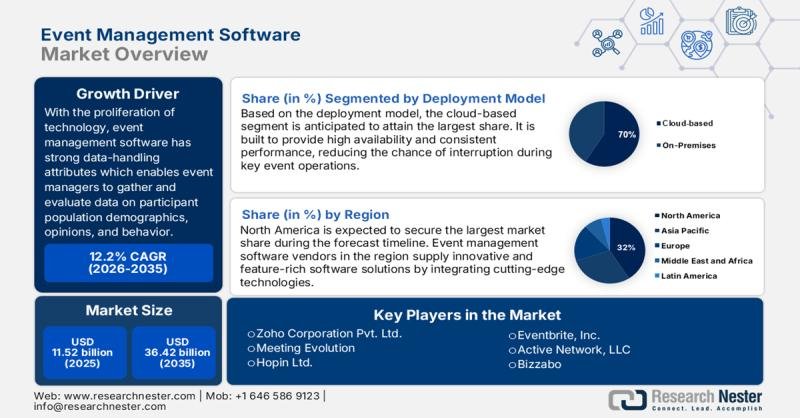
The Event Management Software Market is on a strong growth trajectory, reflecting the digital transformation of the global events industry. The market is projected to grow from USD 11.52 billion in 2025 to USD 36.42 billion by 2035, registering a compound annual growth rate (CAGR) of 12.2% between 2026 and 2035. This expansion is driven by the rising need for automation, real-time analytics, and enhanced attendee engagement across both in-person and virtual event formats.
➤ Request Free Sample PDF Report @ https://www.researchnester.com/sample-request-4999
Regional Performance Highlights
North America remains the dominant regional market, expected to account for approximately 32% of the global share by 2035. The region benefits from a mature digital infrastructure, high adoption of SaaS platforms, and a strong presence of leading event technology providers. Enterprises in the United States and Canada are early adopters of AI-powered event tools and hybrid event solutions.
Europe follows closely, with steady growth fueled by increasing corporate events, exhibitions, and government-backed initiatives promoting digital transformation. Countries such as Germany, the UK, and France are witnessing strong demand for integrated event management platforms, particularly in the B2B sector.
Asia Pacific is emerging as the second-largest market, anticipated to hold around 28% of the global share by 2035. Rapid urbanization, expanding corporate sectors, and the proliferation of startups are contributing to the region’s growth. Countries like India, China, and Southeast Asian nations are experiencing increased adoption of cloud-based event management software, especially for large-scale conferences and virtual events.
➤ Gain access to expanded insights on competitive strategies, market size, and regional analysis. Event Management Software Market Report Overview here: https://www.researchnester.com/reports/event-management-software-market/4999
Market Segmentation
The cloud-based deployment model dominates the market, accounting for approximately 70% of the total market share. Organizations prefer cloud solutions due to their scalability, cost-efficiency, and ability to support remote collaboration. Cloud platforms also enable real-time updates, integration with third-party tools, and centralized data management.
In terms of end-users, the event organizers and planners segment holds around 40% of the overall market share. These users rely heavily on event management software to streamline logistics, manage registrations, coordinate vendors, and analyze attendee behavior. Other key end-users include enterprises, educational institutions, and government organizations.
➤ Discover how the Event Management Software Market is evolving globally – access your free sample report → https://www.researchnester.com/sample-request-4999
Top Market Trends
1. Rise of Hybrid and Virtual Event Platforms
One of the most transformative trends in the Event Management Software Market is the widespread adoption of hybrid and virtual event models. Organizations are increasingly blending physical and digital experiences to reach broader audiences and improve accessibility.
Recent industry developments show that event platforms are integrating live streaming, virtual networking lounges, and AI-powered matchmaking features. For example, major conferences now offer simultaneous in-person and online participation, enabling global engagement without geographical constraints.
This trend has redefined event success metrics, shifting focus toward engagement analytics, attendee retention, and digital interaction rates.
2. Integration of Artificial Intelligence and Data Analytics
Artificial intelligence (AI) is playing a pivotal role in reshaping event management software capabilities. AI-driven tools are being used for personalized recommendations, predictive analytics, chatbots, and automated scheduling.
Event organizers are leveraging data analytics to gain insights into attendee preferences, optimize event layouts, and measure ROI more effectively. AI-powered matchmaking systems, for instance, connect attendees with relevant exhibitors or sessions, enhancing the overall event experience.
Additionally, sentiment analysis tools are being used to evaluate attendee feedback in real time, allowing organizers to make on-the-fly improvements.
3. Growing Emphasis on Sustainability and Green Events
Sustainability has become a key consideration in the events industry, influencing software development and event planning strategies. Event management platforms are now incorporating features that support eco-friendly practices, such as digital ticketing, paperless communication, and carbon footprint tracking.
Organizations are increasingly opting for virtual or hybrid events to reduce travel-related emissions. Software providers are also offering tools to measure and offset environmental impact, aligning with global sustainability goals.
This shift is particularly prominent in Europe, where regulatory frameworks and corporate sustainability commitments are driving demand for green event solutions.
➤ Unlock detailed analysis of key market trends transforming hybrid mobility. Get your sample report → https://www.researchnester.com/sample-request-4999
Recent Company Developments
The competitive landscape of the Event Management Software Market is dynamic, with both established players and emerging startups driving innovation. Over the past 12 months, several notable developments have taken place:
1. Cvent
Cvent has expanded its product suite by integrating advanced AI capabilities into its event marketing and management platform. The company recently launched enhanced analytics tools that provide deeper insights into attendee behavior and event performance.
2. Eventbrite
Eventbrite has focused on improving its creator tools, introducing new features for event promotion and ticketing optimization. The company has also invested in mobile-first enhancements to support on-the-go event management.
3. Bizzabo
Bizzabo has introduced new hybrid event solutions, including immersive virtual environments and AI-driven networking features. The company has also strengthened its partnerships with global enterprises to expand its market reach.
4. Hopin
Hopin has undergone strategic restructuring, focusing on core virtual event capabilities. The company has launched updated streaming and engagement tools aimed at improving user experience and scalability.
5. Whova
Whova continues to innovate in attendee engagement, rolling out features such as community boards, gamification tools, and advanced networking functionalities. These updates are designed to boost interaction during both virtual and in-person events.
➤ Request Free Sample PDF Report @ https://www.researchnester.com/sample-request-4999
Related News:
https://www.linkedin.com/pulse/what-driving-global-expansion-anime-market-today-rida-patel-eyief
https://www.linkedin.com/pulse/what-powering-rise-ai-iot-market-adinath-ahuja-drwpf
Contact Data
AJ Daniel
Corporate Sales, USA
Research Nester
77 Water Street 8th Floor, New York, 10005
Email: info@researchnester.com
USA Phone: +1 646 586 9123
Europe Phone: +44 203 608 5919
About Research Nester
Research Nester is a one-stop service provider with a client base in more than 50 countries, leading in strategic market research and consulting with an unbiased and unparalleled approach towards helping global industrial players, conglomerates and executives for their future investment while avoiding forthcoming uncertainties. With an out-of-the-box mindset to produce statistical and analytical market research reports, we provide strategic consulting so that our clients can make wise business decisions with clarity while strategizing and planning for their forthcoming needs and succeed in achieving their future endeavors. We believe every business can expand to its new horizon, provided a right guidance at a right time is available through strategic minds.
This release was published on openPR.