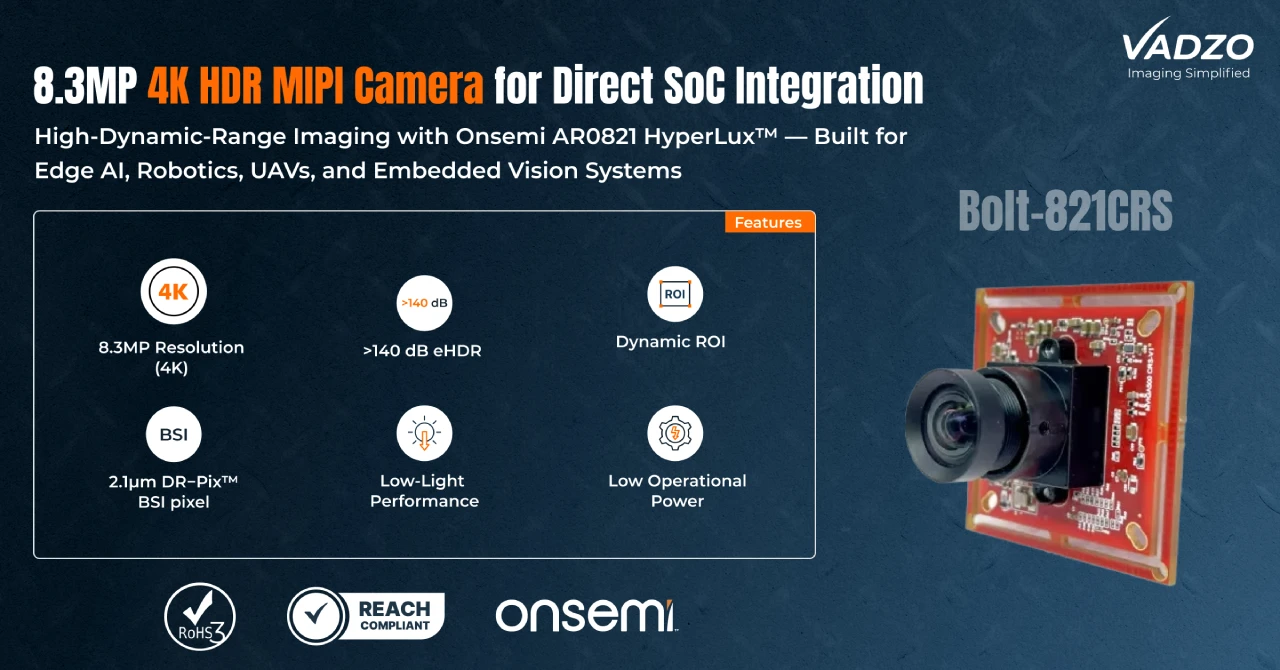
Vadzo’s Bolt-821CRS is a high-resolution 4K HDR MIPI CSI-2 camera module built on the Onsemi AR0821 HyperLux sensor, delivering embedded HDR exceeding 140 dB, direct SoC integration, and a compact board-level footprint purpose-built for UAV, robotics, medical, and edge AI platforms where USB overhead, power draw, and latency are system-level constraints.
FORT WORTH, TX / ACCESS Newswire / April 7, 2026 / Vadzo Imaging, a provider of embedded vision cameras, today announces the launch of the Bolt-821CRS, an 8.3MP 4K HDR MIPI CSI-2 camera module purpose-built for embedded vision engineers who need direct SoC integration without the overhead of a USB stack, driver layer, or intermediary controller. Built on the Onsemi AR0821 HyperLux sensor with embedded HDR exceeding 140 dB, the Bolt-821CRS delivers high-resolution HDR imaging at the board level with the low latency, minimal power draw, and compact footprint that MIPI-native platforms demand. For OEM teams designing vision into edge AI processors, application processors, and embedded SoCs, this is a 4K MIPI camera that integrates at the silicon level and stays out of the way of the rest of the system.
Sensor and Camera Overview
The Bolt-821CRS is built on the Onsemi AR0821 HyperLux sensor, a 1/1.7″ BSI CMOS device with 2.1 µm DR-Pix™ pixel technology, delivering 8.3MP (3848 × 2168) maximum resolution with embedded HDR exceeding 140 dB. The DR-Pix BSI architecture combines back-side illuminated pixel design with in-pixel dual conversion gain, enabling high dynamic range reconstruction directly at the sensor without requiring multi-frame merging or host-side tone mapping. The result is a high-resolution HDR MIPI camera that delivers correctly exposed output across extreme contrast ranges in a single captured frame, with no post-processing overhead on the host SoC.
The Bolt-821CRS outputs directly over 2-lane and 4-lane MIPI CSI-2, connecting to the ISP of the host SoC without bridging, USB enumeration, or driver-layer overhead. Module-level drivers are provided for major embedded platforms including Raspberry Pi 4, Raspberry Pi 5, NVIDIA Jetson Xavier NX, Jetson Orin NX, Jetson Orin Nano, Jetson Orin AGX, and NXP i.MX8M Plus, enabling rapid bring-up without custom sensor driver development. The camera accepts standard M12 (S-Mount) optics with a default 96° DFOV lens, operates across −30°C to 70°C, and is available with support for alternative focal lengths, IR-cut and IR-pass filter configurations, and custom flex cable assemblies for OEM integration.
Key specs: 8.3MP (3848×2168) | Onsemi AR0821 HyperLux 1/1.7″ 2.1 µm DR-Pix BSI | Rolling Shutter | eHDR >140 dB | 2-lane & 4-lane MIPI CSI-2 | S-Mount (M12) | 96° DFOV | −30°C to 70°C | RPI4 · RPI5 · Jetson Xavier NX · Orin NX · Orin Nano · Orin AGX · NXP i.MX8M Plus
Key Capabilities of the Bolt-821CRS 8.3MP 4K HDR MIPI CSI-2 Embedded Camera Module
Direct MIPI CSI-2 Integration: No USB Stack, No Driver Layer, No Intermediary Controller
The Bolt-821CRS outputs image data over MIPI CSI-2, connecting directly to the ISP of the host SoC without a USB controller, bridging chip, or operating system driver layer in the signal path. For embedded platforms with native CSI-2 receivers, including Raspberry Pi, Qualcomm, NXP, NVIDIA Jetson, TI AMx Series, and comparable SoC families, image data arrives at the processor in the fewest possible steps, with deterministic latency and without the enumeration delays or interrupt overhead that accompany USB-based 4K MIPI camera architectures. For OEM teams, direct MIPI integration also simplifies long-term platform maintenance: there is no USB firmware to track, no UVC compliance layer to validate, and no host driver to port when the base OS changes. Module-level drivers for Raspberry Pi 4, Raspberry Pi 5, Jetson Xavier NX, Orin NX, Orin Nano, Orin AGX, and NXP i.MX8M Plus are provided out of the box, covering the majority of embedded Linux platforms used in production edge AI and robotics deployments.
HDR Imaging Across High-Contrast and Dynamically Lit Environments
With embedded HDR exceeding 140 dB and eHDR reconstruction handled at the sensor level, the Bolt-821CRS AR0821 camera captures usable image data in scenes where standard cameras produce clipped highlights or crushed shadows, building entrances under direct sunlight, industrial floors with mixed artificial and natural light, and outdoor environments where illumination shifts continuously within a single frame. Adjustable exposure ratio control gives developers precise command over dynamic range behavior, enabling scene-specific tuning without post-processing pipelines or auxiliary hardware. For edge AI systems running inference directly on captured frames, sensor-level HDR reconstruction means the input to the model is already correctly exposed, reducing pre-processing overhead and improving detection consistency across lighting conditions.
Low Power Architecture for Battery-Constrained and Thermally Limited Platforms
MIPI CSI-2’s physical layer is designed for power efficiency in a way that USB 3.x is not. The Bolt-821CRS operates within the power envelope that embedded platforms allocate for imaging, drawing significantly less than equivalent USB-connected high-resolution camera modules by eliminating the USB PHY, controller silicon, and associated voltage regulation from the power path entirely. For UAV payloads with strict gram-and-milliwatt budgets, wearable devices with limited battery capacity, and industrial embedded systems with passive thermal management, this directly affects system runtime and thermal headroom. Engineers designing multi-camera configurations benefit further: lower per-camera power draw makes parallel MIPI CSI-2 camera arrays practical in platforms where a USB multi-camera setup would exceed the power budget.
Sensor-Level Controls for Edge AI and Resource-Constrained Pipelines
In-pixel binning, windowing, and flexible ROI configuration allow developers to precisely shape the output data stream at the sensor level, reducing resolution, frame area, or pixel count before data enters the ISP. For edge inference pipelines where the neural network input resolution is fixed and smaller than 4K, operating the AR0821 in a binned or windowed mode reduces CSI-2 lane bandwidth consumption, lowers ISP processing load, and frees compute resources for inference and application logic. These controls enable mode switching between full-resolution 4K HDR capture for imaging tasks and reduced-resolution streaming for inference without system restarts or hardware changes, critical for edge AI deployments where compute headroom is finite.
Compact Board-Level Footprint for Space-Constrained OEM Platforms
The Bolt-821CRS is designed to fit directly into embedded system PCB layouts without mechanical accommodation or redesign. The compact board footprint and standard MIPI connector interface allow the module to be treated as a board-level component during system layout, placed alongside the SoC, PMIC, and memory rather than mounted externally. The standard M12 lens mount accepts the default 96° DFOV optic and supports alternative focal lengths and field-of-view configurations for application-specific optical requirements without board changes.
OEM Customization Across Optical, Electrical, and Firmware Parameters
The Bolt-821CRS supports optical customization for alternative M12 lens configurations, DFOV variants, and IR-cut or IR-pass filter options, as well as electrical interface customization for teams integrating into proprietary connector schemes or custom flex cable assemblies. Firmware-level customization enables OEM teams to configure default streaming parameters, ISP behavior, and sensor operating modes for their specific deployment context, reducing bring-up time and eliminating the need to reconfigure camera parameters at application startup. Vadzo’s engineering team supports integration from initial evaluation through production release, providing ISP tuning, sensor configuration, and firmware development as part of the engagement model.
“MIPI cameras have always been the right architecture for serious embedded vision work, lower power, lower latency, direct ISP access, but the integration burden has historically made them harder to evaluate and deploy quickly than USB alternatives. The Bolt-821CRS was built to close that gap. We wanted OEM engineers to be able to bring up an AR0821 on their SoC platform without spending weeks on sensor bring-up, ISP configuration, or driver work. The combination of the HyperLux sensor’s HDR capability and pre-validated platform drivers means teams can move from evaluation board to production integration without switching hardware.” – Ashu Gupta, Product Manager, Vadzo Imaging
Target Applications UAV and Aerial Imaging Systems
Aerial imaging platforms operate under conditions that stress both imaging and power subsystems simultaneously, wide contrast ranges between sky and ground, continuously changing subject depth as altitude and camera angle vary, and strict payload budgets that assign fixed watt-hour allocations to every subsystem. The Bolt-821CRS addresses these constraints directly: MIPI CSI-2 integration eliminates USB PHY power draw, embedded HDR exceeding 140 dB handles the contrast range from direct sunlight to shadowed terrain in a single frame, and the compact board footprint keeps mechanical integration straightforward. For UAV OEM teams, the result is a 4K HDR MIPI camera that delivers high-resolution aerial imaging without the power or weight overhead of USB-connected alternatives.
Robotics and Autonomous Mobile Platforms
AGVs, collaborative robots, and autonomous inspection platforms depend on consistent, low-latency image delivery for navigation, object detection, and manipulation tasks. Latency introduced by a USB stack adds variability that deterministic control systems must account for. MIPI CSI-2 delivery to the SoC ISP removes that variability from the imaging pipeline, providing consistent frame timing that simplifies sensor fusion with IMU, LiDAR, and other perception inputs. The AR0821’s flexible ROI and binning modes allow developers to tune the high-resolution MIPI camera output to match exactly the resolution and frame rate the inference engine consumes, keeping the pipeline lean across all operating modes.
Medical Imaging and Clinical Devices
Medical device design imposes constraints that eliminate most commercial camera modules from consideration, compact board dimensions to fit within device housings, low power to meet IEC 60601 electrical safety requirements, and image quality consistent enough to support diagnostic or procedural use across varying lighting conditions. The Bolt-821CRS is a board-level 4K MIPI camera with a compact footprint compatible with medical device PCB layouts, power consumption in line with embedded medical platform budgets, and HDR imaging that maintains consistent exposure across the mixed lighting environments of clinical settings. Vadzo’s ISP tuning and firmware customization support enable device teams to configure imaging parameters for their specific clinical application.
Industrial Inspection and Machine Vision
Industrial inspection systems require cameras that deliver repeatable image output across wide illumination variation, backlit parts inspection, reflective surface imaging, and mixed ambient and structured light environments, with sensor controls precise enough to match inspection algorithm requirements without post-processing correction. The Onsemi AR0821 4K HDR MIPI CSI-2 camera provides sensor-level HDR handling and flexible ROI configuration that allow inspection engineers to define exactly the image area and dynamic range required for each inspection task. MIPI integration ensures frame data arrives at the ISP with minimal and consistent latency, supporting synchronization with conveyor triggers, strobe lighting, and PLC-driven inspection sequences.
Edge AI Inference Devices and Smart Terminals
Edge AI devices such as smart cameras, inference terminals, and embedded vision appliances are frequently compute-limited platforms where every milliwatt and every millisecond of processing latency affects product performance. The Bolt-821CRS is designed for this context: MIPI CSI-2 delivery feeds directly into the SoC ISP without USB host overhead, in-pixel binning enables the sensor to output at the resolution the inference engine consumes rather than requiring software downscaling, and the compact footprint allows the camera to be integrated as a board-level component within the device enclosure. For teams building smart terminal products on NVIDIA Jetson Orin, or NXP i.MX8M Plus, the Bolt-821CRS integrates into the platform’s native CSI-2 receive lanes without additional hardware.
Access Control and Perimeter Security
Access control and perimeter security installations encounter subjects across variable distances under predictably difficult lighting such as backlit building entrances, low-light overnight conditions, and high-contrast mixed-illumination zones at building perimeters. Standard cameras require scene-specific tuning or auxiliary lighting hardware to handle these conditions reliably. The Bolt-821CRS handles them at the sensor level with embedded HDR exceeding 140 dB and eHDR reconstruction that preserves subject detail across the full contrast range in a single captured frame. For OEM teams embedding this high-resolution HDR MIPI camera into gates, turnstiles, and perimeter monitoring hardware, MIPI integration simplifies board layout relative to USB alternatives and reduces power draw available to the rest of the access control electronics.
Frequently Asked Questions
What SoC platforms does the Bolt-821CRS 4K MIPI Camera support out of the box?
Module-level drivers are provided for Raspberry Pi 4, Raspberry Pi 5, NVIDIA Jetson Xavier NX, Jetson Orin NX, Jetson Orin Nano, Jetson Orin AGX, and NXP i.MX8M Plus. These cover the majority of embedded Linux platforms used in production robotics, edge AI, and industrial deployments. For platforms not on this list, Vadzo’s engineering team provides driver porting support as part of the OEM engagement model.
How does MIPI CSI-2 differ from USB for embedded vision?
MIPI CSI-2 connects the camera directly to the SoC’s ISP pipeline without a USB controller, bridging chip, or host driver layer in the signal path. This delivers deterministic, low-latency frame delivery without USB enumeration overhead, eliminates the USB PHY and controller from the power budget, and removes the USB compliance and driver maintenance burden from long-term platform management. For embedded platforms with native CSI-2 receivers, MIPI is the correct interface for production-grade vision integration.
What is the dynamic range capability of the Bolt-821CRS AR0821 camera?
The Bolt-821CRS delivers embedded HDR exceeding 140 dB through the Onsemi AR0821’s DR-Pix in-pixel dual conversion gain architecture. HDR reconstruction is performed at the sensor level, not through multi-frame merging or host-side tone mapping, meaning correctly exposed output is available directly from the camera without additional processing on the host SoC.
Can the Bolt-821CRS 4K HDR camera be customized for OEM integration?
Yes. Vadzo supports optical customization including alternative M12 lens configurations, DFOV variants, and IR-cut or IR-pass filter options. Electrical customization is available for proprietary connector schemes and custom flex cable assemblies. Firmware and ISP tuning are available for OEM teams configuring default streaming parameters and sensor behavior for their specific deployment context.
What MIPI lane configurations does the Bolt-821CRS MIPI camera support?
The Bolt-821CRS supports both 2-lane and 4-lane MIPI CSI-2 configurations, providing flexibility across SoC platforms with different CSI-2 receiver lane counts. 4-lane configuration supports full-resolution 4K output at maximum frame rates; 2-lane configuration is suitable for platforms with limited CSI-2 lane availability or lower-resolution operating modes.
Availability
The Bolt-821CRS Onsemi AR0821 4K HDR MIPI CSI-2 Camera Module is available now for evaluation and pre-production sampling, with production quantities available for OEM deployment. Evaluation units ship with a default 96° DFOV M12 lens. Engineering teams can access the full technical datasheet, CAD files, and driver documentation at vadzoimaging.com/product/ar0821-4k-hdr-mipi-camera, or contact Vadzo’s sales team directly for volume pricing, customization requirements, and integration support. Units can be ordered directly at vadzoimaging.com/product-page/ar0821-4k-hdr-mipi-camera.
About Vadzo Imaging
Vadzo Imaging develops embedded and machine vision cameras for OEMs and system integrators building production-ready vision systems across industrial automation, robotics, healthcare, and smart infrastructure. The company’s imaging platforms span USB, MIPI, GigE, Wi-Fi, and SerDes interfaces, covering the full range of embedded deployment architectures from compact edge devices to distributed networked systems. Vadzo provides end-to-end imaging support including sensor integration, ISP tuning, firmware development, and module-level drivers, giving engineering teams a single partner from initial evaluation through production lifecycle management.
Media Contact:
Ashu Gupta
Vadzo Imaging
Email: [email protected]
LinkedIn: Vadzo Imaging
YouTube: Vadzo Imaging
X: Vadzo Imaging
SOURCE: Vadzo Imaging