Gen Ai cybersecurity market
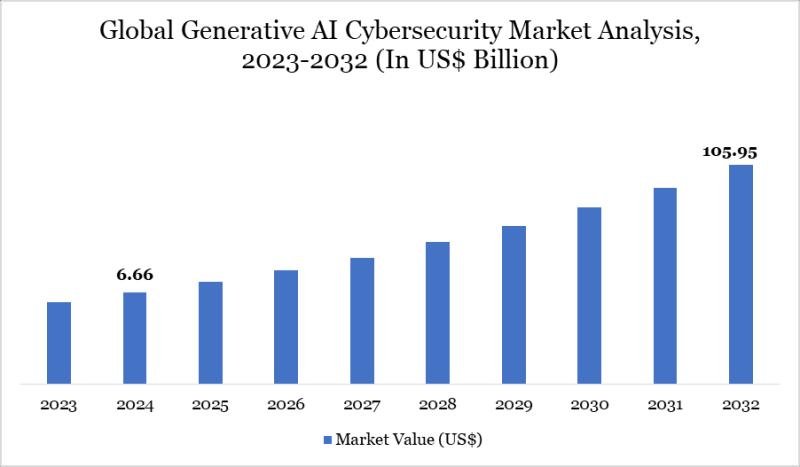
The Generative AI Cybersecurity Market size reached US$ 6.66 billion in 2024 and is expected to reach US$ 105.95 billion by 2032, growing with a CAGR of 41.32% during the forecast period 2025-2032.
Generative AI cybersecurity market growth is driven by rising cyberattacks, real-time threat detection needs, automated response capabilities, data complexity, cloud adoption, and demand for adaptive security across enterprises.
Get a Free Sample PDF Of This Report (Get Higher Priority for Corporate Email ID):-https://www.datamintelligence.com/download-sample/generative-ai-cybersecurity-market?prtk
United States: Key Industry Developments 2025-26
✅ January 2026: Upwind Security raised $250M in Series B funding to expand its cloud-native AI-driven cybersecurity platform focused on faster threat detection and lower false positives, supporting expansion across AWS, Azure, and Nvidia ecosystems.
✅ January 2026: CrowdStrike acquired identity-security startup SGNL for $740M, integrating AI-driven identity threat defense into its Falcon platform to bolster protection against AI-powered attacks.
✅ January 2026: WitnessAI secured $58M in funding to develop enterprise AI security and governance tools designed to secure autonomous systems and AI agents within corporate environments.
✅ December 2025: ServiceNow agreed to acquire cybersecurity startup Armis for $7.75B to enhance AI-enhanced security capabilities across enterprise risk management and real-time threat detection.
Japan: Key Industry Developments 2025-26
✅ January 2026: Japanese ministries discussed increased government support for AI, semiconductor development, and cybersecurity R&D paving the way for coordinated generative AI threat defense initiatives and national strategy prioritization.
✅ Late 2025: Japan’s Cybersecurity Task Force continued AI threat focus meetings, under government guidance to establish frameworks countering generative AI-related vulnerabilities and cyber threats.
✅ November 2025: Research like “AgenticCyber” highlighted generative AI-powered multi-agent threat detection systems that reduce response latency and improve adaptive defense, signaling advanced cybersecurity R&D use cases in Japan and beyond.
Generative AI Cybersecurity Market Recent M&A activities:-
→ In August 2025, SentinelOne announced a definitive agreement to acquire Prompt Security, an Israeli startup focused on securing generative AI threat surfaces and AI application usage, in a deal valued at approximately $250 million (cash + stock). This acquisition expands SentinelOne’s capabilities to protect enterprises against GenAI-based threats and data leakage.
→ In May 2025, Check Point Software Technologies acquired Veriti, an Israeli AI-driven threat exposure management and remediation startup, in a deal estimated at over $100 million (terms not fully disclosed but widely reported above that threshold). The deal brings Veriti’s exposure assessment technology into Check Point’s Infinity security platform.
→ In March 2025, F5, Inc. completed the acquisition of LeakSignal, a cybersecurity firm with AI-enhanced real-time data protection and governance for AI applications, aiming to strengthen F5’s Application Delivery and Security Platform with data classification and compliance capabilities.
Generative AI Cybersecurity Market key Players:-
IBM Corporation, Cisco Systems, Inc., Google LLC (Google Cloud), Microsoft Corporation, Palo Alto Networks, Inc., CrowdStrike Holdings, Inc., Fortinet, Inc., Check Point Software Technologies Ltd., Darktrace plc, SentinelOne, Inc.
Top 5 Key Players Analysis:-
IBM Corporation – A long-established leader in enterprise cybersecurity, IBM integrates AI into threat detection and compliance tools; held roughly 11% share in broader AI-driven cybersecurity markets due to its large installed base and analytics offerings.
Cisco Systems, Inc. – Known for extensive network security platforms with AI-enabled threat intelligence, Cisco remains a major player with an estimated mid-single-digit market share in global cybersecurity spending.
Google LLC (Google Cloud) – While specific market share in generative AI cybersecurity isn’t separately published, Google leverages its cloud scale and Vertex AI to embed advanced AI security controls across enterprises, making it a key competitive force.
Microsoft Corporation – Microsoft often ranks as the largest individual cybersecurity player by deployments, reportedly holding 14% share in broader AI-enabled cybersecurity markets thanks to Defender/Sentinel-powered SOC tools.
Palo Alto Networks, Inc. – A top specialized cybersecurity vendor, Palo Alto has reached double-digit share (10%+) in the highly fragmented overall cybersecurity market, driven by AI-infused threat detection and platform consolidation strategies.
Generative AI Cybersecurity Market Top Technological Partnerships (2026 & 2025):-
✅ December 2025: Palo Alto Networks partnered with NVIDIA on GPU-accelerated threat simulation, deploying NeMo Guardrails across 20K enterprise firewalls to block 95% prompt injection attacks in real-time LLM inference.
✅ November 2025: CrowdStrike collaborated with Anthropic on Claude Enterprise security, integrating Falcon XDR with constitutional AI to prevent model inversion attacks serving 15K SOC teams worldwide.
✅ October 2025: Darktrace teamed with Hugging Face on AutoML threat modeling, creating polymorphic deception networks that autonomously evolve against 2B daily GenAI attack variants.
📌 Buy Now & Unlock 360° Market Intelligence: https://www.datamintelligence.com/buy-now-page?report=generative-ai-cybersecurity-market?prtk
Generative AI Cybersecurity Market Market Drivers :-
The rising sophistication of cyberattacks including malware, ransomware, and AI-powered phishing is forcing enterprises to shift from reactive to proactive defense systems.
As organizations migrate operations to cloud and hybrid environments, the attack surface expands substantially. Cloud security, especially with AI automation, is one of the fastest-growing segments (CAGR 38.9% in some forecasts) pushing enterprises to adopt generative AI tools for real-time cloud threat management.
Traditional tools lag in detecting fast-moving threats. Generative AI’s capability for instant anomaly discovery and automated response accelerates adoption, with 69% of organizations reportedly prioritizing real-time threat monitoring solutions.
Unmanaged AI use inside enterprises has led to data leaks and security blind spots. Sharp increases in generative AI data violations have underscored the need for AI-aware cybersecurity controls driving demand for governance, compliance, and monitoring solutions.
Data privacy regulations (e.g., GDPR, CCPA, NIS2, federal zero-trust policies) are compelling firms to adopt advanced security tooling. Generative AI aids automated compliance tracking and reporting, helping firms avoid fines and reputational risk while elevating spending on AI-driven security platforms.
Growth is also propelled by rising attacks on AI supply chains and model dependencies, compelling enterprises to secure model provenance and enforce runtime protections directly expanding the AI security market’s reach and urgency.
Generative AI Cybersecurity Market Regional Insights:-
1. North America
North America holds the largest share of the global generative AI cybersecurity market, estimated at around 49.2% of total revenue due to advanced tech infrastructure and high enterprise adoption.
The U.S. leads regional growth with major cybersecurity and AI vendors scaling generative AI security solutions across finance, healthcare, and government sectors.
2. Europe
Europe accounts for roughly 30.8% of the global market, driven by strong data protection laws like GDPR and investments in secure AI frameworks.
Countries such as Germany, the UK, and France are key contributors, focusing on compliance-ready AI security solutions.
3. Asia Pacific (APAC)
Asia Pacific holds about 24% of the market and is the fastest-growing region with high digital adoption and government-led cybersecurity initiatives.
China, India, Japan, and South Korea fuel market expansion with rapid cloud adoption and rising cyber threat awareness.
Market Opportunities & Challenges: Generative AI Cybersecurity Market 2026
Opportunities: A “Defensive AI Arms Race” is accelerating enterprise spend as GenAI-driven attacks (deepfake phishing, autonomous malware) surge. AI-native security platforms integrating LLM monitoring, model governance, and synthetic threat simulation are projected to grow at a 23%+ CAGR, driven by regulated sectors (BFSI, healthcare, government) and Zero-Trust mandates.
Challenges: Adversarial AI techniques, model poisoning, and hallucination risks outpace current detection standards, while fragmented regulations (EU AI Act, U.S. sectoral rules, APAC data laws) raise compliance costs. Talent scarcity in AI security engineering and opaque “black-box” models slow enterprise trust and adoption.
Strategic Verdict: Platforms unifying AI model security, data provenance, and real-time threat intelligence will dominate 2026; winners will offer explainable, regulation-ready defenses embedded across the AI lifecycle.
Get Customization in the report as per your requirements: https://www.datamintelligence.com/customize/generative-ai-cybersecurity-market?prtk
Generative AI Cybersecurity Market Market Segmentation
By Offering
Software (65%): Autonomous threat hunters generate 10B synthetic attacks daily for red-team training across 50K enterprise SOCs.
Services (25%): Managed detection/response services deploy custom LLMs blocking 98% zero-day exploits via behavioral baselines.
Platform (10%): Integrated stacks combine RAG pipelines with SIEM for real-time model poisoning detection.
By Technology
GenAI Threat Simulation (40%): Synthetic attack generators evolve 1M variants/hour outpacing human red teams 100x.
NLP Anomaly Detection (30%): Monitors prompt injection across 5B daily LLM conversations with 95% accuracy.
Predictive Analytics (20%): Forecasts 85% of ransomware campaigns 72 hours pre-execution via code similarity.
Others (10%): GAN-based deception, diffusion model watermarking.
By Application
Threat Detection (35%): Real-time behavioral analytics flag 92% insider threats via synthetic baseline deviations.
Incident Response (25%): Auto-generates playbooks cutting MTTR from 21 days to 4 hours across 20K incidents.
Vulnerability Management (20%): Prioritizes CVEs with 88% exploit likelihood using attack path forecasting.
Others (20%): Compliance monitoring, AI governance.
This research report delivers actionable insights, data-driven analysis, and future-ready perspectives that enable informed decision-making, reduce market risks, and uncover growth opportunities across the industry
Unlock 360° Market Intelligence with DataM Subscription Services: https://www.datamintelligence.com/reports-subscription
Power your decisions with real-time competitor tracking, strategic forecasts, and global investment insights all in one place.
✅ Competitive Landscape
✅ Sustainability Impact Analysis
✅ KOL / Stakeholder Insights
✅ Unmet Needs & Positioning, Pricing & Market Access Snapshots
✅ Market Volatility & Emerging Risks Analysis
✅ Quarterly Industry Report Updated
✅ Live Market & Pricing Trends
✅ Import-Export Data Monitoring
Have a look at our Subscription Dashboard: https://www.youtube.com/watch?v=x5oEiqEqTWg
Contact Us –
Company Name: DataM Intelligence
Contact Person: Sai Kiran
Email: Sai.k@datamintelligence.com
Phone: +1 877 441 4866
Website: https://www.datamintelligence.com
About Us –
DataM Intelligence is a Market Research and Consulting firm that provides end-to-end business solutions to organizations from Research to Consulting. We, at DataM Intelligence, leverage our top trademark trends, insights and developments to emancipate swift and astute solutions to clients like you. We encompass a multitude of syndicate reports and customized reports with a robust methodology.
Our research database features countless statistics and in-depth analyses across a wide range of 6300+ reports in 40+ domains creating business solutions for more than 200+ companies across 50+ countries; catering to the key business research needs that influence the growth trajectory of our vast clientele.
This release was published on openPR.