A ransomware strain enters the network, begins executing, and then modifies itself. Mid-run, its binary structure mutates just enough to evade every signature-based control in place. Almost simultaneously, an employee receives an urgent call from the “CEO.” The voice is familiar, authoritative, unmistakable. Within seconds, $243,000 is wired out of the organization, authorized by a decision that felt human but was engineered entirely by a deepfake voice model.
This is not a hypothetical scenario or a future-forward thought experiment. It reflects the operational reality of 2026.
Cybercrime now costs the global economy an estimated $8 trillion annually, driven less by scale alone and more by a fundamental shift in attacker capability. Adversaries are no longer operating manually or opportunistically. They are using generative AI to automate reconnaissance, adapt malware in real time, and execute intrusions at machine speed. While defenders analyze alerts and validate assumptions, attacks are already changing form, moving laterally, and extracting value. The imbalance is no longer gradual. It is immediate, measurable, and accelerating.
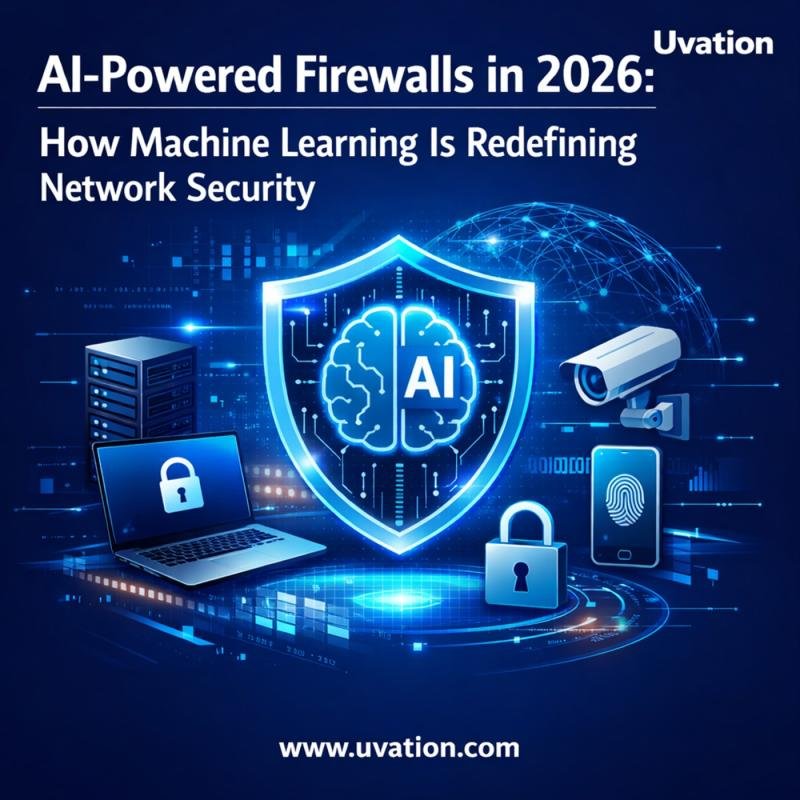
This blog examines how machine learning is redefining network security, how autonomous AI-driven systems are reshaping detection and response, and what organizations must do now to remain resilient.
Why the Legacy Paradigm Has Reached Its Breaking Point
For years, security teams have responded to growing threats by adding more controls, more tools, and more people. On paper, this should have worked. In practice, it has created a fragile, overextended defense model, one that was never designed for adversaries that think, adapt, and operate at machine speed. The traditional, human-led security paradigm is not failing because teams lack skill or effort. It is failing because the assumptions it was built on no longer hold true.
• The Failure of Signatures
Signature-based detection is inherently backward-looking. It cannot stop zero-day exploits, polymorphic malware, or attacks designed to appear new on every execution.
• The Explosion of the Attack Surface
Multi-cloud environments, edge computing, remote users, and an expected 50 billion IoT devices by 2030 have expanded networks beyond the limits of manual control and static policies.
• Tool Sprawl and Analyst Burnout
Enterprises typically run 45-75 siloed security tools, creating alert overload, fragmented visibility, and exhausted analysts forced to connect the dots manually.
• The Speed Gap
With breakout times shrinking to 48 minutes, human-led SOC workflows are simply too slow to detect, investigate, and contain modern attacks.
These factors illustrate why legacy defenses alone are insufficient. The increasing complexity and speed of attacks demand AI-powered, autonomous approaches that can detect, analyze, and respond in real time.
The Pillars of Autonomous Cyber Defense
As legacy defenses struggle to keep pace, organizations are turning to AI and machine learning to fill the gap. These technologies don’t just alert or report: they learn, adapt, and respond in real time, making it possible to detect and contain threats faster than any human team could. The core pillars of this autonomous approach include:
• Behavioral Analytics (UEBA): AI establishes a baseline of normal activity for each user and device. Any deviation, such as unusual login times, unexpected data transfers, or atypical access patterns is automatically flagged for investigation. This approach identifies threats that would bypass signature-based systems.
• Unified Telemetry through Open XDR: Modern platforms consolidate data from network, endpoint, cloud, and identity sources to provide a holistic view of attacks. By connecting disparate signals, AI can reconstruct attacker kill chains and identify compromised assets in real time.
• Predictive Threat Modeling: Machine learning models process global threat intelligence to forecast which vulnerabilities are most likely to be targeted. This enables proactive measures like prioritized patching and early containment before an attack unfolds.
• Instant Autonomous Response: AI-driven systems can execute the entire detection-to-response workflow independently, including actions like host quarantine, account lockdown, and process isolation. This reduces reliance on human intervention and dramatically shortens response times.
These pillars represent a shift from reactive to proactive, autonomous defense, where machine intelligence continuously strengthens the network, keeping pace with threats that humans alone cannot manage.
2026 & Beyond: The Rise of Agentic AI and Self-Healing Networks
The next evolution of network security goes beyond detection and response. AI is moving from reactive assistance to autonomous, agent-driven operations that can anticipate, contain, and correct issues without waiting for human input.
• Multi-Agent Systems: Specialized AI agents now work together as “agent swarms”. Each agent focuses on a specific task: threat hunting, containment, or analysis, and coordinates in real time to manage complex attacks across the network.
• Self-Healing Capabilities: Intelligent networks can automatically detect misconfigurations, disruptions, or anomalies and apply corrective actions immediately, restoring normal operations without manual intervention.
• Explainable AI (XAI): Compliance and trust require visibility into AI decisions. Techniques like SHAP and LIME make AI reasoning transparent, providing analysts with clear explanations for why a specific event was flagged and what actions were taken.
This generation of AI transforms networks from reactive systems into proactive, self-managing ecosystems. Security teams are now guiding a system that learns, adapts, and protects itself continuously.
The Economic Imperative: Why ROI is Now Tangible
AI-driven network security is no longer just a technical upgrade; it is a strategic investment with measurable returns. Organizations that adopt autonomous defenses are seeing clear benefits across costs, efficiency, and workforce effectiveness.
• Cost Reduction: Companies leveraging AI and automation report an average savings of $2.22 million in breach-related costs compared to those relying solely on manual processes. Early detection and automated containment prevent incidents from escalating, directly impacting the bottom line.
• Operational Efficiency: AI handles routine triage, correlates alerts, and reduces false positives by up to 99%, allowing security teams to focus on high-value tasks. Operational costs drop by 50-70% as redundant processes and alert fatigue are eliminated.
• Workforce Uplift: Automation acts as a force multiplier, enabling lean security teams to concentrate on strategic initiatives while AI manages the heavy operational workload. Analysts spend less time firefighting and more time shaping defenses for future threats.
Investing in AI-driven security is no longer optional. It delivers tangible financial and operational benefits while ensuring the organization can respond to threats faster, smarter, and at scale.
Final Word
By 2026, the adoption of machine learning in network security represents a measured shift toward more autonomous and predictive systems. This evolution enables organizations to move from reactive defense models toward a state of proactive resilience through self-learning platforms. A successful long-term strategy will likely rely on platformization, which integrates network, endpoint, and cloud telemetry into unified decision engines to reduce operational complexity and close visibility gaps. As AI-driven security operations become the industry standard by 2030, the role of human security professionals is expected to evolve from manual data triage to high-level strategic oversight. Ultimately, adopting these intelligent systems helps ensure that organizations remain resilient and compliant as digital environments continue to grow in scale and complexity.
Uvation Services: Enabling Operational-First Security and IT
As organizations modernize firewall management and adopt AI-driven security, maintaining reliable, continuous IT and security operations is critical. Uvation offers managed services that ensure performance, governance, and resilience across environments while allowing internal teams to retain strategic control.
Key service areas include:
• Managed Security Operations: 24×7 monitoring, rapid incident response, and policy enforcement.
• Managed Network & Cloud Operations: Resilient connectivity and operational oversight across cloud and hybrid environments.
• Managed IT and Datacenter Operations: Optimizing reliability and reducing operational overhead.
• Managed Advisory & ML/AI Operations: Strategic guidance and support for production-scale AI workloads.
Book a call with Uvation or Visit http://www.uvation.com and get a free consultation and evaluate your firewall, security, and IT strategy.
633 West Fifth Street, Suite 2801, Los Angeles, CA 90071, United States
Uvation is a leading technology solutions provider specializing in AI-powered solutions for businesses. We offer a comprehensive suite of services, including AI infrastructure, cyber security, and marketplace solutions. Our innovative approach helps organizations streamline operations, enhance security, and drive growth.
This release was published on openPR.