Potentiometer Market
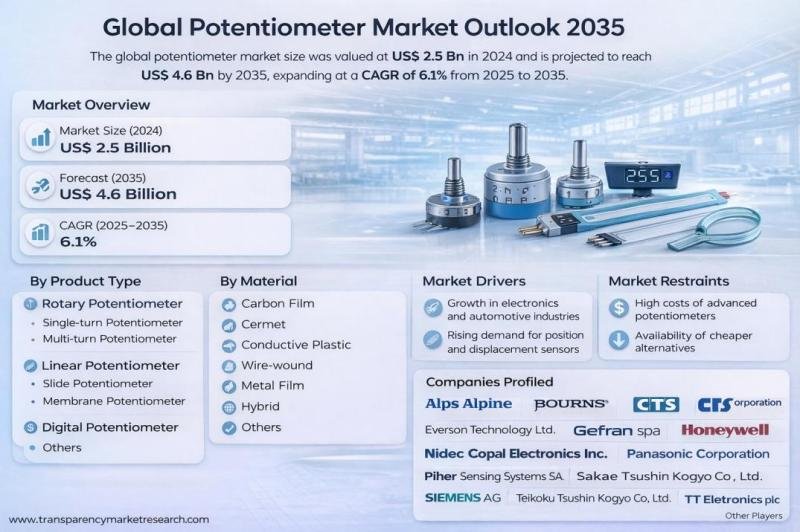
The global potentiometer market was valued at US$ 2.5 Billion in 2024 and is projected to reach US$ 4.6 Billion by 2035, expanding at a compound annual growth rate (CAGR) of 6.1% from 2025 to 2035. Market growth is primarily driven by the rapid proliferation of smart devices and the expanding adoption of industrial automation and robotics across multiple end-use industries.
Access key findings and insights from our Report in this sample – https://www.transparencymarketresearch.com/sample/sample.php?flag=S&rep_id=44420
Market Overview
The potentiometer market represents a vital segment of the global electronic components industry. Potentiometers, also known as variable resistors, are widely used for precise control of voltage, resistance, and signal input across a wide range of electrical and electronic applications. These components enable adjustment and calibration of parameters such as volume, speed, brightness, and position in both manual and automated systems.
Potentiometers are extensively integrated into consumer electronics, automotive systems, and industrial machinery. In consumer electronics, they are commonly found in audio equipment, home appliances, gaming controllers, and display systems. In the automotive sector, potentiometers are used for throttle position sensing, steering systems, pedal modules, and various electronic control units.
Key Market Growth Drivers
Growth of IoT and Smart Devices
The accelerating adoption of the Internet of Things (IoT) and smart technologies is a major driver of the potentiometer market. IoT-enabled devices-including wearables, smart appliances, smart lighting systems, and industrial monitoring solutions-require compact, energy-efficient, and highly reliable components for measurement, control, and feedback.
Potentiometers play a crucial role in enabling accurate signal adjustment, calibration, and automated control within connected devices. As a result, demand for digital potentiometers is increasing, as they offer programmable control, greater precision, and seamless compatibility with microcontrollers and wireless communication technologies commonly used in IoT architectures. The growing need for remote adjustment and automation in smart homes, smart offices, and industrial IoT environments is expected to significantly contribute to market growth over the forecast period.
Expansion of Industrial Automation and Robotics
The expansion of industrial automation and robotics is another key factor fueling demand for potentiometers. Modern manufacturing facilities increasingly rely on automated systems that require precise position sensing, real-time feedback, and reliable motion control. Potentiometers are widely used in automation applications for calibrating production lines, controlling actuators, regulating speed, and ensuring accurate machine positioning.
In robotics, potentiometers-particularly rotary and linear types-are essential for tracking movement and controlling end-effectors. Their ability to convert mechanical motion into measurable electrical signals makes them a preferred choice for automation systems. As industries continue to adopt smart factories, robotics, and AI-driven manufacturing processes, the demand for reliable and cost-effective potentiometers is expected to grow steadily.
Analysis of Key Players
• Alps Alpine Co., Ltd.
• Bourns, Inc.
• CTS Corporation
• Everson Technology Ltd.
• Gefran spa
• Honeywell International Inc.
• Nidec Copal Electronics Inc.
• Panasonic Corporation
• Piher Sensing Systems SA
• Sakae Tsushin Kogyo Co., Ltd.
• Sensata Technologies Holding plc
• Siemens AG
• Teikoku Tsushin Kogyo Co., Ltd.
• Tokyo Cosmos Electric Co., Ltd.
• TT Electronics plc
• Other Players
These companies are profiled in the market research report based on parameters such as company overview, financial performance, product portfolio, business strategies, and recent developments. Continuous investment in R&D and the introduction of advanced digital potentiometers are central to maintaining competitiveness in this evolving market.
Market Challenges & Opportunities
Despite strong growth prospects, the potentiometer market faces challenges such as pricing pressure from commoditization, competition from alternative sensing technologies, and the need for miniaturization without compromising performance.
However, these challenges present significant opportunities for innovation. The rising adoption of EVs, IoT devices, and industrial automation systems is creating demand for high-precision, durable, and digitally integrated potentiometers. Advancements in digital potentiometer ICs, improved durability, and enhanced compatibility with smart systems are expected to open new revenue streams for manufacturers.
Recent Developments
• In March 2025, Texas Instruments launched the MSPM0C1104 MCU, which includes digital control interfaces supporting the trend of embedding digipots in small IoT devices and wearables.
• In March 2025, Mouser Electronics formed a strategic distribution partnership with Microchip Technology for expanding the availability of digital potentiometer ICs for automotive and industrial markets.
Explore our report to uncover in-depth insights – https://www.transparencymarketresearch.com/potentiometer-market.html
Market Segmentations
By Product Type
• Rotary Potentiometer
o Single-turn Potentiometer
o Multi-turn Potentiometer
• Linear Potentiometer
o Slide Potentiometer
o Membrane Potentiometer
• Digital Potentiometer
• Others
By Material
• Carbon Film
• Cermet
• Conductive Plastic
• Wire-wound
• Metal Film
• Hybrid
• Others
Mounting Method
• Surface-Mount Technology (SMT)
• Through-Hole Technology
• Panel Mount
• PCB Mount
• Others
By Technology Type
• Analog
• Digital
Application
• Motion/Position Sensing
• Volume/Audio Control
• Calibration & Adjustment
• Feedback Control Systems
• Test & Measurement Equipment
• User Interface Control
• Others
Sales Channel
• OEM (Original Equipment Manufacturer)
• Aftermarket
The rotary potentiometer segment dominates due to its cost-effectiveness, durability, and broad application across automotive, consumer electronics, and industrial systems. These devices provide precise and reliable feedback for parameters such as volume, speed, intensity, and position.
Regional Outlook
The Asia Pacific region dominated the global potentiometer market in 2024, accounting for approximately 40% of total revenue. The region’s leadership is supported by strong electronics manufacturing capabilities, availability of skilled labor, and rapid technological advancement.
Countries such as China, Japan, South Korea, and India are major producers of electronics, automotive components, and industrial equipment that extensively utilize potentiometers for sensing, control, and calibration. The growing production of electric and hybrid vehicles in the region is further driving demand for potentiometers used in throttle sensors, steering position control, and pedal modules.
In addition, Asia Pacific is a global hub for consumer electronics manufacturing, including audio systems, appliances, gaming devices, and IoT products, all of which contribute significantly to potentiometer consumption. Ongoing industrialization and automation initiatives across the region are expected to sustain its market dominance through 2035.
Why Buy This Report?
• Gain comprehensive insights into market size, growth trends, and forecasts through 2035
• Understand key drivers, challenges, and emerging opportunities shaping the market
• Analyze the competitive landscape and strategies of leading market players
• Access detailed segmentation and regional outlook data
• Support strategic planning for manufacturers, investors, and stakeholders
Buy this Premium Research Report for exclusive, in-depth insights – https://www.transparencymarketresearch.com/checkout.php?rep_id=44420<ype=S
FAQs
1. What is the current size of the potentiometer market?
The global potentiometer market was valued at US$ 2.5 Billion in 2024.
2. What is the expected growth rate of the potentiometer market?
The market is projected to grow at a CAGR of 6.1% from 2025 to 2035.
3. Which region leads the global potentiometer market?
Asia Pacific leads the market with a 40% revenue share.
4. Which type of potentiometer dominates the market?
Rotary potentiometers dominate the market, accounting for 58% of total revenue in 2024.
5. What are the key industries driving potentiometer demand?
Major demand comes from automotive, industrial automation, consumer electronics, and IoT-enabled devices.
More Trending Reports by Transparency Market Research –
NOR Flash Market: https://www.transparencymarketresearch.com/nor-flash-market.html
Pressure Transmitter Market: https://www.transparencymarketresearch.com/pressure-transmitters-market.html
Current Sensor Market: https://www.transparencymarketresearch.com/current-sensor-market.html
Semiconductor Wafer Polishing and Grinding Equipment Market: https://www.transparencymarketresearch.com/semiconductor-wafer-polishing-and-grinding-equipment-market.html
About Transparency Market Research
Transparency Market Research, a global market research company registered at Wilmington, Delaware, United States, provides custom research and consulting services. Our exclusive blend of quantitative forecasting and trends analysis provides forward-looking insights for thousands of decision makers. Our experienced team of Analysts, Researchers, and Consultants use proprietary data sources and various tools & techniques to gather and analyses information.
Our data repository is continuously updated and revised by a team of research experts, so that it always reflects the latest trends and information. With a broad research and analysis capability, Transparency Market Research employs rigorous primary and secondary research techniques in developing distinctive data sets and research material for business reports.
Contact:
Transparency Market Research Inc.
CORPORATE HEADQUARTER DOWNTOWN,
1000 N. West Street,
Suite 1200, Wilmington, Delaware 19801 USA
Tel: +1-518-618-1030
USA – Canada Toll Free: 866-552-3453
Website: https://www.transparencymarketresearch.com
Email: sales@transparencymarketresearch.com
This release was published on openPR.