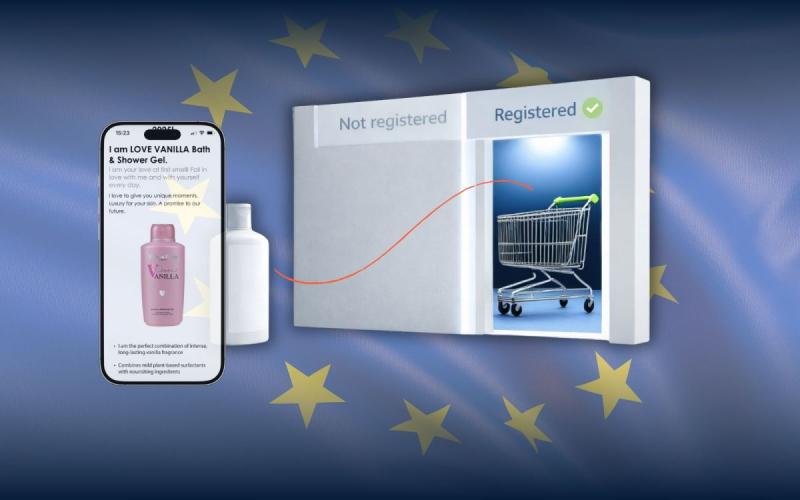
New market access logic: DPP registration becomes mandatory for product placement in the EU market ( (C) Narravero GmbH)
Muenster, January 19, 2026 – The Digital Product Passport has long been a political project. A framework. A roadmap with many open variables. Today, in just six months (!) on July 19, the European Commission is establishing the registry for the Digital Product Passport (DPP)!
Launch of the DPP Registry on July 19, 2026
What sounds bureaucratic marks a fundamental system change. In exactly six months, there will be a central, operational registry for Digital Product Passports. No pilot, no white paper, no draft – just a real infrastructure.
However, the explosive charge lies elsewhere. The official EU documents state unequivocally: “Once the DPP exists and is registered in the DPP Registry, the product can be placed on the market.”
This is more than just a sentence. It is a new market access logic. And registration is no longer a formality. It becomes a prerequisite for products in the relevant categories to be placed on the market at all. It does this by making it visible whether a valid product passport exists for a product and where it is located.
What this means in practice:
1. Product passports become traceable
Each affected product receives a unique identifier, for example a product ID, and the registry can use this identifier to answer:
“Yes, a digital product passport exists for this product – and here is where it can be found.”
Market surveillance authorities and customs offices can thus check whether a DPP exists for a product, whether it is valid, and whether the product may be placed on the market accordingly.
2. Product passports become technically verifiable
The registry does not check the content itself, but rather formal aspects such as authenticity and integrity:
* Formal aspects: Does a product passport exist at all, and is it formally correct?
* Authenticity and integrity: Is it genuine (i.e., created by an authorized company) and has it been modified subsequently?
What is often misunderstood: The registry does not store the entire product passport content. The DPP itself can be located:
* at the manufacturer
* at a service provider
* or in a decentralized infrastructure
Once the registry goes live, it is no longer what companies say that counts, but what their systems can prove – and sustainability finally leaves the realm of declarations of intent.
From July 2026, the Digital Product Passport will no longer be a concept, but a system. And systems do not ask questions about attitude or intention. They either work – or they exclude.
For companies, this means that the leeway they previously had to explain, report, or narrate sustainability is shrinking dramatically. It is no longer enough to say that you are preparing. From this point on, it will become clear whether products can be registered at all. Whether data is available consistently. Whether responsibilities have been clarified.
The real wake-up call is not a new obligation, but the commissioning of the infrastructure. From July 2026, it will no longer be promises that count, but infrastructure capability. And infrastructure capability means much more than just an existing data set: it includes role-based access along the value chain, interoperable data and identification standards, and the ability to keep product information up to date throughout the entire life cycle.
Narravero Gmbh
Am Mittelhafen 10
48155 Muenster
Germany
Frau Dr.Inga Ellen Kastens
025174788851
ingaellen.kastens@narravero.com
In addition to his role as CEO at Narravero, Thomas Roedding is co-chair of the European standardization committee JTC 24* on the Digital Product Passport, in which around 400 experts from 24 countries and 32 liaison organizations are developing eight EU-wide DPP standards. He supports the national DIN/DKE joint committee, participates in the ZIRPAS II research project, and represents JTC 24 internationally–including at the United Nations in Geneva and the Chinese-German cooperation conference on the Digital Product Passport in Qingdao.
More at: http://www.narravero.com
*** is the central European standardization committee for the Digital Product Passport**. Full name: CEN/CENELEC Joint Technical Committee 24 “Digital Product Passport – Framework and System.” JTC 24 develops harmonized European standards for the entire DPP system: i.e., for identifiers, data carriers (e.g., QR, NFC, RFID), interfaces/APIs, security, data storage, and interoperability – across all industries
This release was published on openPR.