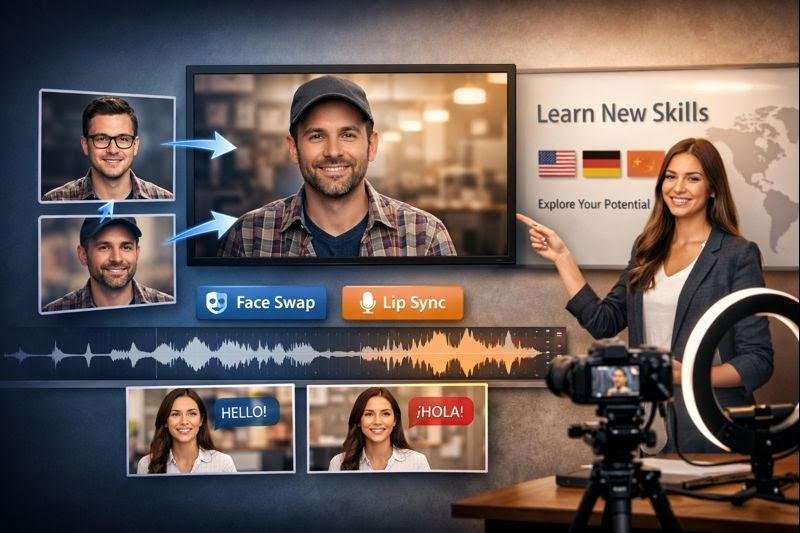
Short-form video creators, marketers, and small teams are under constant pressure to publish more content without expanding production time or budget. In response to this reality, more workflows are shifting from “edit everything from scratch” to “reuse strong footage and transform it safely and intentionally.” Two of the most common transformations today are face swap (for character continuity and format reuse) and lip sync (for quick narration or multilingual voiceovers).
While these techniques are often discussed as trends, the most useful conversation is about process: how to apply them responsibly, keep output consistent, and avoid common quality issues like mismatched lighting, unnatural mouth movement, or identity confusion in collaborative teams.
This release outlines a creator-friendly approach: a repeatable workflow, quality checkpoints, and a decision table that helps teams choose the right method for the job.
Why face swap workflows are becoming “production infrastructure”
In modern content pipelines, face swap is increasingly used less as a gimmick and more as a format tool-especially for creators who publish series content (recurring characters, recurring hosts, recurring hooks). The value is simple: once a format works, the fastest way to scale is to keep what’s working stable and change only what’s necessary.
Common scenarios include:
Series continuity: keeping the same “host” across a multi-part video series
Localization workflows: maintaining visuals while adapting spoken content for different languages
Reshoots without reshooting: fixing a clip when the performance is good but a visual element needs revision
Creative testing: swapping a persona to see if a different “on-camera presence” lifts retention
For teams looking to produce consistent character-led clips, tools like a dedicated face swap video[https://www.goenhance.ai/face-swap] workflow can reduce repetitive re-recording and shorten iteration cycles-especially when the source clip is already strong and only the “who” needs to change.
A simple, repeatable workflow that protects quality
The fastest teams don’t move faster by cutting corners-they move faster by reducing uncertainty. Here’s a workflow that tends to hold up:
Step 1: Start with a clean base clip (quality matters more than settings)
Choose a source video that already has:
stable lighting (no heavy flicker)
clear face visibility (limited occlusion)
minimal extreme motion blur
acceptable framing (avoid constant profile angles)
If the base is messy, transformations often amplify the mess.
Step 2: Set a single goal per version
Pick one primary objective:
“Keep the same scene, change the performer”
“Keep the Same Performer, Change the Message”
“Localize the voice while preserving the visuals”
One goal per version keeps outcomes predictable and reduces the “everything changed and I don’t know why” problem.
Step 3: Run transformation, then validate with a quick checklist
Quality checks that save time later:
Does the face match the lighting direction and color temperature?
Do expressions track the motion in a believable way?
Are there frame jumps near fast head turns?
Do mouth shapes align with the audio timing?
Step 4: Export small tests before committing to a full batch
A 5-10 second sample can reveal most issues. Fix early, then scale.
Decision table: Face swap vs lip sync vs reshoot
Below is a quick guide used by many creators to choose the right approach based on the goal.
Goal
Best first move
Why it works
Watch-outs
Scale a proven series format
Face swap
Keeps a winning structure while testing a new persona
Lighting mismatch if source is inconsistent
Add narration without filming
Lip sync
Faster than a full talking-head reshoot
Mouth timing needs clean audio
Localize for new regions
Lip sync
Preserves visuals while adapting language
Pronunciation and cadence need review
Fix a clip with strong acting
Face swap
Saves the performance while repairing identity continuity
Avoid unrealistic skin tone shifts
High-trust brand message
Reshoot or hybrid
Maximum control and fewer artifacts
Highest time cost
Where lip sync fits, especially for multilingual content
For creators producing tutorials, product explainers, or educational shorts, lip sync is often the missing piece that makes repurposing actually work. Instead of rebuilding visuals, teams can adapt the spoken track for different languages, tones, or scripts-while keeping pacing and structure consistent.
A practical example:
same demo footage
same on-screen captions layout
localized voiceover with matching mouth movement
consistent branding across regions
For teams that want a lightweight way to test this, an AI lip sync video generator free[https://www.goenhance.ai/lip-sync] option can help produce quick drafts before committing to higher-production localization.
Responsible use and trust signals (EEAT considerations)
As these workflows become mainstream, audiences also expect transparency and responsible handling. For brands and publishers, trust is not optional-it’s the foundation for sustainable distribution.
Best practices many teams follow:
Use consent-based inputs: only use faces and voices you have rights to use
Label synthetic or altered media when appropriate: especially for ads, endorsements, or public-facing claims
Avoid impersonation: do not represent altered footage as a real person’s statement or action
Maintain internal controls: store source assets securely and limit access in team workflows
In short: the same tools that make production faster also require stronger standards.
A practical takeaway for creators and small teams
Face swap and lip sync aren’t “magic buttons.” They’re best treated like editing capabilities: powerful when used with a plan, unreliable when used as a shortcut without quality control.
The most effective workflow is simple:
Start with a strong base clip
Change one thing at a time
Validate with a checklist
Scale only after the sample looks right
That approach helps teams move faster and protect credibility-two goals that usually conflict in short-form production.
Media Contact
Company Name: Astha Credit & Securities Pvt Ltd NSE, BSE & MCX SEBI
Contact Person: Irwin
Country: India
https://www.goenhance.ai/
Media Contact
Company Name: Astha Credit & Securities Pvt Ltd NSE, BSE & MCX SEBI
Contact Person: Irwin
Country: India
https://www.goenhance.ai/
This release was published on openPR.