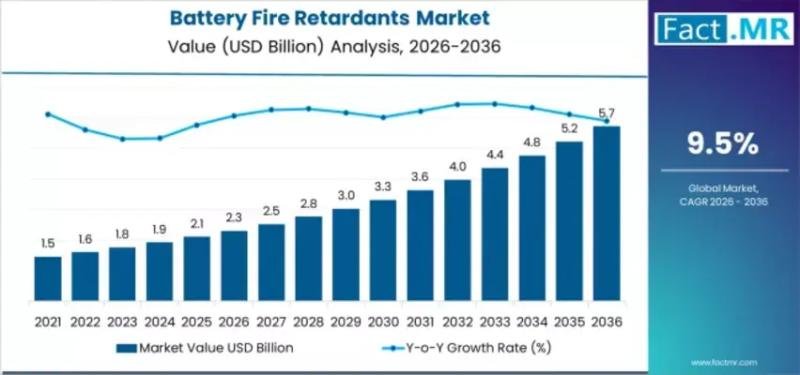
The battery fire retardants market is projected to witness robust growth over the next decade as demand for safer, more resilient energy storage systems continues to rise across electric vehicles, consumer electronics, grid storage applications, and industrial uses. In 2026, the market is valued at approximately USD 1.9 billion, and it is expected to reach USD 5.3 billion by 2036, representing an absolute increase of USD 3.4 billion over the forecast period. This expansion reflects a compound annual growth rate (CAGR) of around 10.9% between 2026 and 2036, supported by stringent safety regulations, growing adoption of lithium-ion batteries, and increasing concerns about thermal runaway and fire hazards in high-energy-density battery systems.
Quick Market Snapshot (2026-2036)
Market Value (2026): USD 1.9 Billion
Market Forecast Value (2036): USD 5.3 Billion
Forecast CAGR: ~10.9%
Leading Material Types: Intumescent additives, mineral fillers, halogen-free retardants, synergistic fire retardant systems
Key End-Use Industries: Electric vehicles, consumer electronics, energy storage systems, industrial batteries
Primary Growth Drivers: EV safety requirements, energy storage deployment, consumer electronics safety standards
Major Growth Regions: Asia Pacific, North America, Europe
To access the complete data tables and in-depth insights, request a Discount On The Report here: https://www.factmr.com/connectus/sample?flag=S&rep_id=12981
Market Overview
Battery fire retardants are critical components in modern battery designs, particularly for lithium-ion and other high-energy chemistries that are susceptible to thermal runaway – a chain reaction that can cause rapid temperature increases and potential fires. Fire retardant additives can be incorporated directly into polymer separators, electrode binders, electrolyte compositions, and pack-level materials. They function by enhancing char formation, diluting combustible gases, inhibiting radical chain reactions, or forming protective barriers that shield critical components from heat and flame.
In addition to additives, specialised coatings and barrier films are applied to battery casings, wiring harnesses, and module interfaces to slow down or prevent flame spread. These combined strategies help manufacturers comply with evolving safety standards, improve consumer confidence, and reduce warranty, recall, and liability costs associated with battery fires.
Key Demand Drivers
Rapid Adoption of Electric Vehicles
The transition to electric mobility is a primary catalyst for the battery fire retardants market. As automakers scale production of electric cars, buses, and commercial vehicles, ensuring battery safety becomes paramount due to the high energy densities involved. National and regional safety regulations require rigorous testing and certification for battery systems, driving the integration of advanced fire retardant solutions across cell, module, and pack levels.
Rising Use of Energy Storage Systems
Utility-scale energy storage installations and residential battery solutions are increasingly deployed to balance renewable energy generation, provide backup power, and improve grid stability. These applications typically involve large battery arrays where any fire incident could have significant financial and operational impacts. Fire retardants enhance system safety, making energy storage installations more reliable and acceptable to regulators, investors, and end users.
Consumer Electronics Safety Standards
Consumer electronics – including smartphones, laptops, wearables, and portable power devices – rely on compact lithium-ion batteries prone to overheating under stress or faulty conditions. Enhanced fire retardant materials are used in separators, casings, and internal components to reduce the risk of ignition, smoke, and flame propagation, supporting compliance with international safety standards and reducing product liability.
Regulatory Emphasis on Battery Safety
Regulatory bodies across key markets are tightening safety standards for batteries used in transportation, stationary storage, and consumer devices. Standards often address thermal stability, fire resistance, containment, and smoke suppression. Compliance with these standards incentivises manufacturers to adopt proven fire retardant technologies that meet or exceed prescribed performance criteria.
Market Segmentation Insights
By Material Type
Intumescent Additives: Expand when exposed to heat, forming insulating char layers that protect underlying materials.
Mineral Fillers: Such as aluminium trihydrate and magnesium hydroxide that release water on heating, cooling and diluting combustible gases.
Halogen-Free Fire Retardants: Preferred for environmental and health reasons, contributing to safer combustion profiles.
Synergistic Fire Retardant Systems: Blend multiple chemistries to achieve enhanced performance across temperature ranges.
Specialised Coatings & Barrier Films: Applied to surfaces and interfaces within battery packs to retard ignition and flame spread.
By Battery Application
Electric Vehicles: Leading application due to the scale of battery deployment and stringent automotive safety standards.
Consumer Electronics: High demand for compact, effective fire suppressive materials in portable batteries.
Energy Storage Systems: Growing adoption in residential, commercial, and utility sectors supporting renewables integration.
Industrial Batteries: Includes material handling, backup power, and motive applications where safety is mission-critical.
By End User Industry
Automotive OEMs: Integrate fire retardants into EV battery designs to meet safety and performance benchmarks.
Battery Manufacturers: Adopt advanced retardant systems during cell and pack production.
Consumer Electronics Brands: Use fire-safe materials to reduce device risk and improve certifications.
Energy Storage Developers: Implement safety solutions for grid and microgrid battery installations.
Regional Demand Dynamics
Asia Pacific
Asia Pacific is the largest regional market for battery fire retardants, propelled by rapid EV adoption, extensive consumer electronics manufacturing, and energy storage expansion. Countries in the region host leading battery cell producers and automotive OEMs, with safety performance increasingly prioritized in product design and certification.
North America
North America shows strong growth driven by high demand for electric vehicles, robust deployment of utility energy storage systems, and stringent regulatory focus on battery safety. Established standards bodies and consumer safety advocacy further reinforce adoption of advanced fire retardant materials.
Europe
Europe’s market growth is underpinned by strict environmental and safety regulations, proactive adoption of electric mobility policies, and investment in grid storage infrastructure. The region’s sustainability goals and consumer demand for safe, reliable products support steady uptake of fire retardant solutions.
Competitive Landscape
The battery fire retardants market features participation from large chemical manufacturers, speciality additives producers, and advanced materials innovators. Competitive strategies include development of high-performance, eco-friendly chemistries, partnerships with battery and OEM manufacturers, and investments in application engineering to tailor solutions for specific battery formats.
Key focus areas for differentiation include enhancing thermal stability, reducing smoke and toxic by-products during combustion, improving compatibility with evolving battery chemistries (including solid-state batteries), and demonstrating compliance with international safety standards.
Strategic initiatives also encompass expanding regional supply networks, collaborating with recyclers to align fire retardant systems with circular material flows, and building testing and validation capabilities to accelerate market adoption.
Future Outlook
The battery fire retardants market is positioned for sustained growth through 2036 as global energy transitions accelerate and safety remains a paramount concern across battery applications. Advancements in material science, regulatory harmonisation, and consumer awareness will drive broader integration of fire retardant technologies that balance safety, performance, and sustainability.
Increasing use of high-energy chemistries, rapid charging systems, and complex battery architectures will elevate the importance of advanced thermal and fire safety solutions. Battery fire retardants will continue to play a crucial role in ensuring that energy storage systems – from electric vehicles to grid installations – operate reliably and safely in diverse operating environments, supporting confidence among manufacturers, regulators, and end users worldwide.
Browse Full Report: https://www.factmr.com/report/battery-fire-retardants-market
Purchase Full Report for Detailed Insights
For access to full forecasts, regional break-outs, product- and application-level analysis, company share details, and emerging trend assessments, you can purchase the complete report: https://www.factmr.com/checkout/12981
Have specific requirements or need assistance on report pricing or have a limited budget? Please contact sales@factmr.com
Related Reports:
Battery Separator Coatings Market: https://www.factmr.com/report/battery-separator-coatings-market
Battery Pack Foils Market: https://www.factmr.com/report/battery-pack-foils-market
Battery-Integrating Textile Current Collector Yarns Market: https://www.factmr.com/report/battery-integrating-textile-current-collector-yarns-market
Battery Shield Market: https://www.factmr.com/report/battery-shield-market
Contact:
US Sales Office
11140 Rockville Pike
Suite 400
Rockville, MD 20852
United States
Tel: +1 (628) 251-1583, +353-1-4434-232
Email: sales@factmr.com
About Fact.MR:
Fact.MR is a global market research and consulting firm, trusted by Fortune 500 companies and emerging businesses for reliable insights and strategic intelligence. With a presence across the U.S., UK, India, and Dubai, we deliver data-driven research and tailored consulting solutions across 30+ industries and 1,000+ markets. Backed by deep expertise and advanced analytics, Fact.MR helps organizations uncover opportunities, reduce risks, and make informed decisions for sustainable growth.
This release was published on openPR.