Next Generation Memory Market
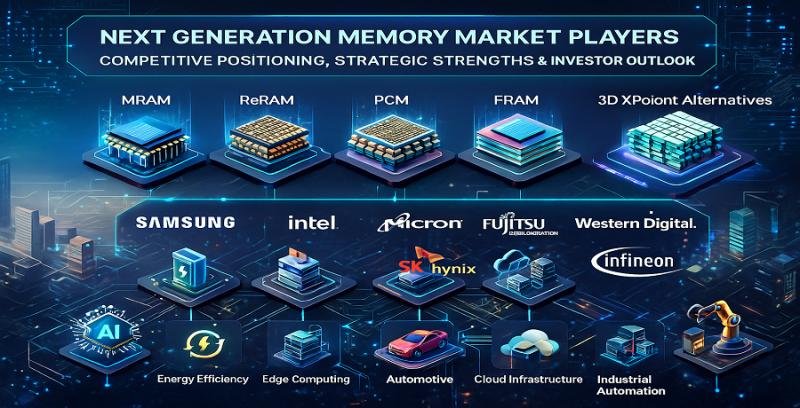
The next generation memory market is entering a pivotal stage as computing architectures evolve, energy-efficient data processing becomes critical, and AI-driven workloads push the boundaries of traditional storage systems. Emerging memory technologies-such as MRAM, ReRAM, PCM, FRAM, and 3D XPoint alternatives-are reshaping how devices store and access data. With rising adoption across consumer electronics, automotive electronics, cloud infrastructure, and industrial automation, next-generation memory is becoming an essential enabler of performance-oriented and ultra-low-power applications.
As companies accelerate digital transformation, edge computing, and AI-optimized hardware strategies, next-generation memory technologies are increasingly viewed as strategic assets. This article explores the major players shaping the landscape, their competitive positioning, and critical investment themes influencing the global market.
➤ Request Free Sample PDF Report @ https://www.researchnester.com/sample-request-3724
Top Companies & Their Strategies
1. Samsung Electronics – Samsung remains a dominant force in the next generation memory market, leveraging its strong semiconductor manufacturing ecosystem, extensive R&D investments, and high-volume production capabilities. The company focuses on MRAM, advanced NAND alternatives, and embedded memory solutions. Samsung’s strategy emphasizes power-efficient designs for AI, IoT, and mobile systems, supported by long-term partnerships with leading device OEMs.
2. Intel Corporation – Intel continues influencing the market through its innovations in persistent memory technologies and advancements in data-centric system architectures. Although its 3D XPoint collaboration evolved over time, Intel’s focus on high-performance memory modules and CPU-memory integration keeps it at the competitive forefront. Its reach across data centers, cloud service providers, and enterprise computing strengthens its strategic position.
3. Micron Technology – Micron focuses on high-value memory technologies including ReRAM and advanced low-latency architectures. The company emphasizes energy-efficient products suitable for industrial IoT, automotive ADAS, and edge computing environments. Micron’s strong fabrication capabilities and deep relationships with hyperscale and OEM customers reinforce its market resilience.
4. Fujitsu Semiconductor – Fujitsu plays a critical role in FRAM technology development, targeting low-power, high-reliability applications in smart meters, medical devices, and embedded electronics. Its advantage lies in specialized low-energy designs and its ability to offer differentiated memory solutions in regulated markets requiring long-term performance stability.
➤ Explore detailed profiles of top players and new entrants in this space – access your free sample report → https://www.researchnester.com/sample-request-3724
5. Western Digital (WD) – Western Digital combines storage expertise with next-generation non-volatile memory development aimed at enterprise and cloud applications. The company is advancing technologies compatible with high-throughput systems and AI workloads. Strategic collaborations with fabrication partners and system integrators help WD expand its footprint in emerging architectures.
6. SK Hynix – SK Hynix focuses on MRAM and advanced DRAM alternatives, supported by a strong presence in mobile and high-performance computing markets. Its cost-effective manufacturing processes and global supply chain efficiency enhance competitiveness. The company also invests heavily in process node reduction and low-power memory, aligning with growing demand for AI-enabled devices.
7. Everspin Technologies – Everspin is recognized as a dedicated leader in MRAM technology, specializing in discrete and embedded MRAM products. Its strength lies in niche industrial, aerospace, and enterprise storage applications where durability and endurance are critical. Everspin’s specialized product portfolio gives it an advantage in markets requiring robust data retention.
8. Infineon Technologies – Infineon is expanding in the next generation memory market through FRAM and automotive-grade non-volatile memory products. The company’s strategy focuses on safety-critical systems, electric vehicles, and smart manufacturing. Its ability to comply with global automotive standards and deliver high-reliability memory positions Infineon as a strong player in regulated sectors.
➤ View our Next Generation Memory Market Report Overview here: https://www.researchnester.com/reports/next-generation-memory-market/3724
SWOT Analysis
Strengths – Leading companies benefit from strong fabrication capabilities, robust IP portfolios, and extensive R&D investments. Their global supply chain relationships with OEMs and cloud providers provide stable long-term demand. Advanced materials engineering and integration capabilities give them a competitive edge in performance and energy efficiency. Many players maintain diversified memory portfolios that help mitigate technology-specific risks.
Weaknesses – Next-generation memory technologies often face high production costs and complex manufacturing requirements. Some companies struggle with scaling new materials and ensuring compatibility with legacy architectures. Limited commercialization of certain technologies-such as PCM and high-density MRAM-creates challenges in achieving mass adoption. Pricing pressures and capital-intensive fabrication processes also constrain smaller players.
Opportunities – Rising adoption of AI, edge computing, autonomous vehicles, and industrial IoT is creating significant opportunities for memory technologies offering low latency and high endurance. Increased demand for secure, energy-efficient, and durable memory in consumer electronics and automotive applications supports broader market penetration. Emerging economies offer openings for localization and supply chain expansion. Additionally, strategic partnerships between foundries and memory innovators are accelerating commercialization.
Threats – The market faces competition from advanced NAND, DRAM, and evolving system-on-chip architectures that integrate alternative memory blocks. Supply chain disruptions and geopolitical tensions can impact fabrication timelines and access to critical materials. Rapid technological shifts may shorten product lifecycles, requiring continuous reinvestment. Environmental and regulatory constraints surrounding semiconductor manufacturing also pose rising compliance challenges.
➤ Access a complete SWOT breakdown with company-specific scorecards: Claim your sample report → https://www.researchnester.com/sample-request-3724
Investment Opportunities & Trends
1. M&A Activity and Consolidation
The next generation memory market is experiencing increased consolidation as semiconductor giants acquire specialized memory startups to strengthen their intellectual property and accelerate time-to-market. Investors are showing heightened interest in MRAM, ReRAM, and FRAM developers offering differentiated performance advantages. Partnerships between chip manufacturers and cloud providers are expanding, enabling co-designed memory architectures optimized for AI and high-performance computing.
2. Technology Integration and Advanced Material Development
Significant investment is flowing into companies refining new materials, device structures, and 3D memory stacking techniques. Startups specializing in novel non-volatile memory-particularly spintronic and neuromorphic architectures-are attracting venture capital. Embedded memory integration within microcontrollers and AI accelerators is emerging as a key investment frontier. Foundry partnerships are enabling large-scale transitions from pilot lines to commercial production.
3. Regional Expansion and Policy Support
Countries in Asia-Pacific, Europe, and North America are prioritizing semiconductor self-reliance, creating incentives for next-generation memory manufacturing. Government-backed semiconductor policies are encouraging new fabs and R&D centers. Regions such as South Korea, Taiwan, Japan, and the U.S. are attracting the bulk of capital due to strong fabrication ecosystems. Automotive and industrial automation sectors in Europe also contribute to rising demand for reliable next-generation memory solutions.
Notable Developments in the Last 12 Months
• Samsung expanded MRAM integration across advanced process nodes for embedded solutions.
• Micron accelerated development of ReRAM-based low-power memory targeting industrial applications.
• Intel introduced new persistent memory enhancements aligned with AI-optimized data center architectures.
• Everspin launched updated MRAM product families for industrial and enterprise storage systems.
• SK Hynix announced new partnerships around AI-memory co-optimization at smaller process nodes.
• Infineon invested in expanding FRAM production capabilities for automotive-grade electronics.
• Western Digital strengthened collaborations aimed at advancing emerging non-volatile memory technologies.
➤Request Free Sample PDF Report @ https://www.researchnester.com/sample-request-3724
Related News –
https://www.linkedin.com/pulse/how-apis-powering-next-generation-digital-innovation-gefpf
https://www.linkedin.com/pulse/why-businesses-rapidly-adopting-5g-edge-cloud-network-jbcqf
Contact Data
AJ Daniel
Corporate Sales, USA
Research Nester
77 Water Street 8th Floor, New York, 10005
Email: info@researchnester.com
USA Phone: +1 646 586 9123
Europe Phone: +44 203 608 5919
About Research Nester
Research Nester is a one-stop service provider with a client base in more than 50 countries, leading in strategic market research and consulting with an unbiased and unparalleled approach towards helping global industrial players, conglomerates and executives for their future investment while avoiding forthcoming uncertainties. With an out-of-the-box mindset to produce statistical and analytical market research reports, we provide strategic consulting so that our clients can make wise business decisions with clarity while strategizing and planning for their forthcoming needs and succeed in achieving their future endeavors. We believe every business can expand to its new horizon, provided a right guidance at a right time is available through strategic minds.
This release was published on openPR.