Smart Card IC Market
Smart Card IC Market Size Outlook 2034
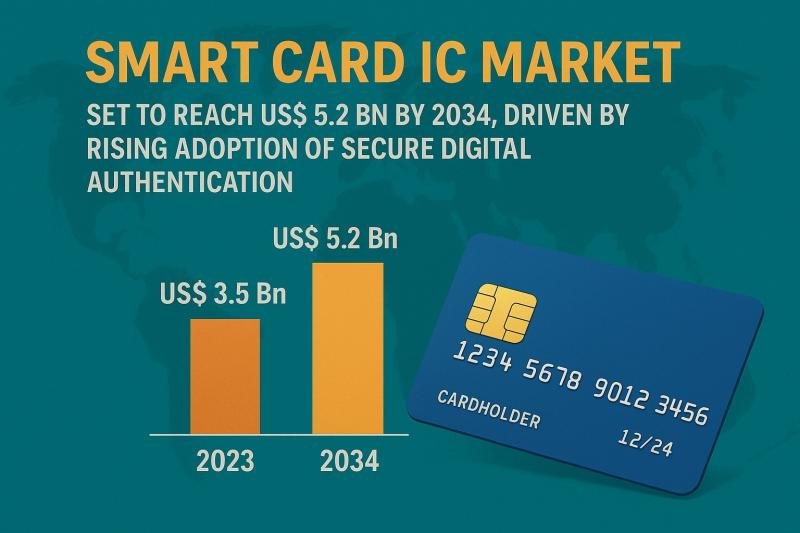
The global smart card integrated circuit (IC) market was valued at US$ 3.5 billion in 2023. With increasing adoption of digital transactions, expanding use of secure identification systems, and rising deployment of contactless payment technologies, the sector is forecast to grow at a CAGR of 3.7% from 2024 to 2034, reaching an estimated US$ 5.2 billion by 2034. Demand continues to accelerate across telecommunications, BFSI, government identity programs, transportation, and access-control applications.
👉 Get your sample market research report copy today@ https://www.transparencymarketresearch.com/sample/sample.php?flag=S&rep_id=86309
Market Overview
Smart card ICs serve as the foundation of modern secure digital ecosystems. These compact, high-security chips are embedded within smart cards used for financial transactions, identity verification, SIM cards, healthcare records, loyalty programs, and transportation systems. Enhanced security features-such as hardware encryption, biometrics compatibility, and tamper-resistant architecture-make smart card ICs a crucial component in global data protection infrastructures.
The growing push toward cashless economies, government initiatives for national ID digitization, and rapid growth in contactless payments have significantly boosted smart card IC adoption. With advancements in NFC technology, EMV standardization, and eSIM integration, manufacturers are focusing on delivering faster, more secure, and energy-efficient integrated circuits.
Increasing concerns regarding cybersecurity, coupled with expanding IoT ecosystems, continue to shape the direction of innovation in the smart card IC industry.
Key Market Growth Drivers
1. Expansion of Digital Payments
The global shift toward cashless transactions-supported by mobile wallets, contactless cards, and QR-based payments-continues to drive smart card IC demand. EMV chip adoption has become a global norm to improve payment security.
2. Government-led Identity Digitization Programs
Smart card ICs are integral to national identity solutions including e-passports, driver’s licenses, social security cards, and healthcare IDs. With countries adopting centralized biometric and digital ID systems, smart card IC demand is rising sharply.
3. Growth of Telecom Sector and SIM Card Demand
Despite the emergence of eSIM, traditional SIM cards continue to be used widely in developing regions. Increasing smartphone penetration indirectly supports smart card IC market expansion.
4. Rising Security Concerns
Data theft and cybercrime have increased the need for tamper-resistant, hardware-level security solutions. Smart card ICs provide multi-layered authentication and encryption, ensuring high data integrity.
5. Advancements in Contactless and NFC Technology
Contactless smart cards, enabled by NFC-integrated chips, are transforming sectors like transportation, retail, and corporate access control.
Analysis of Key Players – Key Player Strategies
Prominent companies in the market include
• Analog Devices, Inc.
• CEC Huada Electronic Design Co., Ltd.
• imatric LLC.
• Infineon Technologies AG
• Microchip Technology Inc.
• Nations Technologies Inc.
• NXP Semiconductors
• Semiconductor Components Industries, LLC
• SAMSUNG
• Shanghai Fudan Microelectronics Group Co., Ltd.
• Sony Corporation
• STMicroelectronics
• Texas Incorporated
• TOSHIBA CORPORATION
• Watchdata Group
Their growth strategies revolve around:
1. Continuous Innovation in Security Architecture
Players are embedding advanced cryptographic engines, secure processors, and biometric pairing features to enhance card security.
2. Focus on Low-power, High-performance ICs
Manufacturers are designing chips optimized for long lifecycle, reduced energy consumption, and high-speed processing.
3. Strategic Partnerships with Card Manufacturers
Collaborations with fintech companies, telecom operators, and government agencies help increase product reach.
4. Portfolio Diversification
Companies are launching hybrid ICs suitable for multi-application cards used for payments, identity, transportation, and access control.
5. Expansion in Emerging Markets
Asia Pacific, Africa, and the Middle East are attractive markets due to national ID deployment, rising mobile connectivity, and expanding banking access.
👉 Discuss Implications for Your Industry Request Sample Research Report PDF@ https://www.transparencymarketresearch.com/sample/sample.php?flag=S&rep_id=86309
Key Developments in Smart Card IC Market
• In May 2024, Samsung was granted a patent for an IC for fingerprint reading, storage, and processing, and biometric cards from the U.S. Patent and Trademark Organization. The IC incorporates the fingerprint sensor, the secure element where the biometric template is stored, and the secure processor where the match is carried out.
• In June 2022, STMicroelectronics launched ST4SIM-201 embedded SIM (eSIM) for machine-to-machine (M2M) communication, which meets the latest standards for 5G network access, M2M security, and flexible remote provisioning and management
Market Challenges & Opportunities
Challenges
• Rise of eSIM Technology: The shift toward embedded SIMs may reduce traditional SIM-based chip demand in the long term.
• High Competition and Price Pressure: Numerous players contribute to competitive pricing, impacting profit margins.
• Security Vulnerabilities: Sophisticated cyberattacks require constant updates in chip security architecture.
• Complex Certification Requirements: Compliance with EMV, ISO/IEC, and national security standards adds cost and complexity.
Opportunities
• Growing Biometric Smart Cards: Incorporation of fingerprint sensors in payment and ID cards creates new revenue opportunities.
• AI-driven Card ICs: Smart ICs with machine-learning capabilities for enhanced fraud detection can transform market offerings.
• Expansion of Transit Ticketing Solutions: Smart cards for metro, bus, and rail systems are gaining global acceptance.
• Digital Government Transformation: National digital identity programs across emerging economies will generate significant IC demand.
• Hybrid Cloud-connected Smart Cards: Next-generation cards integrated with secure cloud authentication offer strong potential.
Investment Landscape and ROI Outlook
The investment environment for smart card ICs remains stable and promising, driven by global digitization efforts and cybersecurity priorities.
Key Investment Highlights
• Steady Demand across BFSI and Telecom: These sectors provide consistent, long-term revenue streams for IC manufacturers.
• Government Projects Offer High ROI: National ID, healthcare ID, and public transit card programs create large-scale opportunities.
• Emergence of Next-gen Smart Cards: Biometric and cloud-enabled cards promise higher margins and product differentiation.
• Growing Financial Inclusion Initiatives: Developing economies continue to adopt digital banking and payment cards.
By 2034, ROI is expected to remain strong due to sustained demand from both public and private sectors, even as the market shifts toward advanced and multifunctional IC solutions.
Market Segmentation
By Type
• Microcontroller-based Smart Card ICs
• Memory-based Smart Card ICs
• NFC-enabled ICs
• Security ICs
• Biometric Smart Card ICs
By Interface
• Contact
• Contactless
• Dual Interface
• Hybrid
By Application
• Payment & Banking
• Government ID & E-passports
• Telecom (SIM/eSIM)
• Transportation & Ticketing
• Healthcare
• Access Control
• Retail & Loyalty Programs
By End-user
• Government Agencies
• Banks & Financial Institutions
• Telecom Operators
• Enterprises
• Healthcare Providers
By Region
• North America
• Europe
• Asia Pacific
• Latin America
• Middle East & Africa
Why Buy This Report?
• Provides accurate market sizing and forecasts through 2034
• Offers deep insights into technological trends and innovations
• Includes detailed competitive landscape and strategic analysis
• Highlights opportunities in biometric cards, NFC solutions, and government ID programs
• Helps investors, manufacturers, and policymakers make informed decisions
• Covers regional trends and growth potential across emerging markets
👉 To buy this comprehensive market research report, click here to inquire@ https://www.transparencymarketresearch.com/checkout.php?rep_id=86309<ype=S
FAQs
1. What is the projected market size for 2034?
The smart card IC market is expected to reach US$ 5.2 billion by 2034.
2. What is driving the growth of the smart card IC market?
Increasing digital payments, identity digitization, and advanced security requirements are major contributors.
3. Which region dominates the market?
Asia Pacific leads, driven by telecom growth, digital banking adoption, and national ID programs.
4. What is the biggest challenge for manufacturers?
Price pressure and rapid technology evolution, especially eSIM adoption, are major challenges.
5. Who are the key players?
Analog Devices, Inc., CEC Huada Electronic Design Co., Ltd., imatric LLC., Infineon Technologies AG, Microchip Technology Inc., Nations Technologies Inc., NXP Semiconductors, Semiconductor Components Industries, LLC, SAMSUNG, Shanghai Fudan Microelectronics Group Co., Ltd., Sony Corporation, STMicroelectronics, Texas Incorporated, TOSHIBA CORPORATION, and Watchdata Group.
More Trending Research Reports-
• Palm Vein Biometrics Market – https://www.transparencymarketresearch.com/palm-vein-biometrics-market.html
• Battery TIC Market – https://www.transparencymarketresearch.com/battery-tic-market.html
About Us Transparency Market Research
Transparency Market Research, a global market research company registered at Wilmington, Delaware, United States, provides custom research and consulting services. The firm scrutinizes factors shaping the dynamics of demand in various markets. The insights and perspectives on the markets evaluate opportunities in various segments. The opportunities in the segments based on source, application, demographics, sales channel, and end-use are analysed, which will determine growth in the markets over the next decade.
Our exclusive blend of quantitative forecasting and trends analysis provides forward-looking insights for thousands of decision-makers, made possible by experienced teams of Analysts, Researchers, and Consultants. The proprietary data sources and various tools & techniques we use always reflect the latest trends and information. With a broad research and analysis capability, Transparency Market Research employs rigorous primary and secondary research techniques in all of its business reports.
Contact Us
Transparency Market Research Inc.
CORPORATE HEADQUARTER DOWNTOWN,
1000 N. West Street,
Suite 1200, Wilmington, Delaware 19801 USA
Tel: +1-518-618-1030
USA – Canada Toll Free: 866-552-3453
Website: https://www.transparencymarketresearch.com
Blog: https://tmrblog.com
Email: sales@transparencymarketresearch.com
This release was published on openPR.