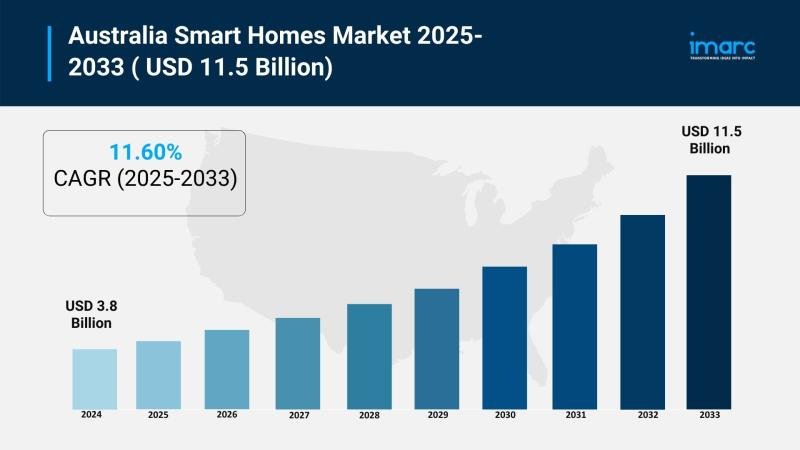
The latest report by IMARC Group, titled “Australia Smart Homes Market Report by Component (Hardware (Security, Home Automation, Home Entertainment, Home Healthcare), Smart Appliances, AI Speaker, Services (Energy Consumption and Management Services, Security Services, Healthcare Services, Entertainment Services)), Application (Security and Surveillance, Lighting, Entertainment, Energy Management, HVAC, Smart Kitchen, Home Fitness and Wellness), and Region 2025-2033,” offers comprehensive analysis of the Australia smart homes market growth. The report includes competitor and regional analysis, along with detailed breakdown of the market segmentation. The Australia smart homes market size reached USD 3.8 Billion in 2024. Looking forward, IMARC Group expects the market to reach USD 11.5 Billion by 2033, exhibiting a CAGR of 11.60% during 2025-2033.
Base Year: 2024
Forecast Years: 2025-2033
Historical Years: 2019-2024
Market Size in 2024: USD 3.8 Billion
Market Forecast in 2033: USD 11.5 Billion
Market Growth Rate (2025-2033): 11.60%
Australia Smart Homes Market Overview
The Australia smart homes market is driven by increasing adoption of AI in homes for temperature control, security systems, and energy management, the trend of smart living by residents, increased adoption of voice-enabled devices, including smart speakers and smart displays that allow hands-free operation of lamps, lighting, thermostats, music, videos, and home entertainment systems. Other factors include the rising adoption of smart security systems with facial recognition, remote access, and real-time alerts, and increasing demand for smart thermostats, smart lighting, and smart energy monitoring systems for real-time power usage optimization. The market is also helped by Hisense Australiawide’s gradual rollout of ConnectLife-enabled appliances in January 2024, with televisions now also integrated into their energy savings ecosystem and smart home management. In July 2024, LG Electronics acquired a controlling 80% stake in Athom smart home operating system, which provides connectivity to LG’s ThinQ ecosystem. The abundance of Internet of Things (IoT) devices has changed regular homes into smart homes through smooth automation. Cities urbanize, especially in Sydney and Melbourne, and people readily access the internet for driving technological lifestyles. Real estate developers who are smart incorporate smart lighting, smart thermostats, and smart security systems into new housing developments.
Australia’s smart home market is strongest in security and surveillance systems (networked cameras, smart locks, and motion sensors), energy management systems (solar and batteries with smart meters), entertainment/IoT (voice assistants and connected screens), HVAC control, and lighting control systems. Growth areas are expected to be in AI-driven predictive maintenance and voice assistants that learn user behavior, easy to buy and use IoT devices, retrofitting with smart plugs and devices to create DIY systems to avoid heavy installation costs, expanding voice and gesture controls to enable automation in the homes of the elderly and disabled, and government interest in smart and sustainable cities. General purpose smart home platforms, smart speakers, connected air conditioners, smart light switches and lamps, and internet-connected HVAC and AC systems have become increasingly popular. Cities in the Australian Capital Territory, New South Wales, Victoria and Queensland have become most popular with smart home devices, due to higher urban population density and access to digital infrastructure. However, Australia’s tech-savvy population, remote working culture, as well as increasing demand for connected living environments and micro-living with integrated smart technology systems, is also seen as an increasingly attractive area for home automation innovation, despite hurdles including high up front costs, data privacy and -security concerns and compatibility issues between multiple platforms.
Request For Sample Report:
https://www.imarcgroup.com/australia-smart-homes-market/requestsample
Australia Smart Homes Market Trends
• AI adoption acceleration: Artificial intelligence revolutionizing smart homes through temperature control, security management, and energy optimization, with systems interpreting user habits and adjusting to individual preferences, providing preventive maintenance and advanced voice-controlled assistants enhancing functionality and environmental friendliness.
• Voice-controlled device growth: Smart speakers and displays with advanced voice assistants enabling hands-free management of diverse home tasks from lighting and thermostats to entertainment systems, with improving accuracy and reliability making Australians more accustomed to streamlined daily activities.
• Smart security expansion: Facial recognition, remote monitoring, and real-time notification systems transforming home security with network-enabled cameras, intelligent locks, and movement sensors providing greater control and access through smartphone remote operation offering homeowners enhanced peace of mind.
• Energy efficiency prioritization: Homeowners increasingly adopting automated thermostats, intelligent lighting, and energy monitoring systems to lower utility expenses and reduce ecological impact, with solar energy integration and smart meters boosting household efficiency reflecting climate awareness and cost savings.
• IoT device proliferation: Internet of Things transforming conventional living spaces into interconnected environments with smart refrigerators, voice-activated assistants, remotely controlled cameras facilitating seamless automation, centralized management, real-time observation, and data-driven choices enhancing convenience and safety.
• Integrated ecosystem development: Shift toward fully integrated solutions combining energy management, entertainment, and security with AI-driven personalized adaptive automation, sustainable smart solar integration, and interoperable platforms creating comprehensive connected living experiences.
Market Drivers
• Urbanization and digital readiness: Rising urban population in Sydney and Melbourne with tech-savvy demographics having better access to modern infrastructure, high-speed internet, and technology-driven lifestyles, with compact urban residence designs lending to integrated smart systems maximizing space and utility.
• Energy cost reduction demand: Growing consumer awareness of climate issues and utility expense savings driving adoption of energy-efficient smart home options including automated thermostats, intelligent lighting, solar energy solutions, and home energy management systems enabling real-time power consumption control.
• Security and safety concerns: Increasing homeowner prioritization of enhanced protection with smart security systems offering facial recognition, remote monitoring, real-time notifications, intelligent locks, and movement sensors providing greater control and peace of mind through smartphone remote access.
• Remote work culture impact: Post-pandemic lifestyle changes with remote working becoming permanent reinforcing need for connected living environments, home office automation, climate control optimization, and comprehensive smart systems supporting productivity and comfort in residential spaces.
• IoT affordability and accessibility: IoT-enabled products becoming more affordable and user-friendly encouraging consumers to create comprehensive smart home systems, with straightforward device integration, centralized management platforms, and wireless solutions lowering adoption barriers.
• Developer integration initiatives: Real estate developers increasingly incorporating smart features including automated lighting, smart thermostats, and integrated security systems directly into new construction enabling smoother connectivity, enhanced energy efficiency, and heightened property value appealing to tech-conscious buyers.
Challenges and Opportunities
Challenges:
• High initial investment costs with smart security systems, intelligent lighting, automated climate control, and home assistants requiring significant financial commitment particularly for middle- to lower-income households, with professional installation and technical support further raising expenses restricting broader penetration
• Data privacy and security concerns with increasingly interconnected data-driven systems raising cybersecurity anxieties as homeowners become cautious about personal data collection, storage, and sharing, with unauthorized access and hacking risks creating distrust requiring transparent policies and robust encryption
• Device compatibility issues with lack of interoperability across manufacturers, incompatible software platforms, assorted communication protocols (Zigbee, Z-Wave, Wi-Fi), and proprietary ecosystems complicating integration creating frustrating user experiences and increasing setup costs and maintenance complexity
• Digital literacy gaps particularly among elderly populations and non-tech-savvy demographics struggling with smart home setup, operation, and troubleshooting requiring intuitive interfaces, comprehensive support systems, and educational initiatives to maximize adoption across age groups
Opportunities:
• Smart real estate integration incorporating automated lighting, thermostats, and security systems directly into new housing construction phase enabling smoother connectivity, enhanced efficiency, heightened property value, with government support for sustainable urban development promoting smarter community infrastructure.
• Retrofitting solutions expansion providing affordable non-invasive methods to upgrade existing homes through smart plugs, wireless security systems, app-controlled lighting meeting demand without extensive renovations, with user-friendly wireless automation tools accessible to wider audiences including renters.
• Voice and gesture control advancement transforming engagement with intuitive interfaces minimizing screen reliance, simplifying activities for elderly individuals and those with disabilities through Alexa integration and gesture-responsive sensors, with natural language processing and motion detection improvements.
• Energy management innovation developing comprehensive solutions combining solar integration, smart meters, automated thermostats, and real-time monitoring systems enabling significant utility cost reductions, carbon footprint minimization, and sustainable living aligned with climate awareness priorities.
• AI and predictive analytics enhancement implementing machine learning for personalized automation, preventive maintenance alerts, energy optimization algorithms, security threat detection, and adaptive climate control creating intelligent responsive environments anticipating user needs and preferences.
Australia Smart Homes Market Segmentation
By Component:
Hardware:
• Security
• Home Automation
• Home Entertainment
• Home Healthcare
Smart Appliances
AI Speaker
Services:
• Energy Consumption and Management Services
• Security Services
• Healthcare Services
• Entertainment Services
By Application:
• Security and Surveillance
• Lighting
• Entertainment
• Energy Management
• HVAC
• Smart Kitchen
• Home Fitness and Wellness
By Region:
• Australia Capital Territory & New South Wales
• Victoria & Tasmania
• Queensland
• Northern Territory & Southern Australia
• Western Australia
Browse Full Report:
https://www.imarcgroup.com/australia-smart-homes-market
Australia Smart Homes Market News (2024-2025)
• January 2024: Hisense Australia widened ConnectLife-enabled smart home appliance range adding integration with latest TV lineup providing improved energy efficiency, remote control, and smart home control through specific mobile app demonstrating convergence of entertainment and automation.
• July 2024: LG Electronics acquired 80% stake in Athom smart home platform adding connectivity to LG ThinQ ecosystem driving AI home innovation forward and growing open smart home platform capabilities supporting interoperability and comprehensive automation.
• 2024: Real estate developers accelerated smart feature integration in new housing projects incorporating automated lighting, smart thermostats, and integrated security systems directly into construction phase responding to buyer preferences for tech-enhanced homes with convenience and sustainability.
• 2024: AI-powered smart home systems expanded functionality with temperature control automation, security management enhancement, energy optimization algorithms, and voice-controlled assistants interpreting user habits and adjusting to individual preferences improving efficiency and personalization.
• 2024: Voice-controlled smart device adoption surged with smart speakers and displays featuring advanced voice assistants enabling hands-free management of lighting, thermostats, entertainment systems, and appliances reflecting consumer preference for intuitive interfaces.
• 2024: Smart security system deployment accelerated with facial recognition technology, remote monitoring capabilities, real-time notification features, network-enabled cameras, intelligent locks, and movement sensors providing enhanced protection and smartphone-based remote access control.
• 2024: Energy-efficient smart home solutions gained prominence with automated thermostats, intelligent lighting, energy monitoring systems, solar integration, and smart meters enabling real-time power consumption management reducing utility costs and ecological impact.
• 2024: Retrofitting solutions expanded availability with affordable smart plugs, wireless security systems, app-controlled lighting enabling existing home upgrades without extensive renovations, making smart technology accessible to wider audiences including renters and budget-conscious consumers.
Key Highlights of the Report
• Market Performance (2019-2024)
• Market Outlook (2025-2033)
• Industry Catalysts and Challenges
• Segment-wise historical and future forecasts
• Competitive Landscape and Key Player Analysis
• Component, Application, and Regional Analysis
Ask analyst for your customized sample:
https://www.imarcgroup.com/request?type=report&id=33105&flag=F
Q&A Section
Q1: What drives growth in the Australia smart homes market?
A1: Market growth is driven by urbanization and digital readiness in Sydney and Melbourne with tech-savvy demographics, energy cost reduction demand with climate awareness driving efficiency adoption, security and safety concerns prioritizing enhanced protection systems, remote work culture reinforcing connected living environment needs, IoT affordability making products accessible, and developer integration initiatives incorporating smart features into new construction.
Q2: What are the latest trends in this market?
A2: Key trends include AI adoption acceleration with temperature control and energy optimization, voice-controlled device growth enabling hands-free management, smart security expansion with facial recognition and remote monitoring, energy efficiency prioritization reducing utility expenses, IoT device proliferation creating interconnected environments, and integrated ecosystem development combining energy management, entertainment, and security.
Q3: What challenges do companies face?
A3: Major challenges include high initial investment costs with significant financial commitment requirements restricting middle-income household adoption, data privacy and security concerns with cybersecurity anxieties about personal data collection and hacking risks, device compatibility issues across manufacturers with incompatible protocols complicating integration, and digital literacy gaps among elderly populations struggling with setup and operation.
Q4: What opportunities are emerging?
A4: Emerging opportunities include smart real estate integration incorporating automation into new construction with government support, retrofitting solutions providing affordable non-invasive upgrade methods for existing homes, voice and gesture control advancement creating intuitive interfaces for accessibility, energy management innovation with comprehensive solar integration and monitoring systems, and AI predictive analytics enhancement for personalized automation and preventive maintenance.
Q5: What is the market forecast for Australia smart homes?
A5: The Australia smart homes market was valued at USD 3.8 Billion in 2024 and is projected to reach USD 11.5 Billion by 2033, exhibiting a CAGR of 11.60% during 2025-2033, driven by AI adoption, IoT proliferation, energy efficiency demand, urbanization, and integrated ecosystem development.
Q6: Which components dominate the market?
A6: Hardware components including security systems, home automation devices, home entertainment platforms, and home healthcare solutions dominate the market. Security and surveillance applications lead with network-enabled cameras and intelligent locks. AI speakers and voice-controlled devices are rapidly growing segments enabling hands-free home management.
Q7: What recent product launches occurred?
A7: Major launches include Hisense Australia widening ConnectLife-enabled appliance range with TV integration in January 2024 providing improved energy efficiency and centralized smart home control, and LG Electronics acquiring 80% stake in Athom platform in July 2024 adding connectivity to LG ThinQ ecosystem driving AI innovation and open smart home platform growth supporting comprehensive automation capabilities.
Contact Us
IMARC Group
134 N 4th St. Brooklyn, NY 11249, USA
Email: sales@imarcgroup.com
Tel No: (D) +91-120-433-0800
United States: +1-201-971-6302
About Us
IMARC Group is a leading market research company that offers management strategy and market research worldwide. We partner with clients in all sectors and regions to identify their highest-value opportunities, address their most critical challenges, and transform their businesses. IMARC’s information products include major market, scientific, economic and technological developments for business leaders in pharmaceutical, industrial, and high technology organizations. Market forecasts and industry analysis for biotechnology, advanced materials, pharmaceuticals, food and beverage, travel and tourism, nanotechnology and novel processing methods are at the top of the company’s expertise.
This release was published on openPR.