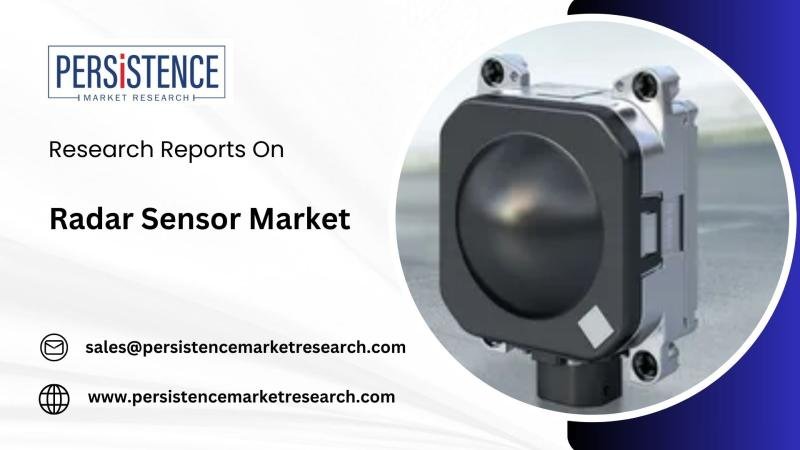
Radar Sensor Market
Overview of the Radar Sensor Market
The global radar sensor market is on a robust growth trajectory, projected to reach US$ 12.8 billion by 2025 and further expanding to US$ 37.9 billion by 2032, registering an impressive CAGR of 16.8%. Radar sensors, which utilize radio waves to detect distance, velocity, and angle of objects, have become essential across diverse industries such as automotive, industrial automation, aerospace, defense, and security. Their ability to perform in challenging environmental conditions and provide accurate real-time data has made them indispensable for next-generation technologies.
The automotive sector dominates the market, primarily due to the surge in demand for advanced driver-assistance systems (ADAS) and autonomous driving technologies. Meanwhile, North America leads globally, driven by high adoption of smart mobility, defense modernization, and significant investments in radar-based sensing technologies. The region’s leadership is also supported by strong semiconductor innovation and government funding for safety and surveillance infrastructure.
Elevate your business strategy with comprehensive market data. Request a sample report now: https://www.persistencemarketresearch.com/samples/33474
Key Highlights from the Report
The global radar sensor market is forecasted to reach US$ 37.9 billion by 2032, growing at a CAGR of 16.8%.
Automotive radar sensors hold the largest market share due to increasing deployment in ADAS systems.
North America dominates the market, while Asia-Pacific is emerging as the fastest-growing region.
Advancements in millimeter-wave and ultra-wideband radar technologies are fueling innovation.
Growing demand for industrial automation and safety systems is driving market expansion.
Key players are focusing on miniaturization, low power consumption, and integration with IoT solutions.
Market Segmentation
The radar sensor market is segmented based on product type, technology, and end-user industries. Product-wise, the market includes imaging radar sensors and non-imaging radar sensors. Imaging radar sensors are gaining traction in automotive and defense applications due to their ability to generate detailed environmental images, while non-imaging sensors are widely used for speed and distance measurement in industrial and aerospace systems. The trend toward higher frequency and precision sensing is driving demand for 77 GHz and 79 GHz radar modules in compact, energy-efficient designs.
By end-user, the market is categorized into automotive, aerospace & defense, industrial, healthcare, and security & surveillance. The automotive segment remains dominant, driven by radar-based ADAS solutions such as blind-spot detection, adaptive cruise control, and collision avoidance systems. The industrial segment is expected to grow substantially due to increasing use of radar sensors in robotics, process monitoring, and factory automation, where safety and precision are paramount.
Regional Insights
North America holds the lion’s share of the radar sensor market, attributed to its strong defense infrastructure, early adoption of radar-enabled vehicles, and growing investments in autonomous technology. The region’s major players like Texas Instruments and NXP Semiconductors continue to innovate high-performance radar sensors for safety-critical applications.
Asia-Pacific, on the other hand, is projected to record the fastest growth during the forecast period. Countries like China, Japan, and South Korea are aggressively investing in automotive radar systems and industrial automation. The rapid expansion of the semiconductor industry and government initiatives supporting road safety and smart manufacturing further fuel regional market growth.
Market Drivers
One of the key drivers of the radar sensor market is the increasing integration of radar technology in automotive systems. The rising global emphasis on road safety and the evolution of autonomous vehicles have made radar sensors a critical component of ADAS solutions. In addition, radar sensors are being increasingly adopted in industrial automation, robotics, and defense surveillance due to their reliability in harsh environments and capability to detect objects through obstacles like fog, dust, or smoke.
Technological innovations, including millimeter-wave radar, digital beamforming, and signal processing advancements, are enabling radar sensors to deliver enhanced accuracy and range. The growing trend toward miniaturized and low-power radar modules further expands their application scope in consumer electronics and drones, creating new growth avenues for manufacturers.
Read More: https://www.persistencemarketresearch.com/market-research/radar-sensor-market.asp
Market Restraints
Despite robust growth, the market faces several restraints, including high costs associated with radar sensor development and integration. The complexity of radar systems-especially in multi-channel and high-frequency applications-adds to the overall production cost, limiting their adoption in cost-sensitive industries.
Additionally, interference and signal distortion issues in densely populated radar environments can affect accuracy, necessitating advanced algorithms and design sophistication. Moreover, competition from other sensing technologies such as LiDAR and ultrasonic sensors poses challenges to radar adoption in certain automotive and industrial use cases.
Market Opportunities
The future holds immense opportunities for radar sensor manufacturers as emerging technologies converge. The proliferation of Internet of Things (IoT) and smart infrastructure projects worldwide is expanding the use of radar sensors for motion detection, smart home automation, and environmental monitoring.
Furthermore, the growth of autonomous drones and robotic systems presents new opportunities for radar integration to enhance situational awareness and navigation in complex terrains. Investments in next-generation semiconductor materials and the shift toward solid-state radar designs will further reduce production costs, enabling mass adoption across various industries.
Do You Have Any Query Or Specific Requirement? Request Customization of Report: https://www.persistencemarketresearch.com/request-customization/33474
Reasons to Buy the Report
✔ Gain detailed insights into the radar sensor market’s size, growth rate, and forecast to 2032.
✔ Understand the competitive landscape, including key players and recent technological advancements.
✔ Identify emerging applications of radar sensors across automotive, defense, and industrial sectors.
✔ Evaluate regional growth trends and investment opportunities in high-potential markets.
✔ Access reliable, data-backed analysis to support strategic business decisions.
Frequently Asked Questions (FAQs)
How Big is the Radar Sensor Market?
Who are the Key Players in the Global Radar Sensor Market?
What is the Projected Growth Rate of the Radar Sensor Market?
What is the Market Forecast for Radar Sensors for 2032?
Which Region is Estimated to Dominate the Industry through the Forecast Period?
Company Insights
Prominent players in the global radar sensor market are actively developing advanced solutions to strengthen their market presence. Key players include:
Texas Instruments Incorporated
NXP Semiconductors N.V.
Infineon Technologies AG
Robert Bosch GmbH
Continental AG
DENSO Corporation
HELLA GmbH & Co. KGaA
Lockheed Martin Corporation
Smartmicro GmbH
ZF Friedrichshafen AG
Recent Developments:
Infineon Technologies AG introduced its new 60GHz radar sensor platform designed for smart home and industrial automation applications, offering high precision and energy efficiency.
Continental AG launched an advanced short-range radar (SRR) sensor tailored for ADAS systems, improving detection accuracy in congested urban environments.
Conclusion
The radar sensor market is entering an era of rapid expansion, propelled by accelerating demand across automotive, industrial, and defense sectors. With revenues projected to surpass US$ 37.9 billion by 2032, radar technology continues to evolve through innovations in semiconductor design, millimeter-wave frequencies, and artificial intelligence-based signal processing.
As industries increasingly prioritize automation, safety, and connectivity, radar sensors will remain at the forefront of innovation-enabling smarter vehicles, safer work environments, and more efficient security systems. The market’s future will be shaped by continued technological evolution, regional investments, and strategic collaborations that drive radar capabilities to new heights.
Related Reports:
High Side Switches Market https://www.persistencemarketresearch.com/market-research/high-side-switches-market.asp
Identity and Access Management Market https://www.persistencemarketresearch.com/market-research/identity-access-management-market.asp
Industrial Transceivers Market https://www.persistencemarketresearch.com/market-research/industrial-transceivers-market.asp
Contact Us:
Persistence Market Research
Second Floor, 150 Fleet Street,
London, EC4A 2DQ, United Kingdom
USA Phone: +1 646-878-6329
UK Phone: +44 203-837-5656
Email: sales@persistencemarketresearch.com
Web: https://www.persistencemarketresearch.com
About Persistence Market Research:
At Persistence Market Research, we specialize in creating research studies that serve as strategic tools for driving business growth. Established as a proprietary firm in 2012, we have evolved into a registered company in England and Wales in 2023 under the name Persistence Research & Consultancy Services Ltd. With a solid foundation, we have completed over 3600 custom and syndicate market research projects, and delivered more than 2700 projects for other leading market research companies’ clients.
Our approach combines traditional market research methods with modern tools to offer comprehensive research solutions. With a decade of experience, we pride ourselves on deriving actionable insights from data to help businesses stay ahead of the competition. Our client base spans multinational corporations, leading consulting firms, investment funds, and government departments. A significant portion of our sales comes from repeat clients, a testament to the value and trust we’ve built over the years.
This release was published on openPR.