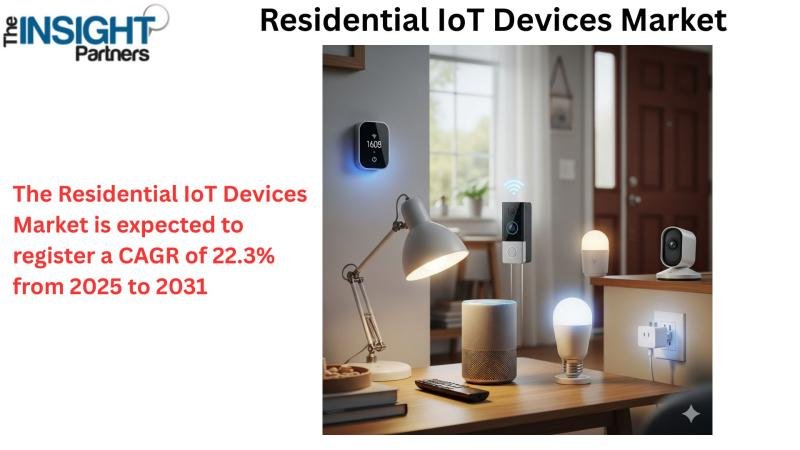
Residential IoT Device Market
New York, US – September 19, 2025- The global market for residential Internet of Things (IoT) devices is poised for significant growth through 2031, driven by a convergence of factors that are making smart home technology more accessible and desirable for consumers. A new report by The Insight Partners highlights the current state of the market, the key drivers behind its expansion, and the major companies leading the charge in innovation. The analysis reveals a sector experiencing steady growth in market size, share, and technological development.
Request Sample Pages of this Research Study at – https://www.theinsightpartners.com/sample/TIPRE00009570?utm_source=OpenPR&utm_medium=10812
Key Drivers of Market Growth
Several factors are fueling the rapid adoption of residential IoT devices, transforming homes into smarter, more convenient, and more efficient living spaces:
• Growing demand for smart home solutions: As people increasingly value convenience, energy efficiency, and the ability to remotely manage their homes, the demand for smart home technologies is soaring. Devices like smart thermostats, automated lighting, and advanced security systems are at the forefront of this trend, offering seamless control and integrated solutions.
• Technological advancements in connectivity: Improvements in wireless standards like Wi-Fi 6, Zigbee, and Z-Wave are enhancing device interoperability and reliability. These advancements enable a more seamless connection between various smart devices, which is crucial for a fully automated and integrated home environment.
• Declining cost of hardware and sensors: Advances in manufacturing and increased production scale are driving down the cost of essential components like sensors and microcontrollers. This makes smart home devices more affordable for a broader consumer base, including middle-income households, and encourages the development of new and innovative applications.
• Support from government policies: Governments are actively promoting residential IoT adoption through policies, grants, tax rebates, and programs focused on energy efficiency and sustainability. These initiatives accelerate the demand for smart meters, connected HVAC systems, and other energy-saving technologies.
• Widespread internet and smartphone access: The ubiquitous nature of reliable internet and smartphones is a foundational driver. As more households are connected, consumers have the ability to effortlessly control their IoT devices through apps, monitor their homes remotely, and leverage voice assistants, all of which are critical to the smart home experience.
Recent Innovations and Market Leaders
Leading companies are actively shaping the future of the residential IoT market with a constant stream of new products and strategic developments. For example, on August 26, 2025, Samsung Electronics announced that its AI-powered vacuum cleaners and refrigerators received IoT security certification from a global organization, highlighting the growing importance of device security. The company also expanded its proprietary One UI platform to its home appliances, providing a unified software experience across its product ecosystem.
Other major developments include Honeywell’s launch of a new AI-powered platform, Honeywell Connected Solutions, which integrates various building technologies into a single interface for more efficient operation. Additionally, Honeywell introduced a new smart residential gas meter designed for automation and remote operability, focusing on enhanced safety for utilities and consumers.
LG Electronics is also heavily invested in the space, showcasing its “Affectionate Intelligence” at CES® 2025. The company’s innovations focus on seamlessly integrating AI into daily life to provide enhanced convenience and a more personalized customer experience. LG also unveiled the LG ThinQ ON AI home hub, an innovative centerpiece for a smart home ecosystem where devices and empathetic AI work together to deliver customized comfort.
Industry Collaboration and Key Players
The residential IoT market is a collaborative ecosystem, with partnerships driving innovation. An example is the collaboration between Kontron, a leading IoT technology supplier, and Qualcomm Technologies, Inc. This partnership is now in the development phase, with Kontron integrating Qualcomm’s 5G, AI, and edge computing technologies into new embedded solutions, which will likely find applications in residential products.
The market is home to several major players, including:
• Amazon.com, Inc.
• Bosch.IO GmbH (Robert Bosch GmbH)
• ecobee
• Google, LLC
• Honeywell International Inc.
• LG Electronics
• Qualcomm Technologies, Inc.
• Radio Thermostat Company of America
• Samsung
Future Outlook
The outlook for the residential IoT market is one of rapid and sustained growth. As energy efficiency becomes a priority for consumers, and as AI integration and connectivity continue to improve, smart home automation will become even more common. The ongoing decline in device costs and increased interoperability will drive widespread adoption, ultimately transforming homes into intelligent, self-regulating living spaces. The market is propelled by a combination of evolving consumer preferences, technological breakthroughs, and greater awareness of the benefits of a connected home. As demand continues to rise, businesses will continue to innovate and expand their offerings, capitalizing on these emerging trends to further fuel market expansion.
Interested in Purchasing this Report? Click here – https://www.theinsightpartners.com/buy/TIPRE00009570?utm_source=OpenPR&utm_medium=10812
If you have any queries about this report or if you would like further information, please contact us:
Contact Person: Ankit Mathur
E-mail: sales@theinsightpartners.com
Phone: +1-646-491-9876
The Insight Partners is a one stop industry research provider of actionable intelligence. We help our clients in getting solutions to their research requirements through our syndicated and consulting research services. We specialize in industries such as Semiconductor and Electronics, Aerospace and Defense, Automotive and Transportation, Biotechnology, Healthcare IT, Manufacturing and Construction, Medical Device, Technology, Media and Telecommunications, Chemicals and Materials.
This release was published on openPR.